You finish a memorable book, open a blank page, and write: “It was good.” Then: “I liked the characters.” You know what you felt, but the reasons are harder to explain. Without those reasons, another reader learns little about whether the book might suit them.
Learning how to write a book review means turning impressions into useful observations. This guide offers seven steps, an adaptable template, fictional examples, and a final checklist. You do not need advanced literary vocabulary, a star rating, or a long essay.
What Is a Book Review?
A book review introduces a book, evaluates selected aspects of its content and writing, and explains who may enjoy it. A summary says what the book contains; a review also considers how effectively it works.
| Type | Main purpose | Typical content |
|---|---|---|
| Book review | Evaluate and guide readers | Brief description, supported opinions, recommendation |
| Book summary | Explain the content | Main events or ideas without extended evaluation |
| Book report | Demonstrate understanding | Plot, characters, or arguments, as the assignment requires |
| Reading journal entry | Record a personal response | Reactions, questions, quotations, and connections |
School requirements vary, and these forms can overlap. Concordia University Library’s guidance distinguishes description from evaluation. For everyday reviews, adapt that distinction to your audience rather than following an academic format automatically.
What Should a Good Book Review Include?
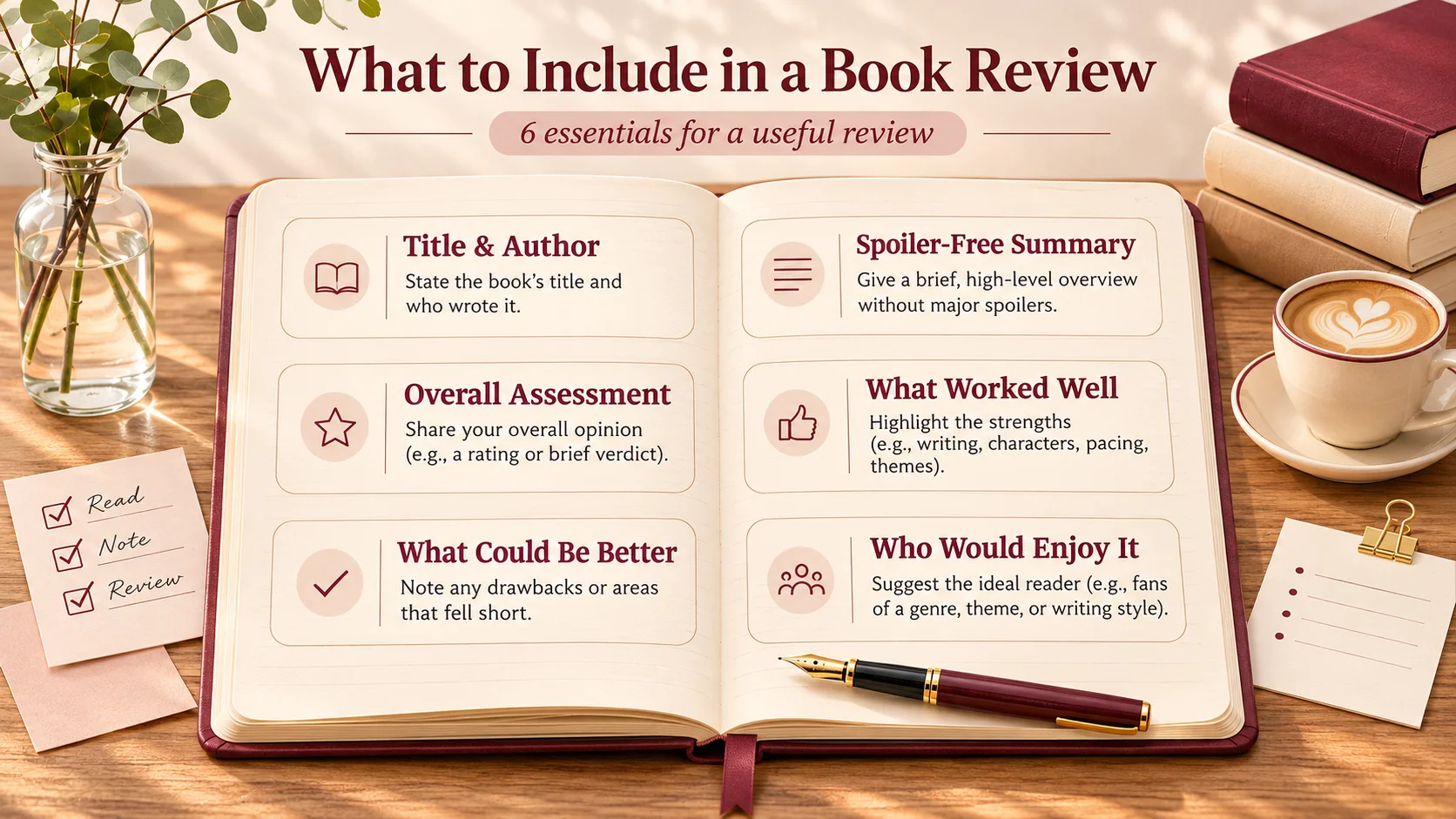
- Title, author, and context: Identify the book and its genre or series position when useful.
- A concise description: Give the premise without explaining the resolution.
- An overall assessment: State the main judgment your review will support.
- Specific strengths: Explain which choices create the reading experience.
- Limitations or trade-offs: Describe relevant weaknesses or preferences fairly.
- An audience-focused conclusion: Say who is likely to appreciate the book and why.
Balance does not mean equal praise and criticism. Represent your assessment honestly; do not invent a flaw to make the review appear fair.
How to Write a Book Review in 7 Simple Steps
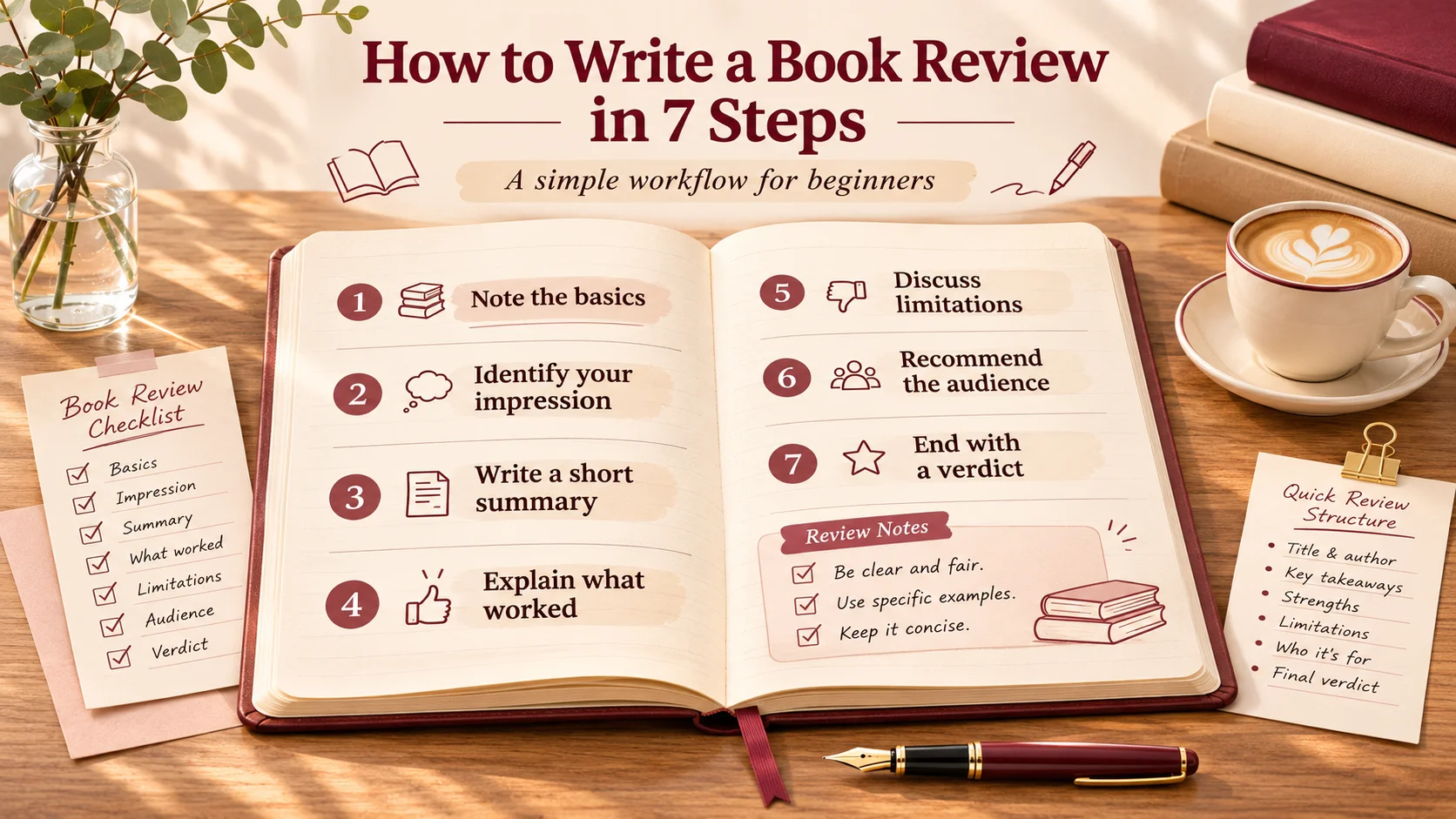
Step 1: Record the Basic Book Details
Check the title, author, genre, and, where relevant, series position and publication year against the book or publisher information. This prevents avoidable errors before you begin. A community review may need only title and author; a school assignment may require full bibliographic details.
Step 2: Identify Your Overall Impression
Before summarizing, ask what stood out, what worked, what felt less successful, and who might enjoy it. Choose the central point your review should communicate. This gives the draft direction.
Illustrative statement: “This mystery creates a memorable atmosphere, although its gradual opening may not suit readers looking for constant action.” That sentence establishes a strength, a qualification, and an audience.
Step 3: Write a Brief Spoiler-Free Summary
Describe the starting premise, central conflict, main setting, and relevant genre expectations. Stop before outcomes or surprise identities. Avoid chapter-by-chapter retelling and long lists of minor characters.
Fictional example: “In a remote seaside village, a visiting woman discovers old letters that unsettle her understanding of a family mystery.” This gives a starting point without solving it.
Step 4: Explain What Worked Well
Choose two or three meaningful observations about character development, setting, atmosphere, pacing, dialogue, style, mystery construction, or themes. Explain the effect of a specific feature, rather than checking every category mechanically.
Illustrative comparison: “The setting was amazing” becomes “The isolated coastal setting reinforces uncertainty, especially as the weather makes leaving increasingly difficult.” The second version explains what the setting contributes.
Use a scene description or a brief, accurately checked quotation when helpful. Our book annotation guide can help you find relevant passages in your notes.
Step 5: Discuss Limitations Constructively
Name the difficulty and its effect. A slow opening, thin secondary character, complex structure, or unconvincing motivation needs an explanation. Separate personal preference from a more specific observation about the writing.
Illustrative wording: “Readers who prefer fast openings may find the early chapters gradual” is more useful than “The book was boring.” You can explain that little changes in the opening chapters without claiming every reader will be bored.
Step 6: Explain Who Should Read the Book
Connect your observations to preferences. A recommendation becomes useful when it explains a match instead of declaring the book universally good or bad.
Fictional example: “Readers who enjoy atmospheric, character-driven mysteries may appreciate this book, while readers looking for nonstop action might prefer something faster.”
Step 7: Finish With a Clear Verdict
End with the main assessment and recommendation. Do not introduce a new plot detail or repeat the whole review. A star rating is optional.
Illustrative verdict: “Choose this for its coastal atmosphere and reflective mystery, provided you do not mind a patient opening.” Readers can understand that conclusion without a number.
A Simple Book Review Template You Can Copy
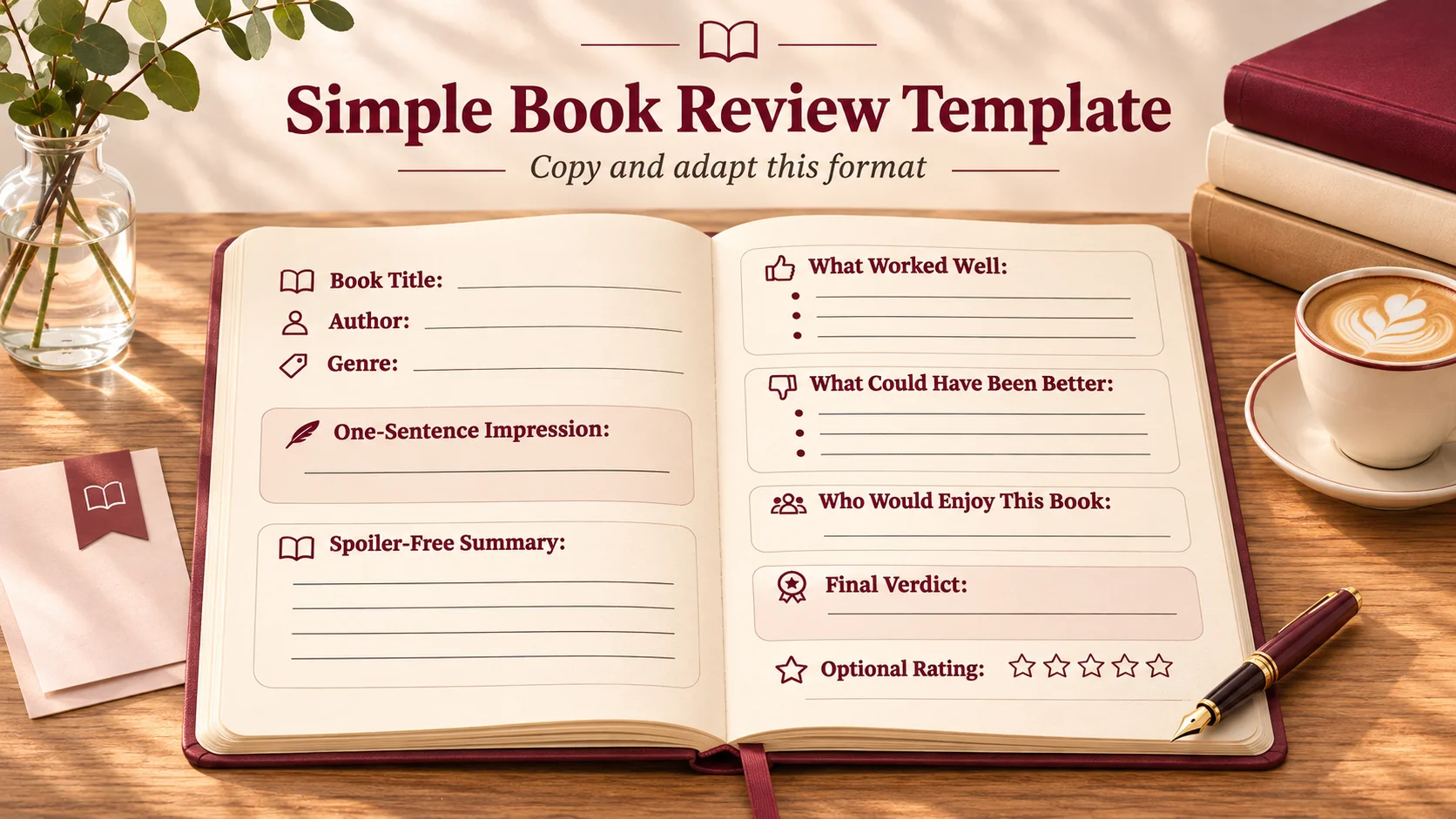
Copy this text into a reading journal, blog draft, personal note, or community review. Replace the prompts and remove fields that do not fit. You can merge the answers into paragraphs afterward.
Book Title:
Author:
Genre:
Publication Year (optional):
Series Position (if applicable):
One-Sentence Overall Impression:
Spoiler-Free Summary:
What Worked Well:
What Could Have Been Better:
Who Would Enjoy This Book:
Final Verdict:
Optional Rating:
Use “What Could Have Been Better” only when you have something relevant to say. The template is a drafting aid, not a requirement to produce a criticism or a score.
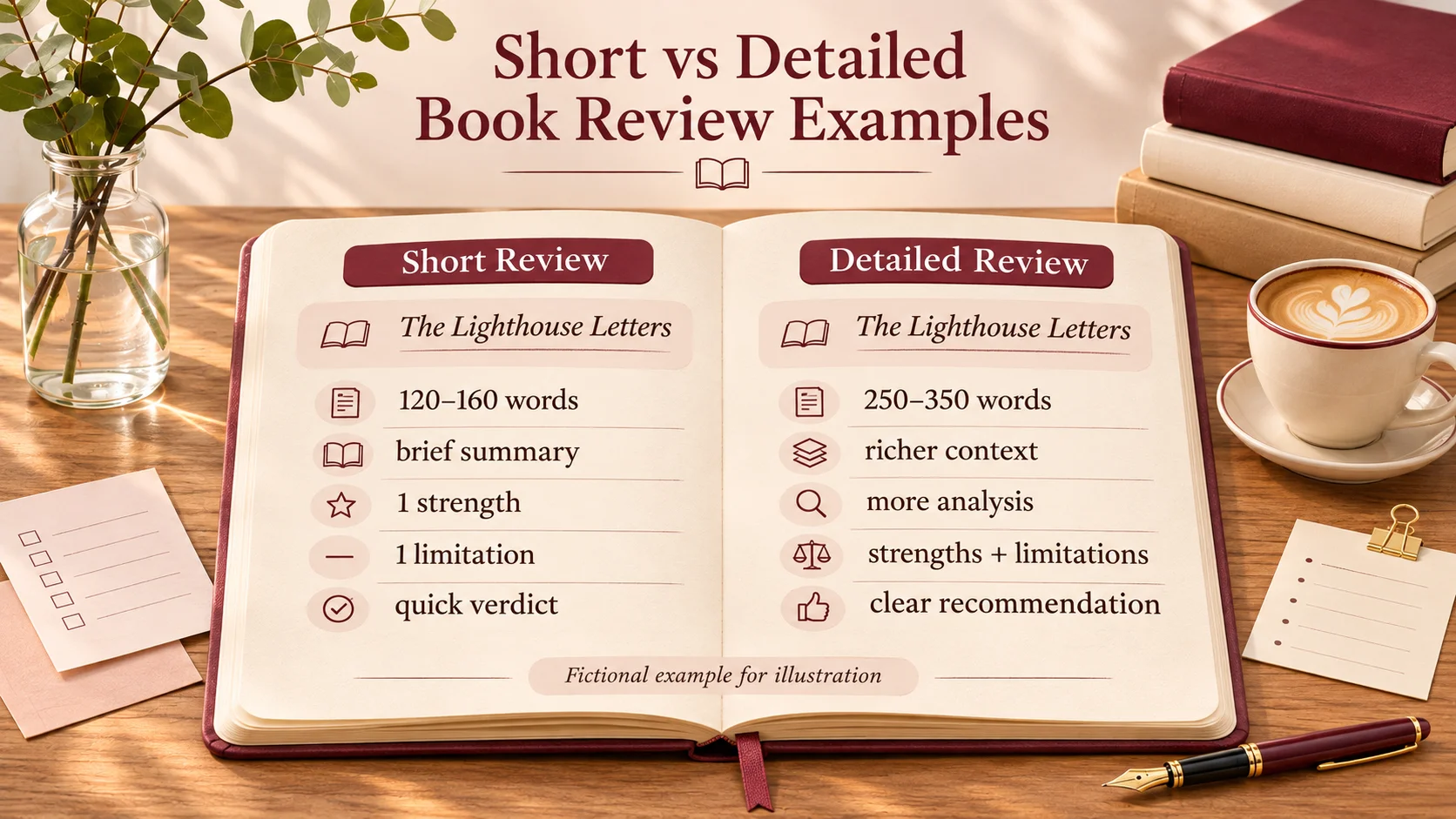
Book Review Example: A Short Review
Fictional example created for illustration. The Lighthouse Letters and Mara Ellison are invented teaching placeholders, not verified published-book details.
In The Lighthouse Letters, fictional author Mara Ellison follows a woman visiting a remote seaside village who discovers old letters connected to a family mystery. The premise makes a quiet investigation feel personal without needing constant danger.
The strongest feature is the coastal atmosphere. Descriptions of narrow paths and changing weather make the village feel both inviting and difficult to leave. The letters also give the central character a reason to reconsider familiar family stories rather than simply collect clues.
The opening is gradual, however, and some conversations repeat uncertainties the reader already understands. Readers seeking rapid discoveries may lose patience.
For those who enjoy reflective mysteries, the combination of place and family questions offers a clear appeal. This is a considered, atmospheric puzzle rather than an action-driven thriller, and that distinction is the best guide to choosing it.
Why it works: The review moves from premise to evaluation, supports the atmosphere claim, identifies a limitation, and recommends an audience. It leaves the mystery unresolved.
Book Review Example: A More Detailed Review
Fictional example created for illustration. This longer version uses the same invented book, author, and premise.
The Lighthouse Letters, a fictional mystery by the invented author Mara Ellison, begins with a woman visiting a remote seaside village. Old letters suggest that a familiar family story is incomplete. The book’s appeal lies less in immediate danger than in watching a comfortable explanation become harder to accept.
The seaside setting gives that uncertainty a physical shape. Narrow paths, changes in the weather, and the distance between houses make ordinary journeys feel consequential. These details create atmosphere while keeping the investigation rooted in places the central character can actually visit.
The protagonist is most interesting when deciding how much to ask the villagers. Her wish to understand the letters competes with a reluctance to disturb relationships she barely knows. That hesitation gives the inquiry an emotional cost. Some secondary characters, however, remain defined mainly by the information they can provide.
The letters offer a useful contrast with village conversation. Written fragments preserve a voice, while spoken recollections show how people arrange or avoid difficult subjects. This makes the process of interpretation part of the mystery without requiring the review to disclose what the letters finally establish.
Pacing is the main qualification. The early chapters spend considerable time establishing uncertainty, and several conversations return to the same unanswered questions. Readers who enjoy settling into a place may welcome this approach. Those expecting frequent reversals could find that the investigation takes too long to gather momentum.
Overall, the novel’s atmosphere and personal stakes make a stronger impression than its speed. It would suit readers who enjoy family mysteries, reflective protagonists, and a setting that shapes the action. Readers wanting a brisk, high-pressure thriller should choose differently. The clearest recommendation is to read it for the experience of questioning a family story, not for relentless suspense.
What changes: The expanded version explains character choices, the role of the letters, and the effect of pacing. Added length provides additional support rather than more plot summary.
How to Write a Book Review Without Spoilers
Describe the Setup, Not the Resolution
Introduce the situation that starts the story. In a fictional example, “Old letters raise questions about a family” is safer than naming the answer those letters reveal.
Discuss the Type of Twist, Not Its Content
You might describe a story as relying on reinterpretation, but even announcing a major twist can change expectations. Avoid hinting at its timing or the scene readers should scrutinize.
Avoid Revealing Hidden Identities
“The investigator faces conflicting accounts” preserves uncertainty. “The investigator is secretly involved” gives away a revelation, even without explaining how. These are invented examples, not details from a published novel.
Be Careful With Comparisons
Comparing two famous endings may spoil both. Compare atmosphere, pace, or narrative style instead of saying that a book uses another novel’s surprise.
Clearly Label Spoiler Discussions
Put an unmistakable warning before any revealing material. Keep spoilers out of titles, opening paragraphs, and previews. If the platform cannot separate that discussion clearly, omit the revelation.
How to Write a Balanced Book Review
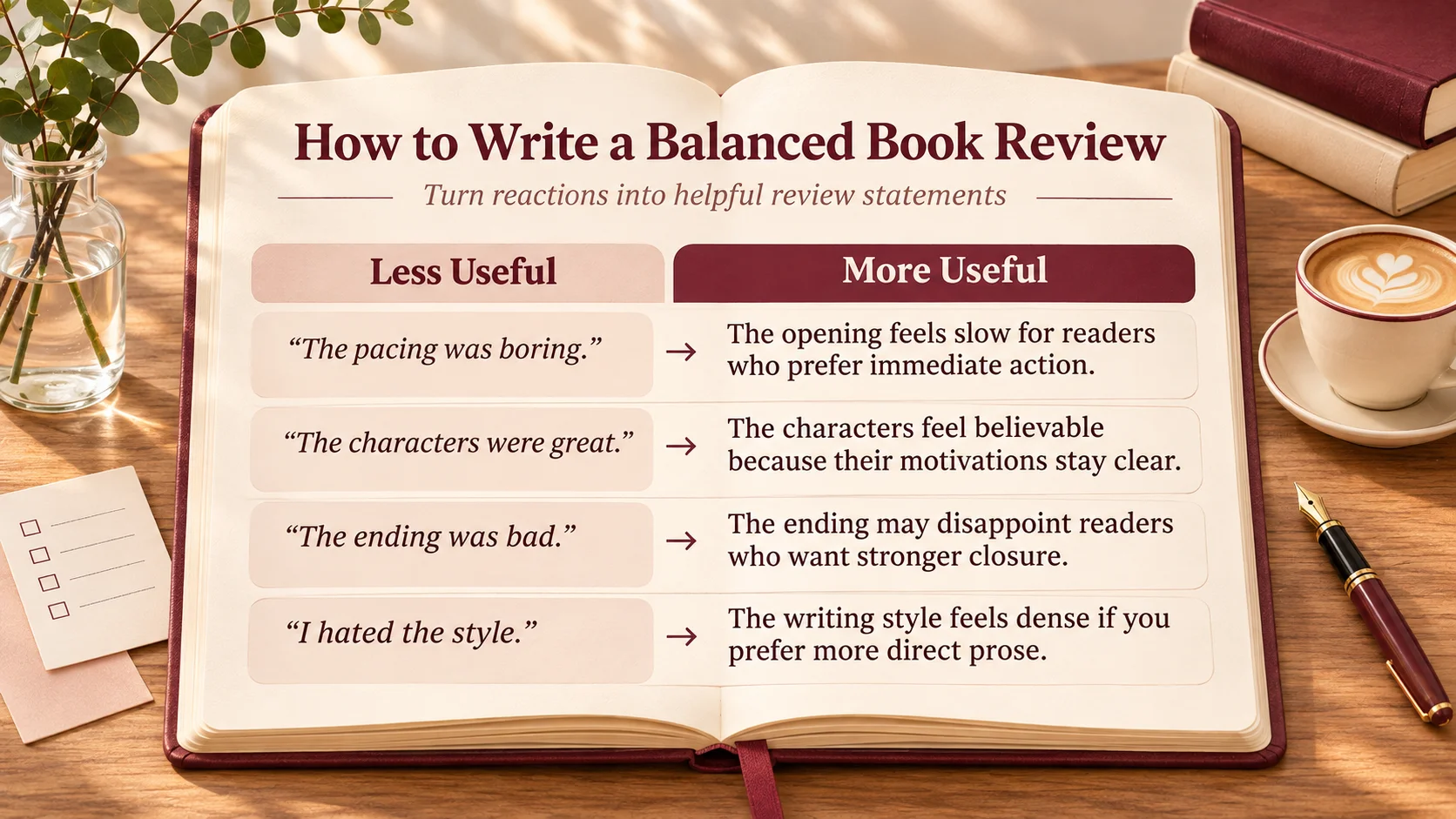
Honest praise and fair criticism both need reasons. Judge a book against what it attempts and its genre expectations. A quiet character study is not automatically unsuccessful because it lacks action. Avoid exaggerated claims such as “everyone will love this.”
| Vague statement | More useful review statement |
|---|---|
| The pacing was terrible. | The middle repeats the same uncertainty without adding much information. |
| The characters were great. | The protagonist’s conflicting loyalties make her decisions difficult to predict. |
| The setting was beautiful. | Descriptions of paths and weather make the village shape the investigation. |
| The ending was bad. | The resolution depends on information introduced too late to feel convincing. |
| The writing was confusing. | Frequent shifts between time periods made the sequence difficult to follow. |
These are illustrative fictional observations. Use only statements you can support from the book you actually read.
How Long Should a Book Review Be?
Length depends on purpose and platform. Treat these as illustrative working ranges, not universal requirements:
- Quick personal review: 50–150 words.
- Short reader review: 150–300 words.
- Detailed blog review: 500–1,000 or more words.
- Academic review: Follow the assignment or publication requirements.
Use the space needed to explain your judgment. Cut repeated summary before adding words merely to meet an informal target.
Should You Give a Book a Star Rating?
Ratings are optional. They are easy to scan, but personal scales differ, and identical scores can conceal different reasons. A clear written verdict can communicate the recommendation on its own. If you use a score, explain what it means; ratings are not a requirement for SEO or search snippets.
How to Review Fiction vs Nonfiction
For fiction, consider characters, plot structure, pacing, themes, setting, and narrative voice. Choose the features central to the book’s intended experience.
For nonfiction, consider purpose, organization, evidence, accuracy, practical usefulness, and intended audience. Check factual claims when necessary, and distinguish “easy to understand” from “well supported.” Do not repeat a claim as fact simply because it appears in the book.
Academic reviews may require scholarly context and specific citation practices. The University of Guelph guide emphasizes purpose and evaluation; UBC’s academic review guidance discusses examining reasoning and evidence. Follow course instructions rather than treating a casual review as an academic submission.
Common Book Review Mistakes to Avoid
- Retelling everything: Keep only the setup needed to understand your assessment.
- Revealing spoilers: Check whether a detail changes what a new reader expects.
- Offering vague praise: Explain what created your response.
- Making taste universal: Identify your preference instead of speaking for everyone.
- Being harsh without reasons: Critique the writing, not the author’s character.
- Overloading quotations: Use short excerpts only when they support your point.
- Copying publisher descriptions: Write an original summary from your reading.
- Inventing unread details: Be transparent if you did not finish; never imply full knowledge.
- Forgetting the audience: Explain which readers the book may suit.
Book Review Checklist Before You Publish
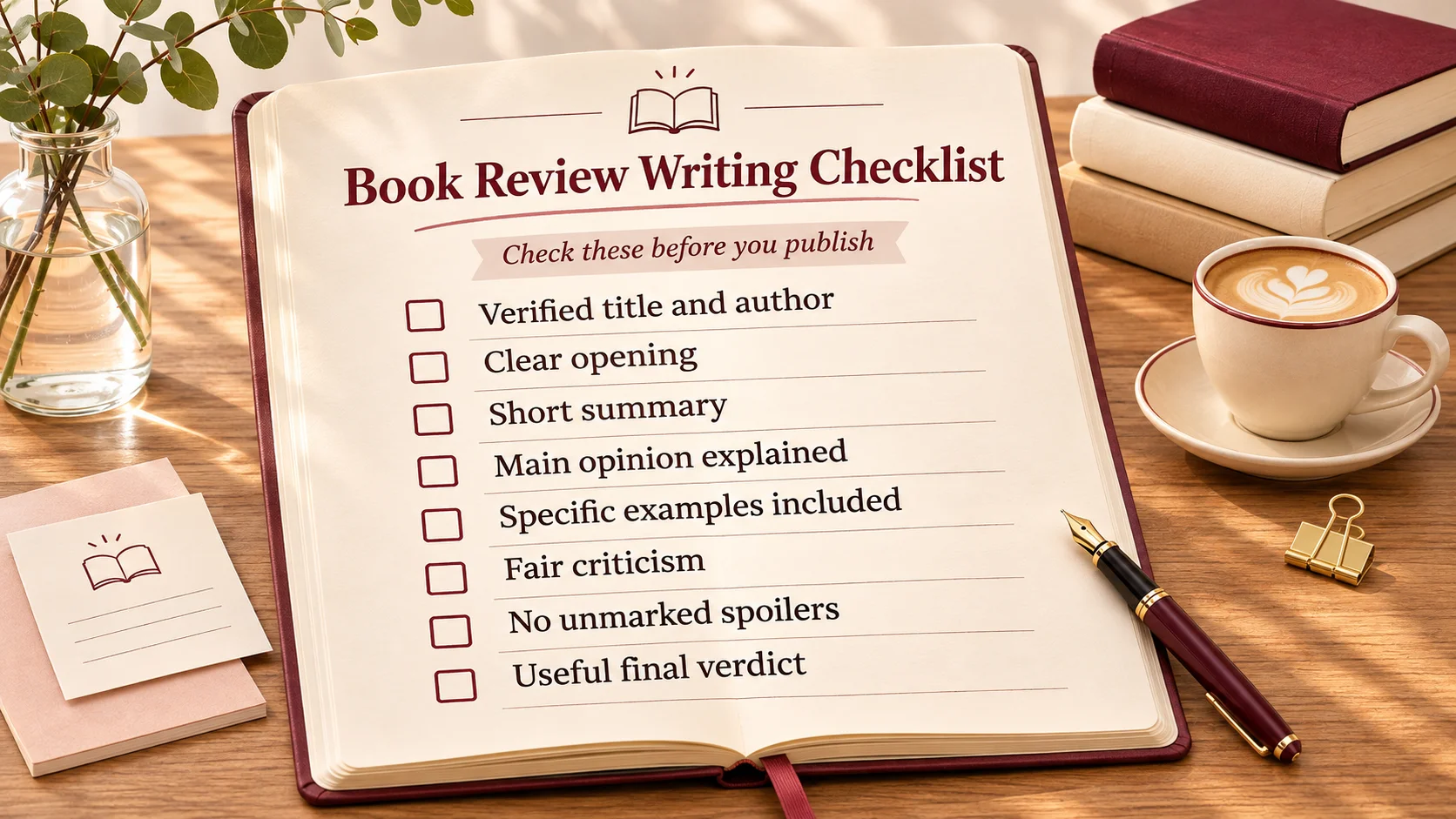
Read the draft once as someone deciding whether to pick up the book. Then check:
- Did I verify the title and author?
- Is my opening clear?
- Is the summary concise?
- Have I explained my main opinion?
- Did I support observations with examples?
- Is the criticism fair?
- Did I avoid unmarked spoilers?
- Is the intended audience clear?
- Does the ending provide a useful verdict?
- Have I checked grammar and factual details?
Purdue OWL’s review-writing guidance also recommends checking names and quotations during revision. A final fact check is separate from deciding whether your opinion feels persuasive.
Your First Book Review: A 15-Minute Writing Exercise
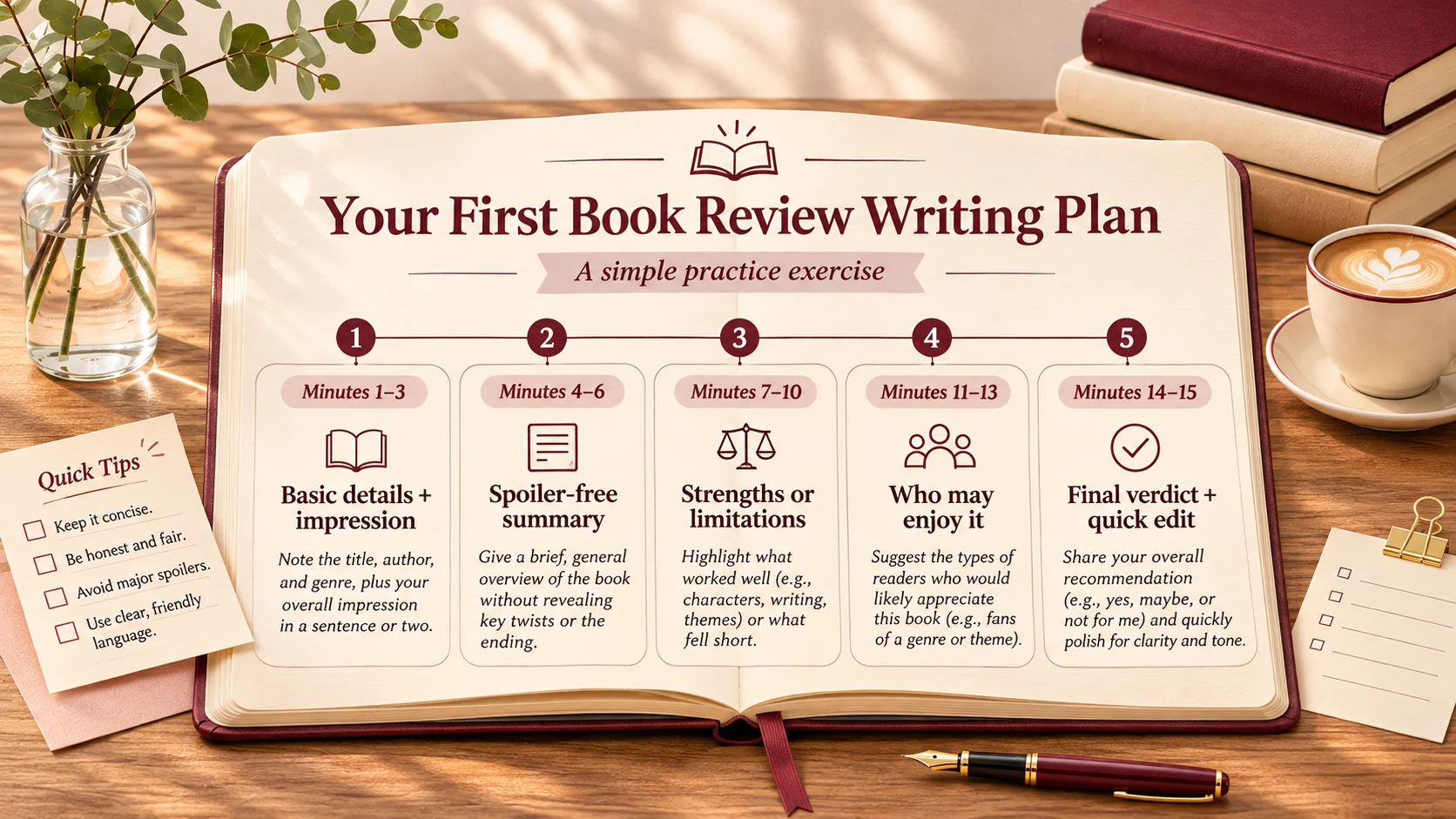
Use a book you have finished and begin with a short review. This timing is an illustrative practice plan, not a deadline; longer reviews and unfamiliar formats may take more time.
- Minutes 1–3: Write the basic information and one-sentence overall impression.
- Minutes 4–6: Draft a brief spoiler-free summary.
- Minutes 7–10: Explain two observations about strengths or limitations.
- Minutes 11–13: Identify who may enjoy the book and why.
- Minutes 14–15: Write a verdict and revise for clarity.
If time runs out, leave a specific next task, such as checking a scene or shortening the summary. A complete short draft gives you something concrete to improve.
Final Thoughts
A useful review explains what the book offers, how effectively it delivers that experience, and which readers might appreciate it. Elaborate language and a long plot summary are unnecessary. Start with one clear opinion, support it with specific observations, and finish with a recommendation another reader can use.
Explore More Book Reviews and Reading Guides
Looking for examples of thoughtful book reviews? Explore our latest book reviews and practical reading guides to discover how different stories can be evaluated and discussed.
Compare how our The Silent Patient review, The Maidens review, and The Fury review organize an assessment. For help collecting useful observations while reading, visit How to Annotate a Book Without Overdoing It.
Frequently Asked Questions
Identify the book and write one sentence capturing your overall impression. Then select the observations that best explain that judgment.
Include basic book details, a brief description, an overall assessment, supported strengths or limitations, and an audience-focused verdict.
A summary describes the content. A review also evaluates how the book works and explains the reasons for that assessment.
Choose a length suited to the platform and purpose. A few clear paragraphs may be enough for a reader review; school or publication requirements take priority.
Yes. Explain the setup and discuss writing choices without revealing outcomes, hidden identities, or the content of surprises.
Only when relevant to your honest assessment. Do not manufacture criticism; explain any limitations fairly and specifically.
No. A written verdict can explain your recommendation. A numerical score is optional and benefits from context.
Follow the specific assignment instructions first, including length, scholarly analysis, and citation requirements. Ask your teacher about anything unclear.
Use a brief premise, two supported observations, and a final recommendation. Add title and author, then revise out unnecessary summary.