
The Silent Patient Review: Is Alex Michaelides’ Thriller Worth Reading?
Some thrillers announce their mystery immediately.
The Silent Patient does exactly that.
Alicia Berenson is a successful painter living in London. One evening, her husband Gabriel returns home, and Alicia shoots him. Afterward, she stops speaking completely.
No confession.
No explanation.
No attempt to tell anyone why.
That silence turns a shocking crime into a psychological mystery, and psychotherapist Theo Faber becomes determined to uncover the reason behind it. The publisher describes the novel as a psychological thriller centered on Alicia’s silence and Theo’s obsession with understanding her motive.
This review stays spoiler-light.
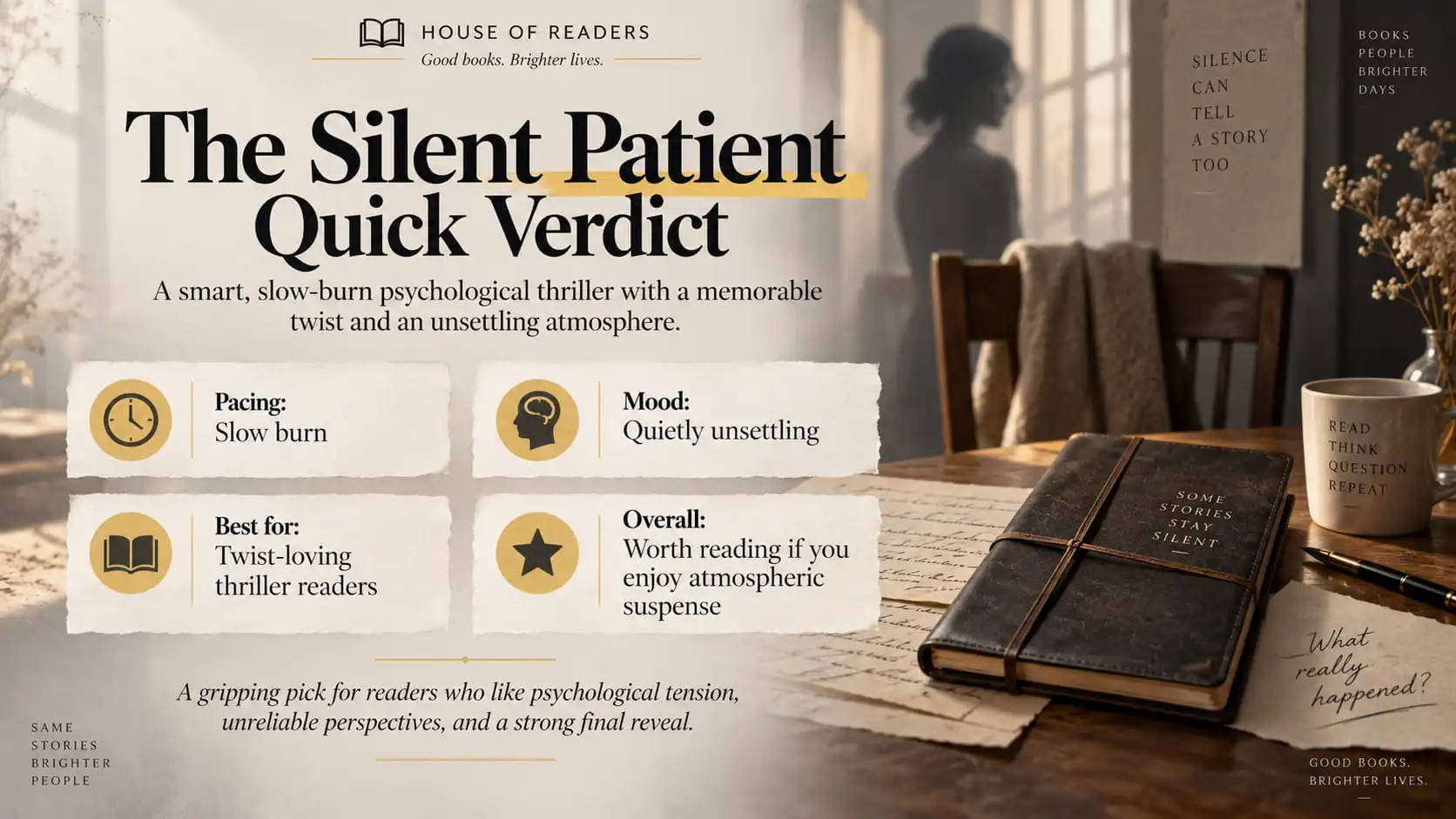
Quick Verdict
House of Readers Rating: 4.25/5
The Silent Patient is a tightly constructed psychological thriller with a strong central mystery and an ending designed to make you reconsider what came before.
It works especially well if you enjoy:
- unreliable perspectives
- psychological puzzles
- short, focused chapters
- morally complicated characters
- stories built around hidden information
- major late-game revelations
It is less effective if you prefer deep character development over plot mechanics or dislike thrillers that deliberately hold back information.
My quick verdict
Pacing: Strong
Mystery: Excellent
Atmosphere: Very Good
Characters: Good
Twist Factor: High
Overall: 4.25/5
What Is The Silent Patient About?
Alicia Berenson appears to have an enviable life.
She is a successful painter.
Her husband Gabriel is a well-known fashion photographer.
They live in a desirable part of London.
Then one evening, Gabriel comes home and Alicia shoots him.
Afterward, she refuses to speak.
Her silence becomes the mystery.
Alicia is eventually placed at the Grove, a secure forensic psychiatric facility, where she remains silent despite years of treatment.
Theo Faber, a criminal psychotherapist, becomes fascinated by her case and takes a position at the Grove partly because he wants the opportunity to work with her.
He believes that if he can get Alicia to speak, he can finally understand what happened.
But the deeper Theo goes, the less simple the story becomes.
What to Expect From The Silent Patient
A Strong Central Mystery
The entire novel is built around one question:
Why did Alicia kill her husband?
That question gives the book a very clear sense of direction.
Even when the story slows down, the mystery keeps pulling you forward.
A Psychological Rather Than Action-Heavy Thriller
This is not a chase-heavy thriller.
Most of the tension comes from:
- conversations
- observations
- therapy sessions
- diary entries
- memory
- suspicion
- hidden motives
The suspense is intellectual more than physical.
An Unreliable Reading Experience
You are constantly working with incomplete information.
Different characters provide different versions of events.
Some people seem suspicious.
Others seem too helpful.
And the book encourages you to form conclusions before giving you the full picture.
A Strong Sense of Obsession
Theo does not simply want to help Alicia.
He becomes deeply invested in understanding her.
That obsession gives the novel much of its psychological tension.
The official author site describes Theo as a therapist obsessed with uncovering Alicia’s motive.
A Big Final Reveal
Yes, this is one of those thrillers where the ending matters a lot.
I will not spoil it.
But the final section changes how you interpret several earlier parts of the story.
That is one of the main reasons the novel became so widely discussed.

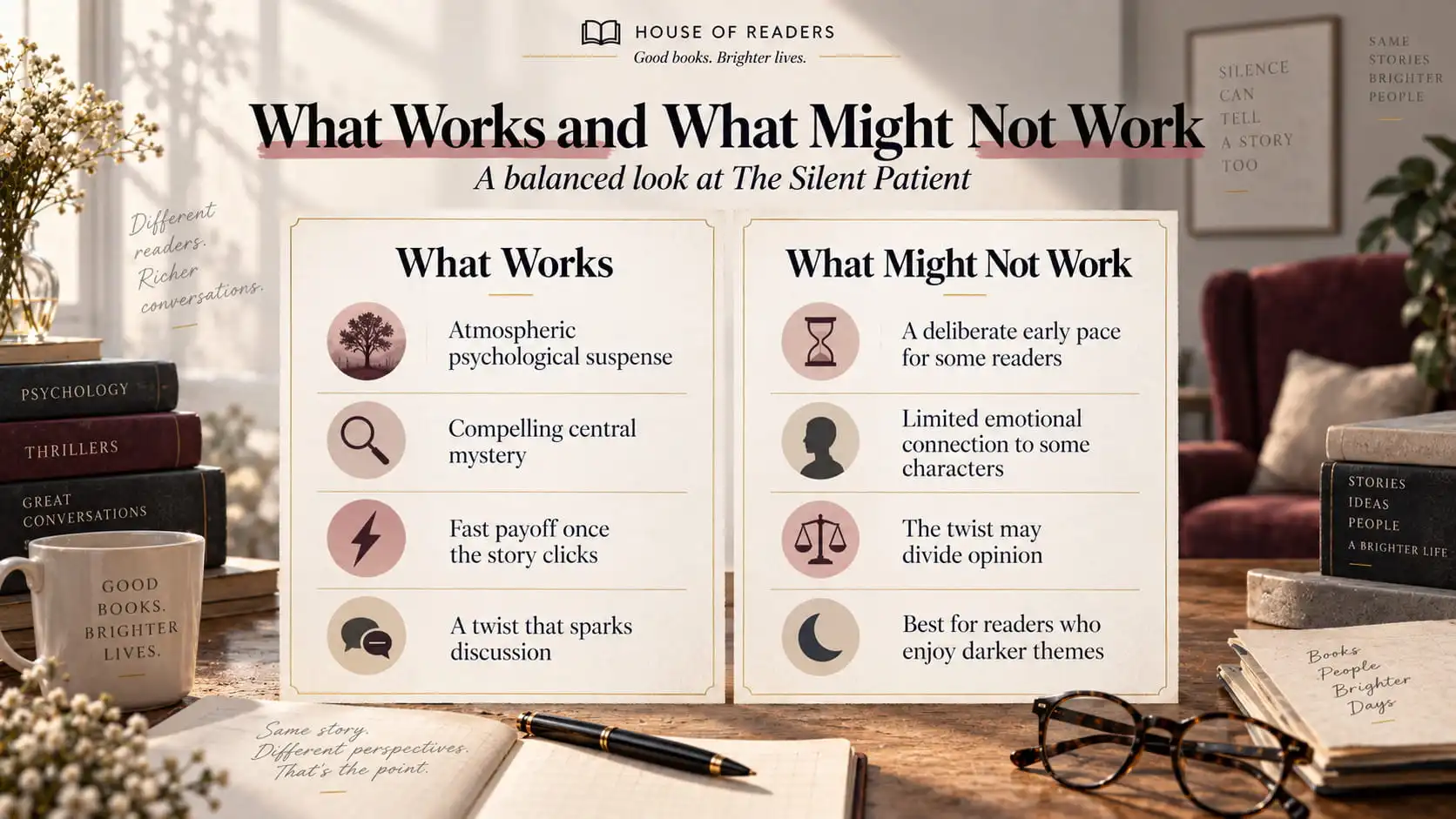
What Works Well
1. The Premise Is Immediately Compelling
A woman kills her husband.
Then never speaks again.
That is an excellent thriller setup because the mystery is instantly understandable.
You do not need fifty pages before knowing what the central question is.
2. The Story Is Easy to Follow
Even though the novel deals with psychological ideas, it is not difficult to read.
The prose is straightforward.
The chapters are manageable.
And the story generally moves with purpose.
That makes it accessible even if you do not read psychological thrillers very often.
3. Alicia’s Silence Creates Constant Tension
Alicia’s refusal to speak is the novel’s strongest device.
Because she cannot simply explain herself, every other character has to interpret her.
The reader has to do the same.
That creates a constant gap between:
what happened
and:
what people think happened
4. The Diary Structure Adds Another Layer
Parts of the story are presented through Alicia’s diary.
That gives the reader access to information Theo does not always have.
But it also creates another question:
How should we interpret what Alicia wrote?
The diary becomes an important part of the mystery without making the structure confusing.
5. The Ending Is Memorable
This is probably the biggest reason people recommend the book.
The ending is designed to force a re-evaluation of what came before.
Macmillan highlights the novel’s twist-heavy structure, and the book has repeatedly been praised for its ending and plotting.
What Might Not Work
1. Some Characters Feel More Functional Than Deep
The plot is the priority.
That means some secondary characters exist mainly to:
- provide information
- create suspicion
- redirect attention
- support the mystery
If you prefer deeply layered character studies, you may find parts of the cast slightly thin.
2. The Book Holds Back Information Deliberately
That is normal for a mystery.
But some readers may feel the story is manipulating the timeline or controlling information too aggressively.
If you dislike being intentionally misdirected, the ending may feel more constructed than organic.
3. The Therapy Setting Is More Thriller Device Than Realistic Clinical Study
The psychiatric setting is important to the story.
But I would not approach the book expecting a realistic exploration of clinical practice.
It is primarily a psychological thriller.
The Grove, therapy sessions, and psychotherapist relationship are there to support the mystery.
4. The Final Reveal May Divide Readers
Some readers will love it.
Others may immediately start questioning whether every detail fits perfectly.
That is fairly common with twist-centered thrillers.
The stronger your reaction to the reveal, the more likely you are to discuss the book afterward.
Is The Silent Patient Scary?
Not in the traditional horror sense.
There are no supernatural elements driving the story.
The tension comes from:
- violence in the past
- psychological uncertainty
- obsession
- secrets
- unstable relationships
- a secure psychiatric setting
I would describe it as unsettling rather than frightening.
If you are comfortable with mainstream psychological thrillers, you will probably be fine with this one.
Is The Silent Patient Easy to Read?
Yes.
This is one of its strengths.
The book is 336 pages in the current Macmillan edition and uses relatively direct prose with a plot-focused structure.
It does not feel academically psychological.
You do not need background knowledge in therapy or psychiatry.
The mystery is easy to understand from the beginning.
That makes it a good choice for someone who is newer to psychological thrillers.
Does The Silent Patient Have a Big Twist?
Yes.
Very much so.
But I would strongly recommend avoiding detailed reviews, videos, and comment sections before reading it.
This is a book where knowing the reveal early would significantly change the experience.
Go in knowing as little as possible.
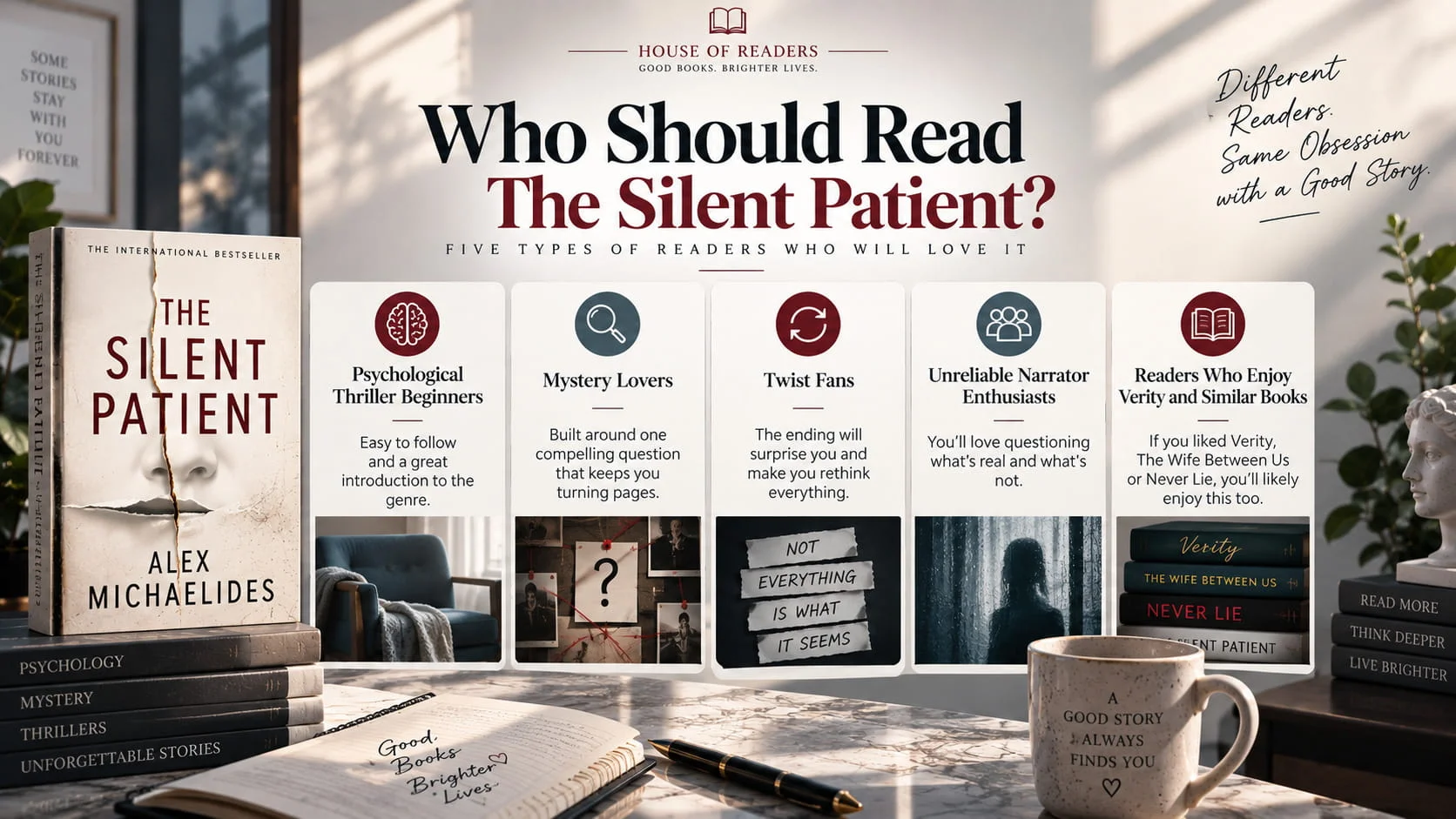
Who Should Read The Silent Patient?
Read it if you enjoy:
- psychological mysteries
- unreliable narrators
- stories about hidden motives
- therapy or psychiatric settings
- diary-style storytelling
- twist endings
- books that make you reconsider earlier chapters
It is especially good for readers who liked:
- Verity
- Never Lie
- The Wife Between Us
- The Woman in the Window
You may want to skip it if:
- you strongly dislike twist-driven stories
- you want deep literary character development
- you prefer action-heavy thrillers
- you dislike stories that deliberately withhold information
Is The Silent Patient Part of a Series?
No.
The Silent Patient is a standalone novel.
It was also Alex Michaelides’ debut novel.
His later books include The Maidens and The Fury, but you do not need to read either of them before or after The Silent Patient.
That makes this an easy book to pick up without committing to a series.
Does The Silent Patient Have a Good Ending?
I think it does.
But the ending works best if you enjoy revelation-based thrillers.
It is not an ending where every character simply explains everything in a neat conversation.
Instead, the final sections change the meaning of earlier events.
That is what makes the book memorable.
Whether you think it is brilliant or slightly too engineered will depend on how much you enjoy being misdirected.
For me, the ending is the reason the book earns its 4.25/5 rating.
Is The Silent Patient Worth Reading?
Yes, especially if you enjoy psychological thrillers built around one strong mystery.
The novel is:
- accessible
- tightly plotted
- easy to binge
- atmospheric
- twist-driven
- discussion-friendly
It is not perfect.
Some characters could be deeper, and the book sometimes prioritizes the mystery over realism.
But the central idea is strong enough to carry the story.
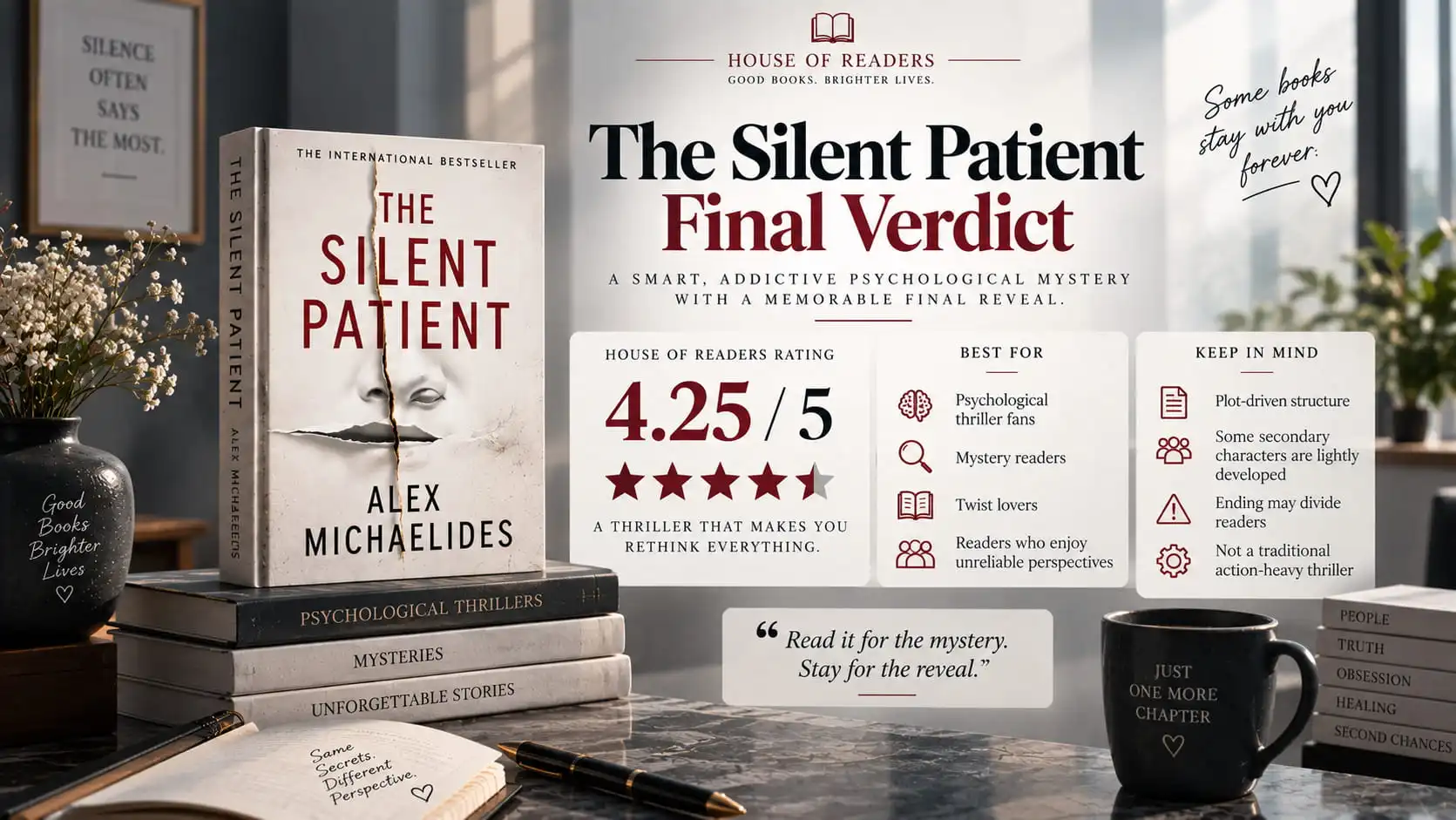
Final Verdict
House of Readers Rating: 4.25/5
The Silent Patient succeeds because it gives the reader a simple question and refuses to answer it until the story is ready.
Alicia’s silence creates a mystery that feels unusually focused.
Theo’s obsession keeps the investigation moving.
And the ending gives the entire book a second layer.
If you enjoy psychological thrillers that rely on:
- secrets
- unreliable information
- character psychology
- hidden motives
- major revelations
this is very likely worth your time.
Final Take
Read it for the mystery. Stay for the reveal.
If You Liked The Silent Patient, What Should You Read Next?
A few strong next choices:
Verity
If you want another psychological thriller built around uncertain truth and hidden information.
Read our:
Verity Review: Is Colleen Hoover’s Thriller Worth Reading?
Never Lie
If you want another fast thriller built around discovering hidden records.
The Wife Between Us
If you enjoy stories that deliberately challenge your assumptions.
The Woman in the Window
If unreliable perception is your favorite part of psychological suspense.
Books Like Verity
Several of the books in our Verity recommendation guide also work well for The Silent Patient readers.