Verity Review: Is Colleen Hoover’s Thriller Worth Reading?
Verity is the kind of book that becomes difficult to discuss without immediately wanting to talk about its ending.
It starts with a struggling writer, an unusual job offer, and a family already carrying more grief than most people could handle.
Then Lowen Ashleigh finds something she was never supposed to read.
From there, Verity becomes less about discovering a simple truth and more about deciding whose version of the truth you are willing to believe.
Colleen Hoover describes Verity as a standalone romantic thriller. The story follows Lowen, a writer facing financial trouble, who is hired by Jeremy Crawford to complete the remaining books in a successful series written by his injured wife, Verity Crawford. While working inside the Crawford home, Lowen discovers an unfinished autobiography containing disturbing claims about Verity and her family.
This review stays spoiler-light. I will discuss the reading experience, pacing, characters, romance, darker material, and whether the book is worth your time without revealing the twists that make the story work
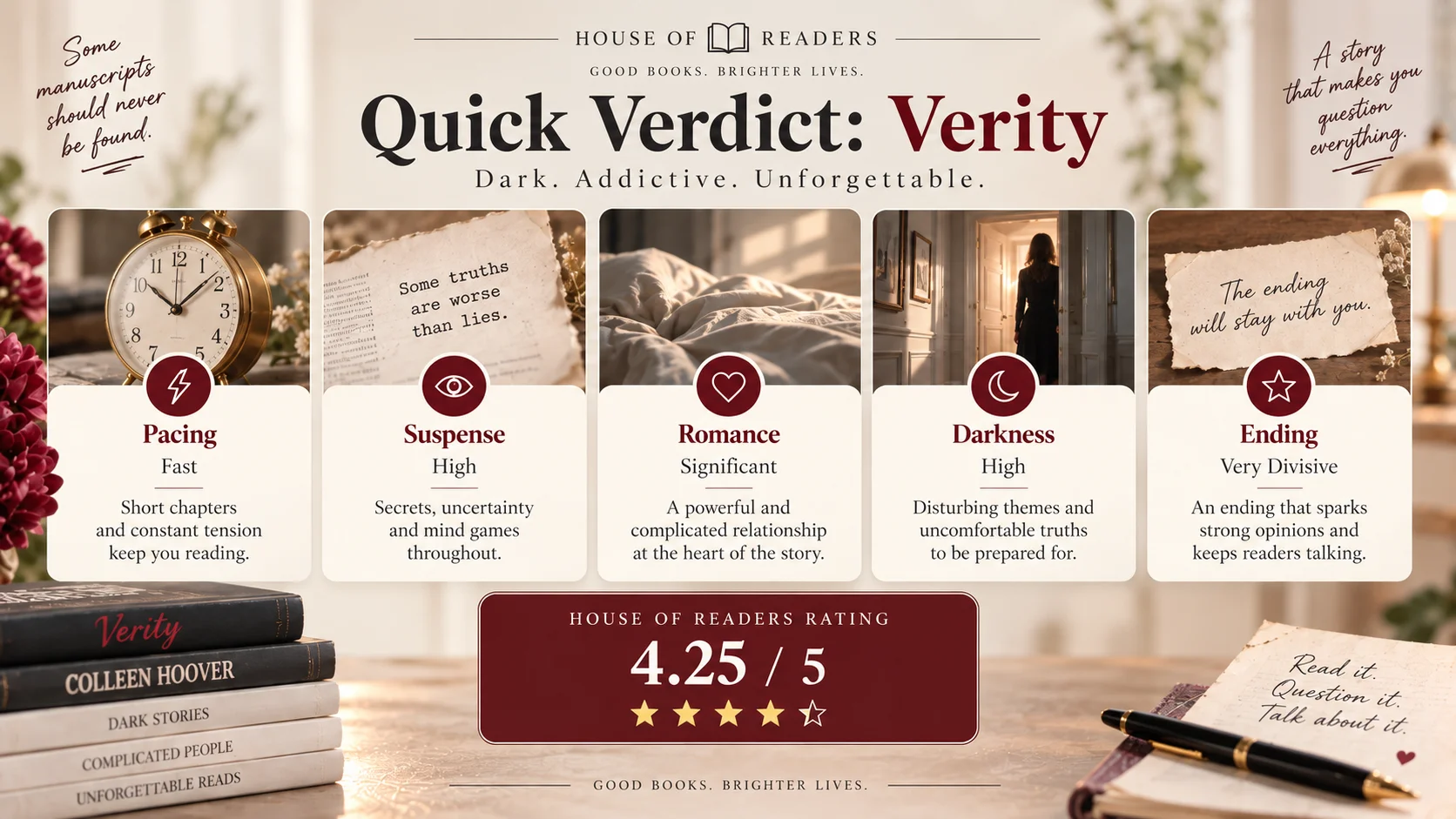
Quick Verdict: Is Verity Worth Reading?
Yes, if you enjoy psychological thrillers that mix obsession, romance, disturbing revelations, and an ending designed to start arguments.
Verity is extremely readable.
The chapters move quickly, the central manuscript gives you a constant reason to continue, and Hoover understands how to end scenes at exactly the point where stopping feels inconvenient.
But this is not a conventional mystery where every clue eventually produces one clean, universally accepted answer.
A large part of the appeal is uncertainty.
You spend much of the book asking:
What actually happened?
By the end, the more interesting question may be:
Who do I believe?
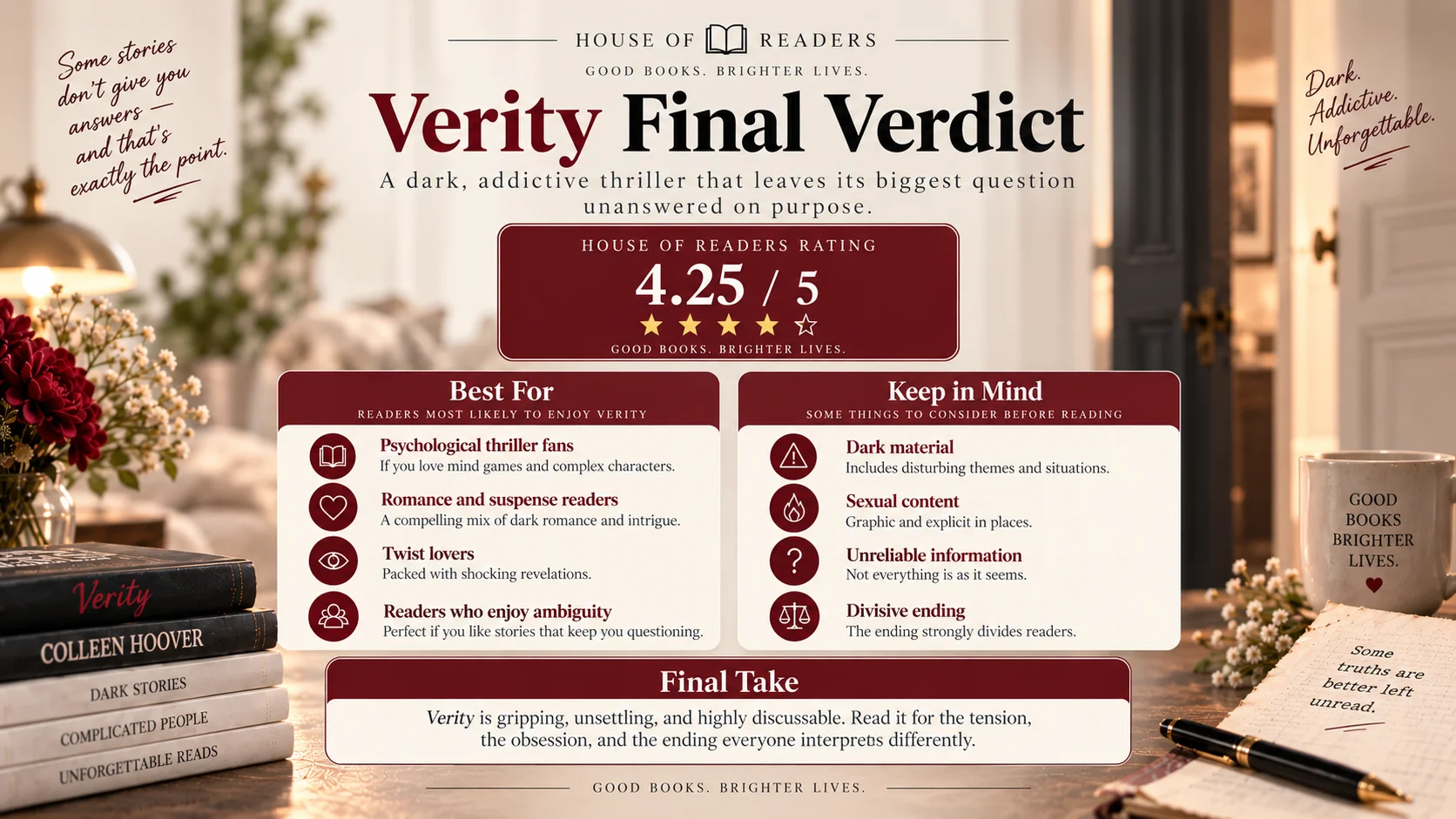
House of Readers Rating
4.25 / 5
Best for
Readers who enjoy:
- psychological suspense
- morally complicated characters
- dark relationship dynamics
- romantic tension
- unreliable information
- endings that leave room for debate
What Is Verity About?
Lowen Ashleigh is a writer whose career and finances are both struggling.
Then she receives an opportunity that could change everything.
Jeremy Crawford wants Lowen to finish a successful book series written by his wife, Verity Crawford, who has been left unable to continue writing.
Lowen travels to the Crawford home to examine Verity’s notes, outlines, and unfinished work.
While searching through Verity’s office, she discovers something completely different.
An unfinished autobiographical manuscript.
It appears to contain intensely personal and deeply disturbing admissions about Verity’s marriage, her children, and events that devastated the Crawford family.
Lowen does not initially show the manuscript to Jeremy.
That decision becomes increasingly complicated as she grows closer to him.
The official publisher description centers the same conflict: Lowen discovers a manuscript Verity never intended anyone to read and begins considering what its contents could mean for Jeremy and his feelings toward his wife.
That is all you really need to know.
The less detail you have before starting Verity, the better.
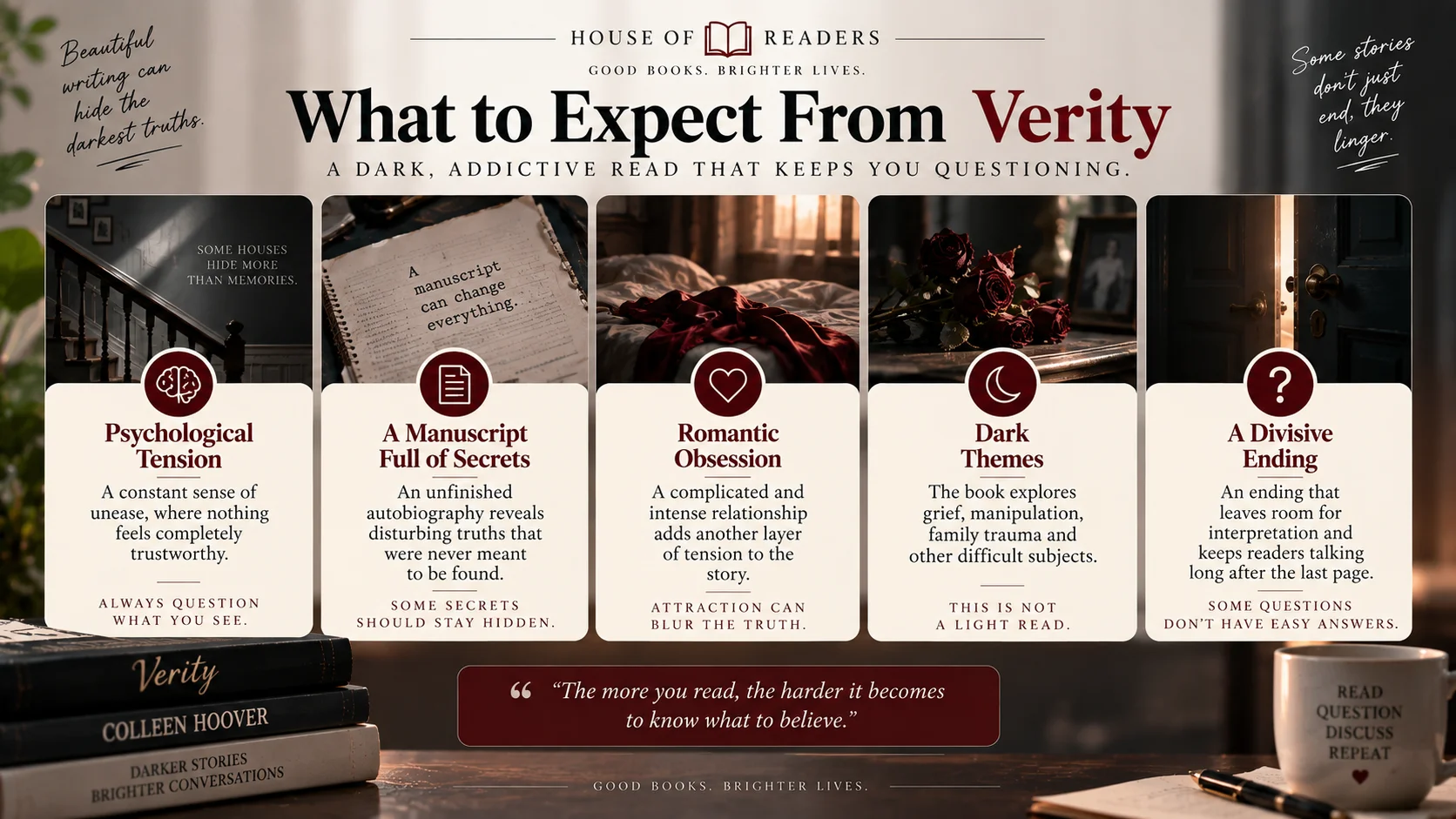
What to Expect From Verity
Psychological Tension
This is the biggest reason to read the book.
The tension comes from uncertainty.
Lowen is living inside Verity’s home, surrounded by Verity’s belongings, husband, history, and writing.
The closer Lowen gets to the family, the more difficult it becomes to separate what she has read from what she is actually observing.
You are constantly evaluating:
- Verity
- Jeremy
- Lowen
- the manuscript
- your own assumptions
That makes the story psychologically uncomfortable even when nothing dramatic is happening on the page.
A Story Inside the Story
The manuscript structure is one of Verity’s strongest hooks.
You are effectively moving between Lowen’s present-day experience and the disturbing account she discovers.
Those manuscript sections gradually alter the way you interpret Verity.
They also create a powerful problem for the reader.
You are reading something extremely intimate while knowing the person who wrote it never intended Lowen to find it.
That creates curiosity and discomfort at the same time.
Romance Is a Major Part of the Story
This is important to know before reading.
Verity is not simply a psychological thriller with a tiny romantic subplot.
Lowen’s growing attraction to Jeremy becomes an important part of the story and influences the decisions she makes.
For readers who enjoy thrillers mixed with romantic tension, this will probably increase the appeal.
Readers who prefer their psychological thrillers almost completely romance-free may enjoy it less.
Dark and Disturbing Material
Verity goes considerably darker than many readers may expect if they primarily know Colleen Hoover through romance.
The book deals with:
- grief
- death
- manipulation
- obsession
- disturbing thoughts
- family trauma
- sexual content
- emotionally uncomfortable material involving children
The official positioning calls it a psychological thriller, while Hoover’s own site describes it as a standalone romantic thriller.
This is not a light suspense read.
An Ending Built for Debate
Avoid spoilers before reading this book.
Seriously.
A large part of Verity’s staying power comes from what the ending forces you to reconsider.
It does not simply ask whether one character was good or bad.
It asks whether the evidence you trusted was ever as reliable as you believed.
Readers continue debating the ending because different interpretations can radically change how you view the entire story.
What Works Well in Verity?
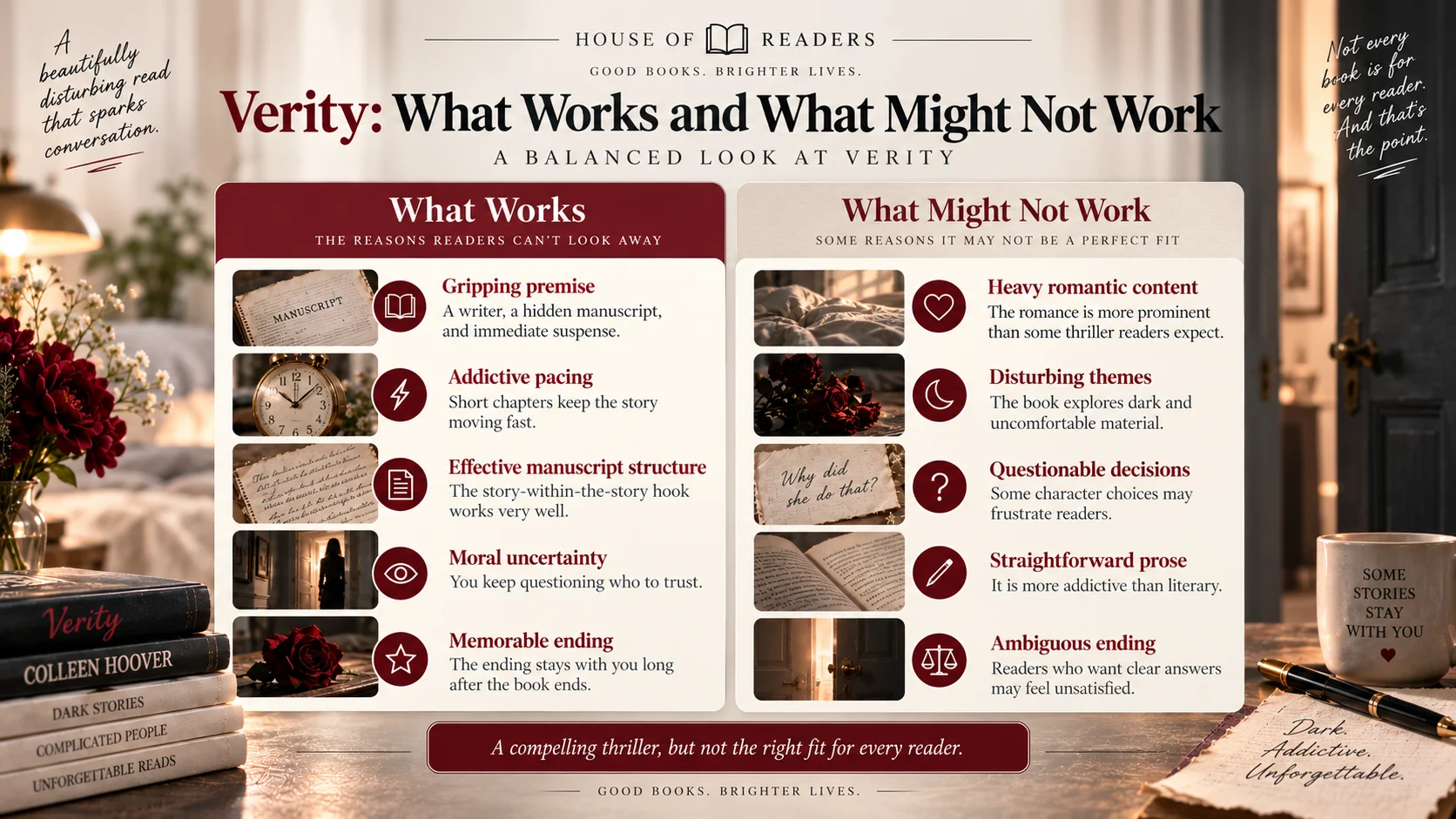
The Premise Is Immediately Compelling
The basic idea is excellent.
A writer enters another author’s home to finish her books and discovers that author’s private manuscript.
You immediately understand why Lowen would keep reading.
And because Lowen keeps reading, you probably will too.
The premise creates tension without needing complicated world-building or a huge cast.
The Book Is Extremely Easy to Binge
This may be Verity’s greatest strength.
Hoover writes in a direct, accessible style.
You rarely have to work to understand what is happening.
That leaves your attention focused on the questions the story is creating.
The result is the classic thriller problem:
You know you should stop reading, but the next chapter is right there.
The Manuscript Sections Are Effective
These sections are intentionally uncomfortable.
They change your perception of Verity before you have enough information to know whether that perception is justified.
That is clever because the manuscript does more than deliver exposition.
It actively shapes the reader’s emotional response.
The Story Creates Genuine Moral Discomfort
Lowen is not a neutral observer.
She develops feelings for Jeremy.
She wants things.
She makes decisions based partly on what benefits her.
That means you cannot simply treat her as an objective investigator uncovering facts.
Her emotions matter.
So do Jeremy’s.
And so does Verity’s inability to explain herself for much of the story.
This makes the central situation far messier than a straightforward mystery.
The Ending Gives the Book a Second Life
Some thrillers end and feel finished.
Verity ends and makes many readers want to immediately discuss what they just read.
That matters.
A divisive ending is not automatically a good ending, but in this case the uncertainty is central to the book’s identity.
The title itself tells you what the story is concerned with:
truth.
And whether we can actually know it.
What Might Not Work for Everyone?
The Romance Can Become Very Prominent
Readers entering purely for psychological suspense may be surprised by how much attention the relationship between Lowen and Jeremy receives.
If romantic and sexual tension improves a thriller for you, this is a strength.
If it interrupts the suspense for you, it may become one of your biggest complaints.
Some Material Is Intentionally Uncomfortable
There are sections of the manuscript that are difficult to read.
The discomfort is purposeful, but that does not mean every reader will want to experience it.
If you are sensitive to stories involving children, grief, abuse, or disturbing family dynamics, checking content warnings first may be worthwhile.
Just be careful because detailed warnings can reveal major information.
You May Question Character Decisions
There are moments when you may wonder why a character stays, waits, hides something, believes something, or behaves in a particular way.
Thrillers frequently rely on questionable decisions to maintain tension.
How much that bothers you will probably influence your rating.
The Story Is More Addictive Than Literary
Like The Housemaid, I would not recommend Verity primarily for ornate prose.
The writing serves the story.
It is direct, readable, and focused on keeping you moving.
Readers wanting a deep literary examination of grief, truth, and morality may find the treatment relatively simple.
Readers wanting a difficult-to-put-down thriller may consider that simplicity a benefit.
The Ending May Frustrate You
The same ambiguity that makes the ending memorable can also annoy readers who want definitive answers.
If you need every mystery completely resolved, Verity may leave you dissatisfied.
If you enjoy arguing about what really happened after finishing a book, it may be exactly your kind of ending.
Is Verity Scary?
Not in the traditional horror sense.
There are no monsters chasing people through hallways.
The fear comes from human behavior.
From imagining what someone may have done.
From being inside a house with someone you no longer understand.
And from wondering whether the person you fear is actually the person you should fear.
I would call Verity:
creepy, disturbing, and psychologically tense rather than conventionally scary.
Is Verity a Romance or a Thriller?
It is both.
Hoover’s own site describes Verity as a standalone romantic thriller, while Grand Central Publishing markets it as a psychological thriller.
That combination explains why the book can attract very different audiences.
Thriller readers get:
- secrets
- manipulation
- uncertainty
- disturbing revelations
Romance readers get:
- attraction
- emotional conflict
- sexual tension
- complicated relationships
Whether you enjoy Verity may depend partly on whether you like those genres mixed together.
Is Verity Easy to Read?
Yes.
This is one of the reasons the book became such an accessible crossover thriller.
You do not need prior knowledge of Colleen Hoover’s other novels.
The story is standalone.
The cast is manageable.
The central mystery appears early.
And the alternating manuscript material keeps giving you reasons to continue.
It is also a good option for someone who wants to try a psychological thriller without beginning with something extremely dense.
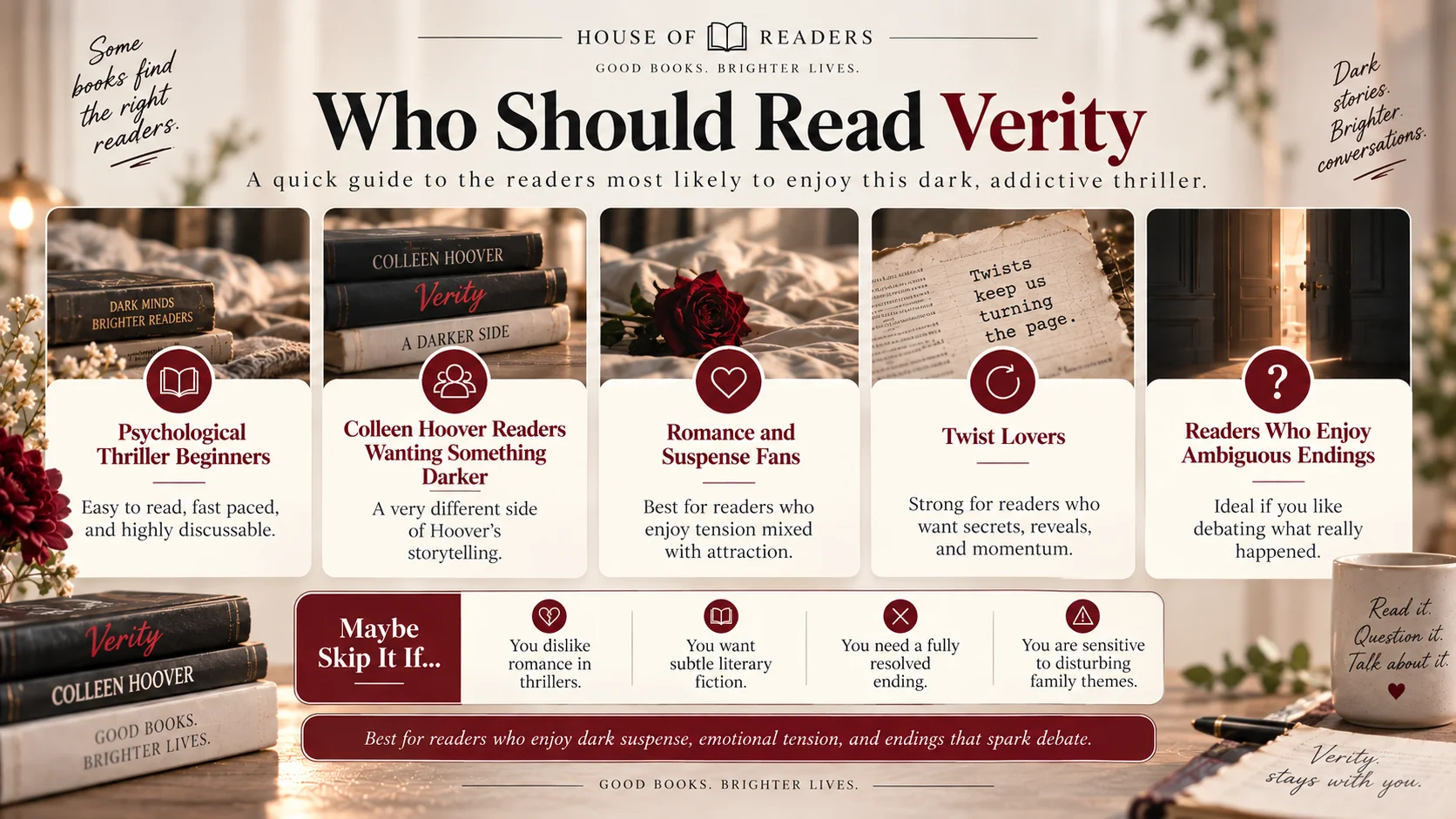
Who Should Read Verity?
I would recommend Verity most strongly to these readers.
Psychological Thriller Beginners
The book is straightforward enough to follow while still delivering the twists, tension, and unreliable information people associate with the genre.
Colleen Hoover Readers Wanting Something Darker
If you have read Hoover’s romance novels and want to see a very different side of her writing, Verity is the obvious place to go.
Readers Who Like Romance Mixed With Suspense
Some people specifically want both.
If you enjoy intense relationships inside darker stories, this combination is likely to work well for you.
Readers Who Love Debating Endings
This may be the perfect audience.
If you finish thrillers and immediately search:
“What did that ending really mean?”
then Verity has a very good chance of working for you.
Readers Who Like Unreliable Narratives
The story constantly asks you to judge the reliability of what you are reading.
Readers who enjoy uncertainty and competing versions of events will probably get more from the book than readers who prefer clear answers.
Who might want to skip it?
Consider another book if you:
- strongly dislike romance in thrillers
- want subtle literary fiction
- need completely resolved endings
- prefer realistic behavior at all times
- are uncomfortable with disturbing family and child-related themes
Is Verity Part of a Series?
No.
Verity is a standalone novel.
You do not need to read any other Colleen Hoover book before it. Hoover’s official site specifically identifies it as a standalone romantic thriller.
That makes it one of the easiest Hoover books to try if psychological suspense interests you more than her connected themes or romance catalog.
Later, we should internally link this article to:
Colleen Hoover Books in Order
and:
Books Like Verity
once those articles are published.
Is There a Verity Movie?
Yes.
A film adaptation of Verity is scheduled for October 2, 2026, according to Colleen Hoover’s official site. The movie stars Anne Hathaway and Dakota Johnson.
This makes the timing of this article particularly useful.
I would add a small update box in WordPress:
Movie update: Verity is being adapted for film, with a theatrical release scheduled for October 2, 2026.
Do not turn this section into a full movie article.
Later we can create a separate:
Verity Movie: Cast, Release Date and What We Know
and internally link the two pieces.
Does Verity Have a Good Ending?
That depends entirely on what you want from a thriller ending.
If you want certainty:
You may be frustrated.
If you want an ending that forces you to reconsider the entire story:
It works very well.
The final information does not simply add another surprise.
It affects the way you interpret earlier events.
And because readers can disagree about what that information means, the story continues after you close the book.
Not literally.
In your head.
That is one of Verity’s biggest strengths.
Final Verdict: Is Verity Worth Reading?
Yes, with one important qualification.
You should read Verity if you want an addictive psychological thriller with romantic tension, uncomfortable secrets, unreliable information, and an ending designed to make you question what you believe.
You should probably choose something else if you want:
- subtle literary prose
- minimal romance
- a completely realistic thriller
- a neatly explained ending
For its intended audience, though, Verity is extremely effective.
It understands curiosity.
It understands discomfort.
And most importantly, it understands that sometimes the best thriller question is not:
“What happened?”
It is:
“What if I believed the wrong person?”
House of Readers Rating
4.25 / 5
Best for
- psychological thriller readers
- dark romance and suspense fans
- readers who like unreliable narratives
- people who enjoy fast books
- readers who love discussing endings
Keep in mind
- disturbing themes
- significant romance and sexual content
- morally complicated characters
- an intentionally ambiguous conclusion