
How to Annotate a Book Without Overdoing It: A Simple System
Many readers want to annotate books to remember more, capture favorite lines, or notice important ideas. Once they start, though, they often mark almost everything or stop every few sentences to take notes. Reading soon feels like homework.
Good annotation should support reading, not interrupt it. This simple system is for casual readers as well as students. You only need a way to mark a passage and a clear reason to return to it.
What Does It Mean to Annotate a Book?
To annotate a book is to leave useful signals for your future self. A mark tells you where to look; a short note tells you why that passage mattered.
- Highlighting or underlining a useful passage
- Writing a short note
- Marking a question
- Noting a personal reaction
- Using tabs or symbols
- Summarizing an important section
You do not need to use every method. A pencil and a few meaningful marks are enough to begin.
The Simple Rule: Only Mark What You Would Want to Find Again
Before marking something, ask: “Would I care about finding this again later?” If the answer is no, keep reading.
An interesting sentence does not automatically need a highlight. Choose passages you would want to revisit, use, question, or enjoy again. This gives each mark a purpose and helps prevent over-annotation.
For example, underline the sentence that explains a useful idea instead of highlighting the whole page that introduces it.
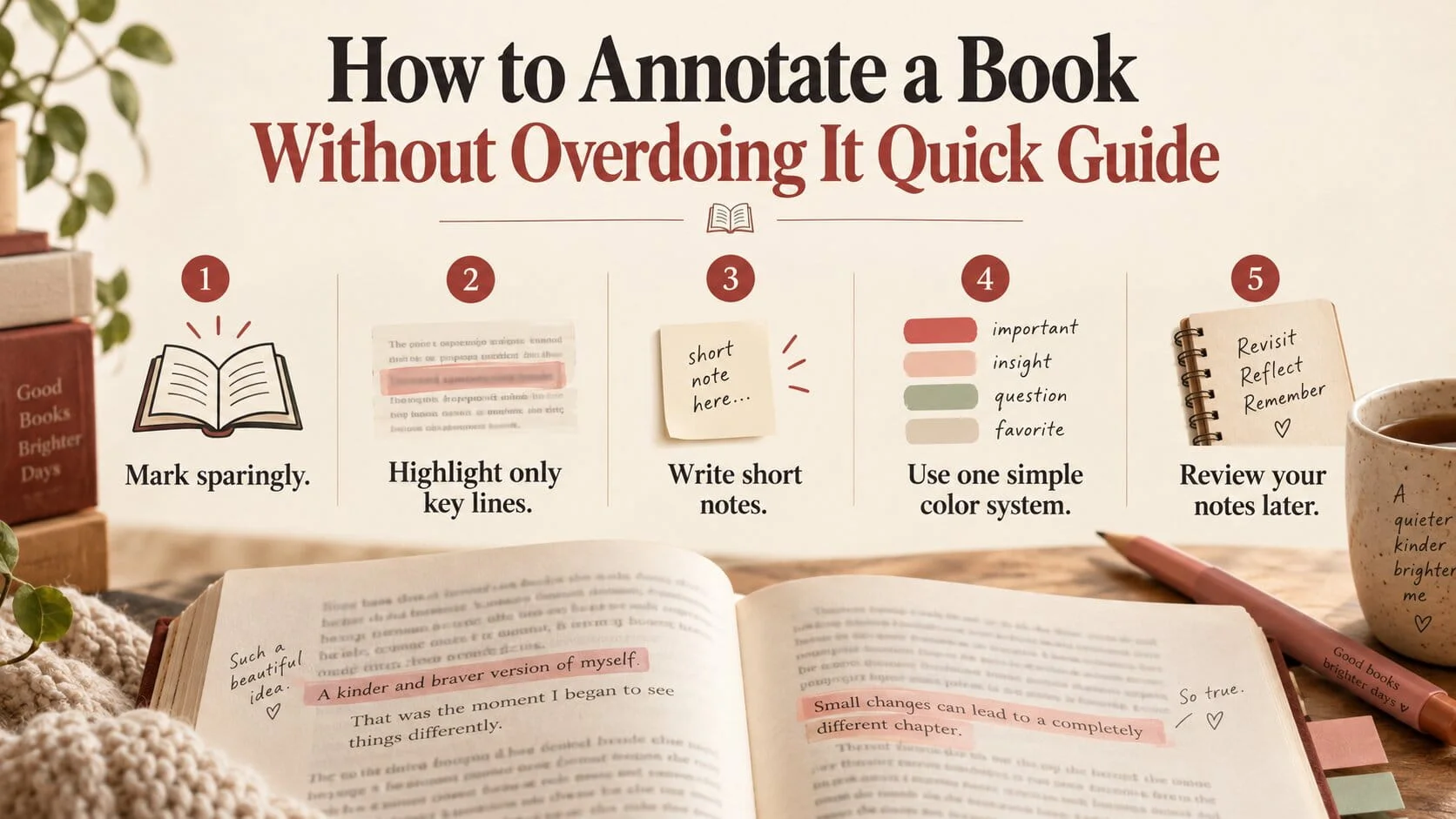
A Simple 4-Part Annotation System
Use four categories and one simple symbol for each. Keep the key on a bookmark if you need a reminder.
1. Important Ideas
Suggested symbol: ★. Use it for an idea or moment that changes your understanding.
- Main arguments
- Useful explanations
- Key discoveries
- Turning points
- Information that changes your understanding
For example, put a star beside the sentence that states the author’s main argument, rather than every sentence supporting it.
2. Questions
Suggested symbol: ?. Mark something you want to understand or return to.
- Something that confuses you
- A detail that makes you curious
- An important point that is unclear
- A moment that makes you predict what happens next
A short note such as “Why this choice?” is enough. You can keep reading and see whether the book answers it.
3. Personal Reactions
Suggested symbol: !. Record your response in a few words.
- “I agree”
- “This surprised me”
- “This reminds me of…”
- “Important”
- “Not convinced”
You do not need to explain every reaction. Add a little context only when your future self would otherwise wonder what you meant.
4. Lines Worth Returning To
Suggested symbol: “. Mark a passage you want to read again or reference later.
- Memorable quotes
- Beautiful writing
- Useful definitions
- Strong observations
- Passages you may want to reference later
Underline the line itself. Add a tab only if finding it quickly will be useful.
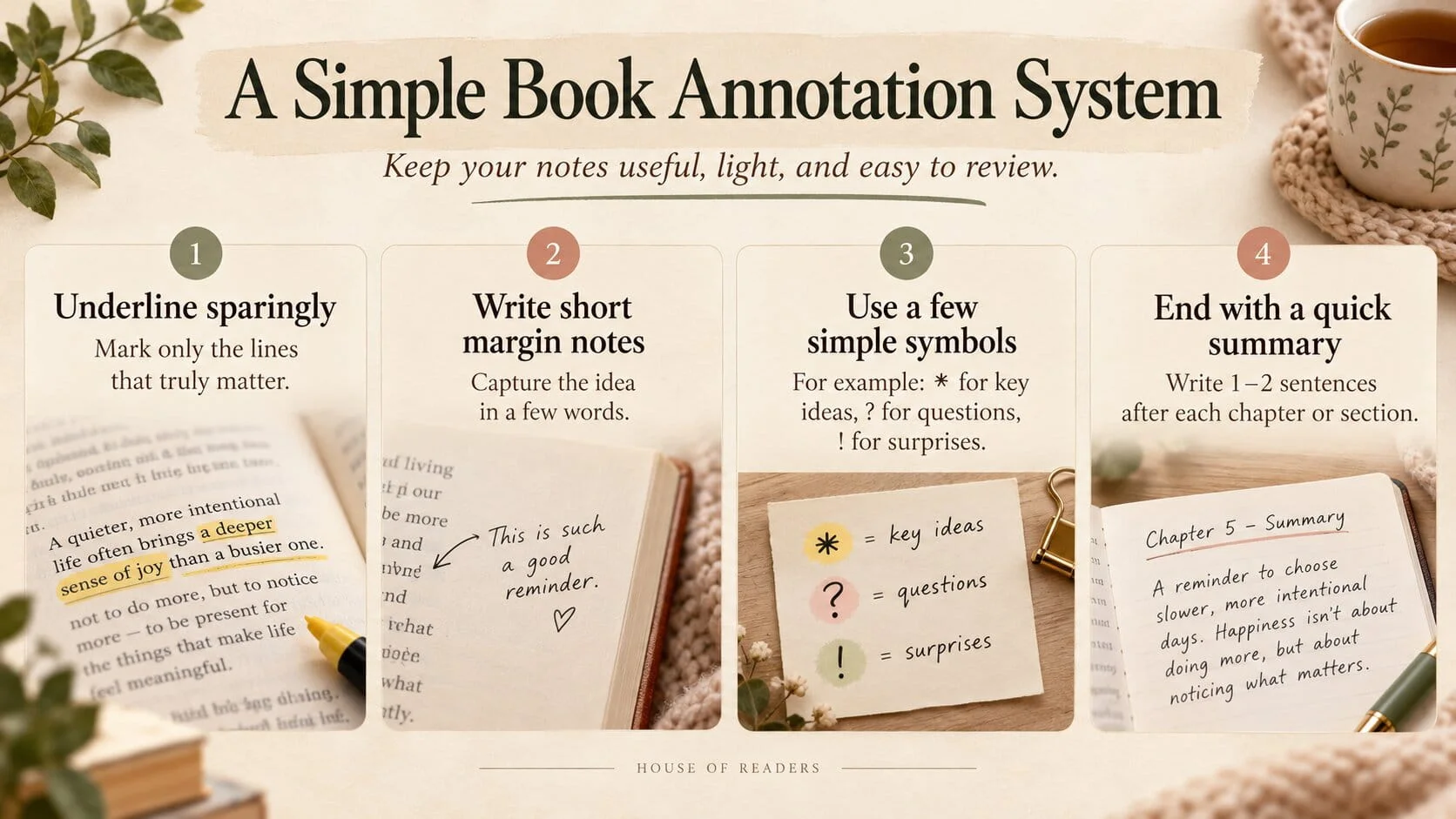
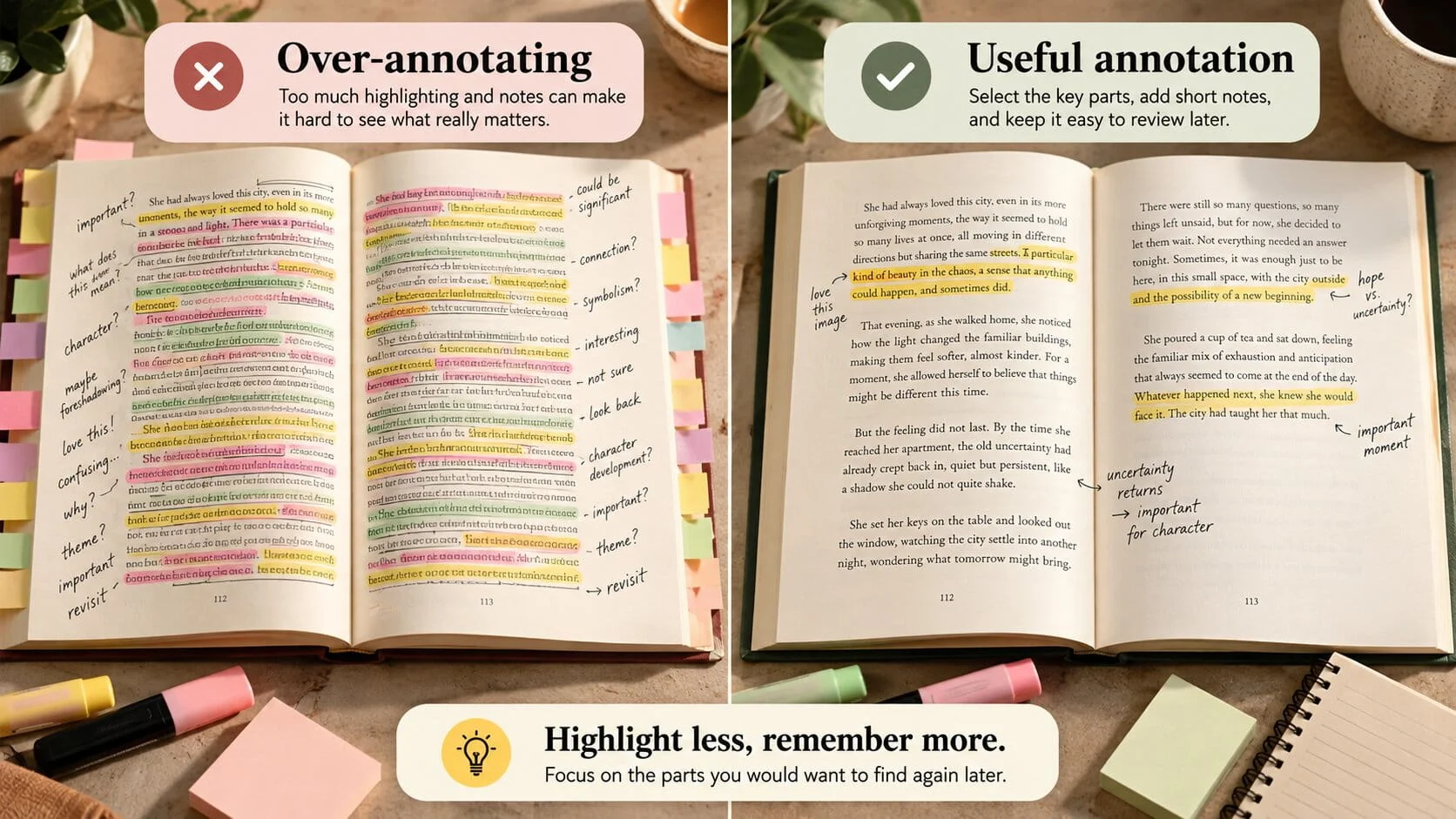
How Much Should You Highlight?
There is no fixed percentage to aim for. If nearly every paragraph is highlighted, the highlights stop helping you distinguish what matters.
- Highlight the smallest useful section.
- A phrase, sentence, or short passage is usually enough.
- Highlight multiple paragraphs only when the full context matters.
Use this quick test: “If you opened the book six months from now, would this highlight still tell you why it mattered?” If it would not, narrow the selection or add a short note.
For example, highlight a definition rather than the entire explanation around it. If the explanation is essential, include just enough of it to preserve the meaning.
Highlight First, Write Less
- Keep reading until the end of the paragraph or idea.
- Decide whether it matters.
- Highlight or underline the key part.
- Add a margin note only if the highlight alone will not make sense later.
Waiting until the idea is complete makes it easier to choose the useful part. You can often leave the highlight to speak for itself instead of stopping to write a summary.
If an example suggests something you want to try, a note like “Use for next project” gives it a purpose without interrupting your reading for long.
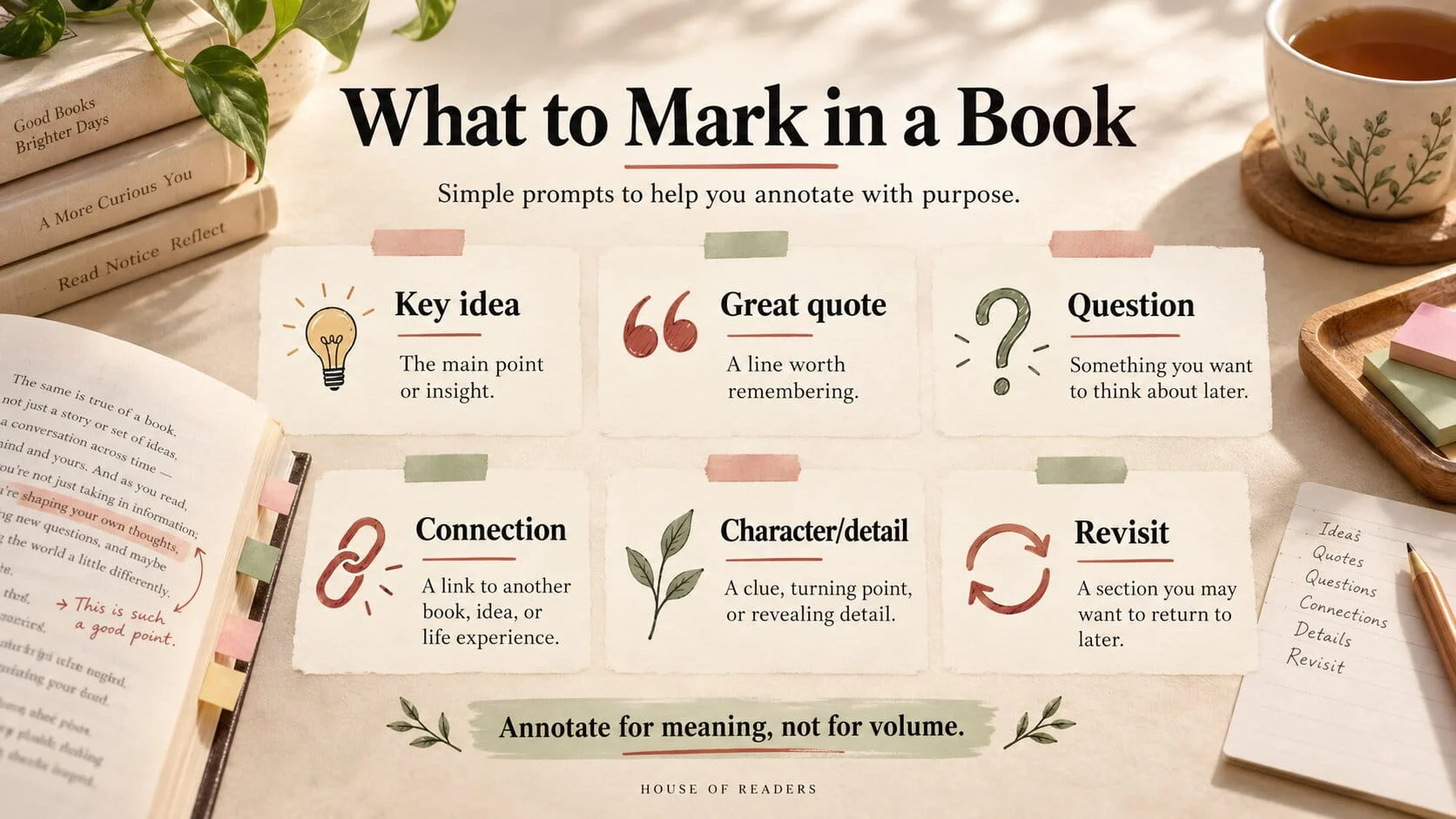
How to Annotate Fiction
With fiction, focus on the reading experience. Notice what changes, what you suspect, and what moves you. You do not need to extract a lesson from every chapter.
Character Changes
Mark moments that reveal motivations, contradictions, relationships, or important decisions. A character refusing help after asking for it might deserve a question mark and “Why pull away?”
Clues and Foreshadowing
In mysteries, thrillers, fantasy, and complex plots, mark details you think may matter later. A repeated object or an unexplained remark can get a simple “?” or “Foreshadowing?” You do not need to solve it immediately.
Themes
Look for recurring ideas such as grief, ambition, identity, power, family, or trust. Write the theme in the margin when a scene adds something to it, rather than marking every mention.
Favorite Writing
- Memorable dialogue
- Strong descriptions
- Emotional passages
- Sentences you simply enjoy
A few favorite lines and one or two observations can be useful. Fiction does not need heavy annotation, especially when you want to stay immersed in the story.
How to Annotate Nonfiction
With nonfiction, focus on what the author is teaching, how the idea is explained, and what you may use. Separate understanding an argument from agreeing with it.
Main Ideas
Ask: what is the author actually arguing or teaching? Mark the clearest statement of the idea. If a chapter has several points, choose the ones you would want to find again.
Evidence and Examples
Mark examples that make the main idea easier to remember. A brief note such as “Example of the rule” can connect an example to its purpose without copying it.
Useful Actions
Mark advice you may actually apply. Add a specific note, such as “Try at next meeting,” if that will help you remember how you intended to use it.
Questions or Disagreements
- Write “I disagree” when you question the argument.
- Write “Check this” when something needs verification.
- Note an idea you want to research further.
Keep the note short and return to it later. You can finish the chapter before deciding whether to pursue the question.
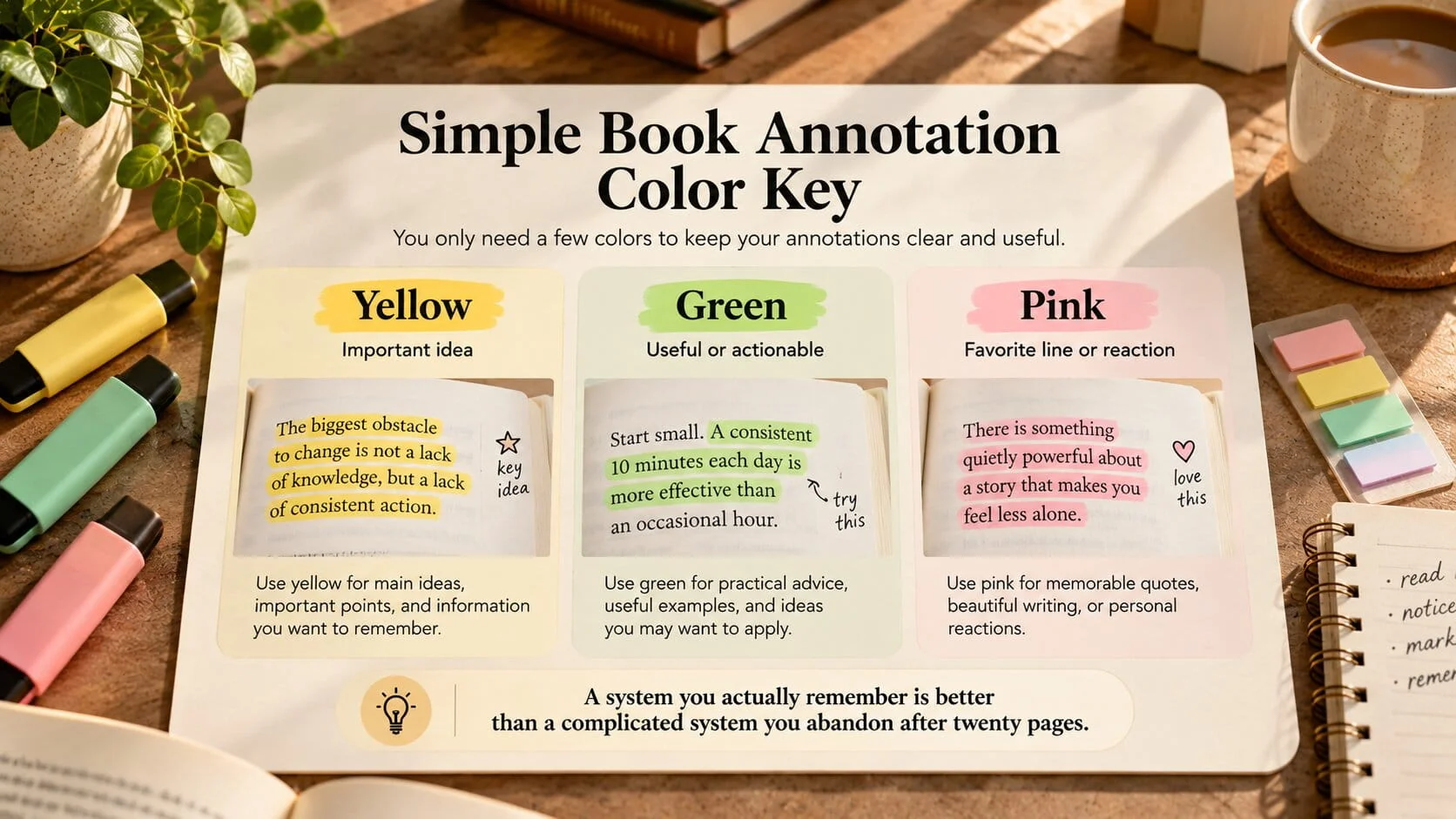
A Simple Color-Coding System
You do not need five or six colors. If colors help you scan your marks, try this small key:
- Yellow: Important idea
- Green: Something useful or actionable
- Pink: Favorite line or emotional reaction
Optionally, use one pen or pencil for margin notes. If you only have one highlighter, use it for every category and let the symbols show the difference.
Too many colors give you more decisions to make and a key to keep checking. A system you actually remember is better than a complicated system you abandon after twenty pages.
Should You Write in the Margins?
Yes, if you are comfortable writing in the book. A good margin note adds a reason, a question, or a connection that the marked text does not explain on its own.
Good margin notes:
- “Why?”
- “Important”
- “Connects to chapter 3”
- “I disagree”
- “Foreshadowing?”
- “Use this later”
Notes that usually add too much work:
- Rewriting the entire paragraph
- Putting long summaries beside every page
- Repeating what the text already says
If you do not want to write directly in the book, use sticky notes or a separate notebook with page numbers. For a borrowed book, keep your notes separate.
How to Annotate Without Ruining Your Reading Flow
- Finish the sentence or paragraph before stopping.
- Keep notes to a few words when possible.
- Do not annotate during every reading session.
- Skip annotation when the story has strong momentum.
- Return later if something feels important.
- Accept that you will miss things.
Annotation is optional. You do not have to annotate to be a serious reader. If marking passages is distracting you from the book, read a chapter without making any marks and return only to what still stands out.
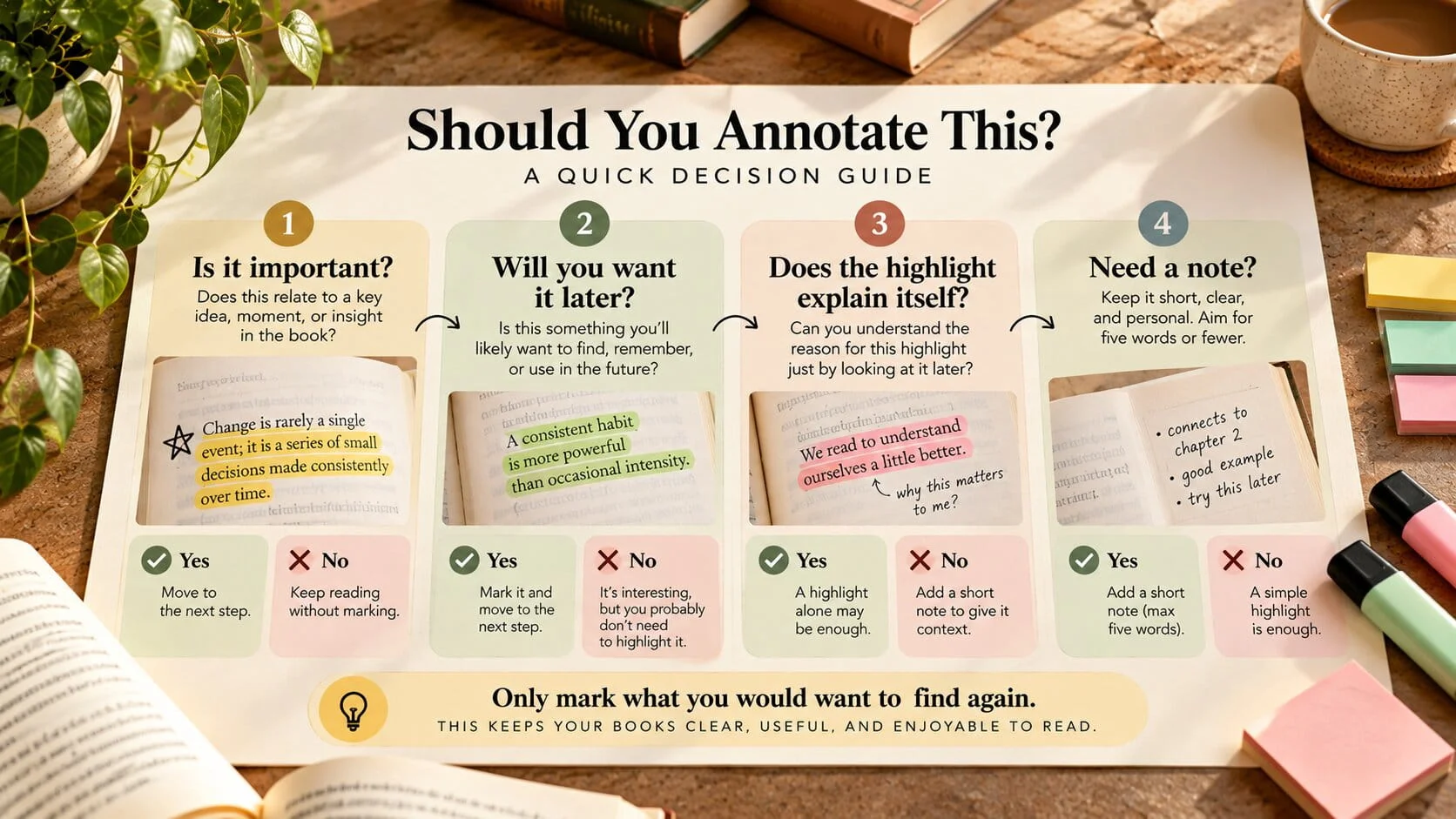
A 30-Second Annotation Decision
When you want to mark something, follow this short decision tree:
- Is this important? If no, keep reading. If yes, ask the next question.
- Will I want to find it again? If no, keep reading. If yes, mark the smallest useful part.
- Does the highlight explain itself? If yes, continue reading. If no, consider a note.
- Can I add a note in five words or fewer? If yes, write it and move on. If no, save the longer thought for the chapter ending.
A no to either of the first two questions is a reason to leave the passage unmarked. For example, an amusing aside you will not revisit can stay unmarked; a useful definition can get a highlight without a note.
Want to remember more of what you read?
Pair this annotation system with our guide on How to Remember What You Read for a simple way to retain more without turning reading into homework.
Common Book Annotation Mistakes
Highlighting Everything
When everything looks important, nothing stands out on a return visit. Finish the paragraph, then choose the sentence or phrase that carries the idea.
Creating Too Many Categories
Keep the system simple enough to remember without checking a long key. If two categories keep overlapping, combine them or use one of the four symbols.
Writing Full Summaries on Every Page
Page-by-page summaries can become more work than reading. If a summary helps, save one short version for the chapter ending.
Stopping Too Often
Constant interruptions can make it harder to follow the argument or story. Finish an idea before marking it, and leave longer thoughts until a natural pause.
Trying to Make Every Page Look Perfect
Annotation is a tool, not a design project. An uneven underline or a plain pencil note is fine if it helps you find the passage later.
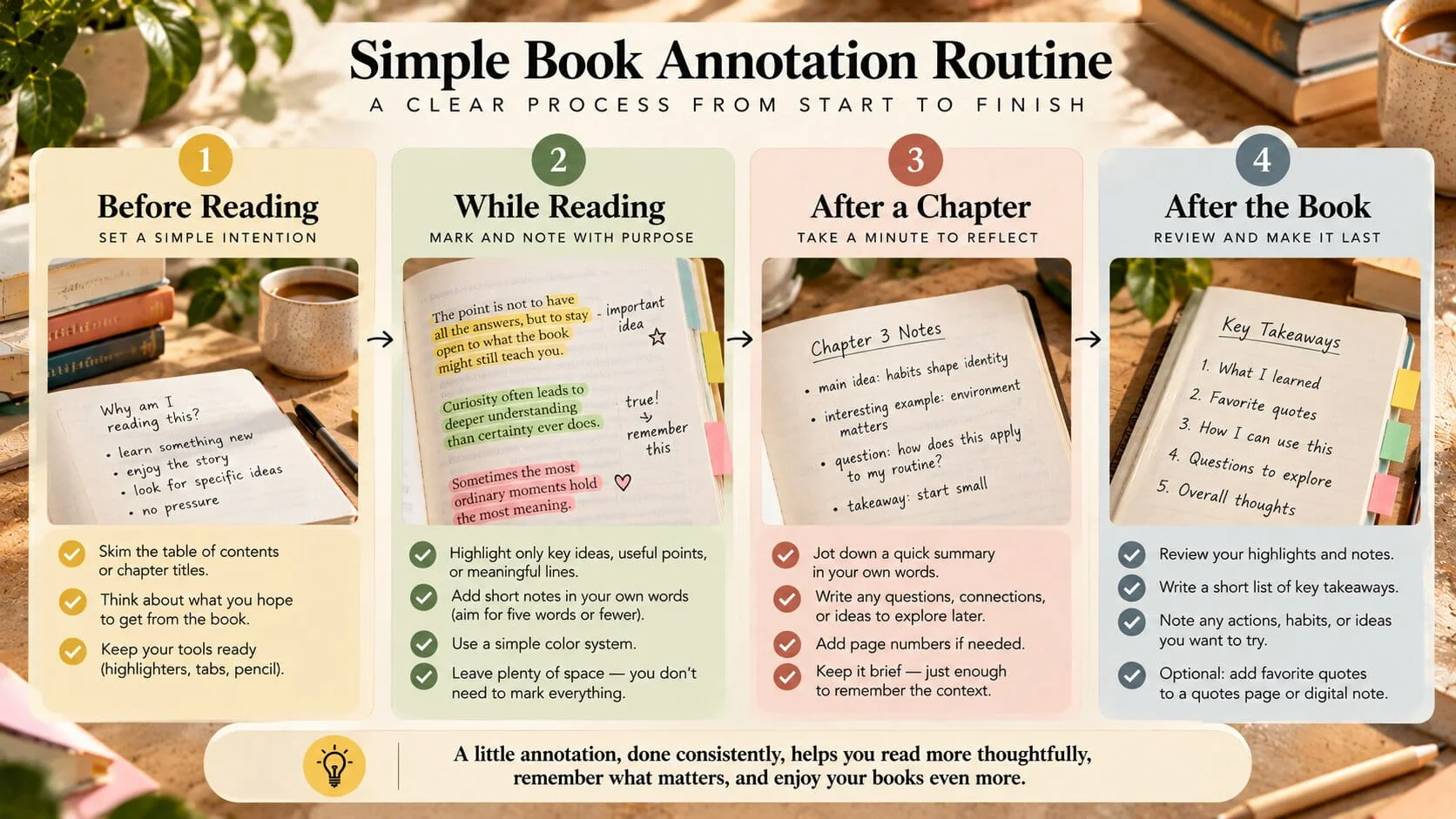
A Simple Annotation Routine You Can Use Today
Before reading:
- Choose one pen or pencil.
- Choose one highlighter.
- Keep a few tabs nearby if you use them.
While reading:
- Mark only important ideas, questions, reactions, and lines worth revisiting.
- Keep margin notes short.
After a chapter:
- Pause for 30 seconds.
- Ask what mattered most.
- Optionally write one short summary.
After finishing the book:
- Review your strongest marks.
- Note the 3 to 5 ideas, moments, or quotes you want to remember.
Final Thoughts
The goal of annotation is not to mark the most pages. The goal is to make the important parts easier to find, understand, and remember.
A few meaningful notes are usually more useful than a book covered in highlights. Start with one highlighter and a few symbols, then adapt the system as you discover which marks you actually return to.
Keep improving your reading system
If you want to make reading easier to maintain, explore our guides on How to Build a Reading Habit That Lasts and How to Read Faster Without Losing Comprehension.
Frequently Asked Questions
Mark only what you would want to find again. Use simple symbols for important ideas, questions, reactions, and favorite lines, and keep notes short.
Highlight the smallest passage that preserves an important idea, useful explanation, question, or favorite line. Finish the paragraph before deciding.
Ask whether you will want to find the passage later. If not, leave it unmarked. Choose a phrase or sentence instead of highlighting the whole paragraph.
Yes, if you own the book and are comfortable doing so. Use sticky notes or a separate notebook for borrowed books or books you want to keep unmarked.
Notice character changes, clues, recurring themes, and favorite writing. A few short marks are enough; keep reading when the story has momentum.
Mark main ideas, helpful evidence or examples, advice you may apply, and questions or disagreements. Add a short note when your reason is unclear.
One color is enough. If you prefer a key, try yellow for important ideas, green for useful actions, and pink for favorite lines or reactions.
Annotations give you useful prompts to revisit. After finishing, review your strongest marks and choose 3 to 5 ideas or moments to remember instead of relying on highlighting alone.
Yes. Use sticky notes, tabs, or a separate notebook with page numbers. In an ebook, use its highlight and note tools.