You pick up a 300-page book and wonder:
How long is this actually going to take me to finish?
The answer can range from a few hours to several weeks.
A fast reader working through an easy thriller may finish quickly.
Someone reading dense nonfiction for 20 minutes each evening may need much longer.
So when asking how long does it take to read a book, page count alone is not enough.
Your reading time depends on:
- how many words the book contains
- how quickly you normally read
- how difficult the writing is
- whether you are reading for enjoyment or study
- how often you stop to take notes
- how much uninterrupted reading time you have
- whether the book keeps you engaged
This guide gives you a practical way to estimate your reading time without turning reading into a race.
Quick Answer: How Long Does It Take to Read a Book?
For many ordinary novels and general nonfiction books, a rough reading-time estimate can look like this:
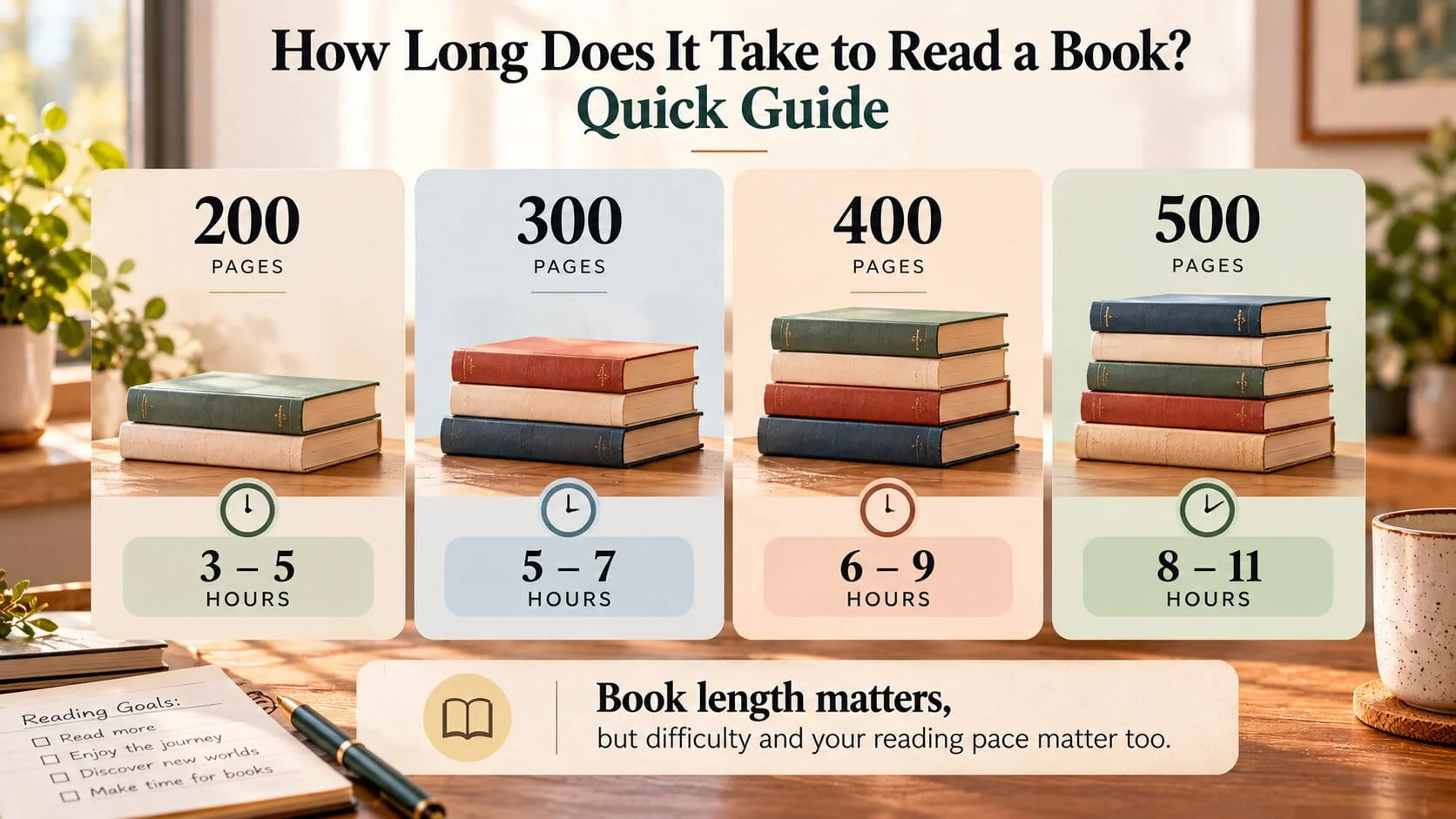
200-page book: around 3 to 5 hours
300-page book: around 5 to 7 hours
400-page book: around 6 to 9 hours
500-page book: around 8 to 11 hours
These are only planning estimates.
A light novel may take less time.
Dense nonfiction, academic material, difficult classics, or books that require frequent rereading can take considerably longer.
Your own reading speed is much more useful than any universal average.
The Simple Reading Time Formula
If you know the approximate word count of a book, the basic calculation is:
Reading time in minutes = Total words ÷ Your reading speed in words per minute
Then:
Reading time in hours = Reading time in minutes ÷ 60
For example:
A book contains approximately 75,000 words.
You read at around 250 words per minute.
75,000 ÷ 250 = 300 minutes.
300 ÷ 60 = 5 hours.
So your estimated reading time would be about 5 hours.
That does not mean you need to sit down and read for five hours continuously.
It simply gives you a useful estimate of the total reading time.
What If You Only Know the Page Count?
Page count is less precise because books differ in:
- page size
- font size
- margins
- spacing
- illustrations
- formatting
- number of words per page
Still, it can be useful for planning.
For a normal novel or general nonfiction book, you can use a rough estimate of 250 to 300 words per page.
That means a 300-page book might contain roughly:
75,000 to 90,000 words
If you read around 250 words per minute, that could mean approximately:
5 to 6 hours of actual reading time
Again, treat this as an estimate rather than a promise.
Reading Time by Book Length
A practical way to think about reading time is by book size.
The estimates below assume relatively comfortable reading rather than highly technical study.
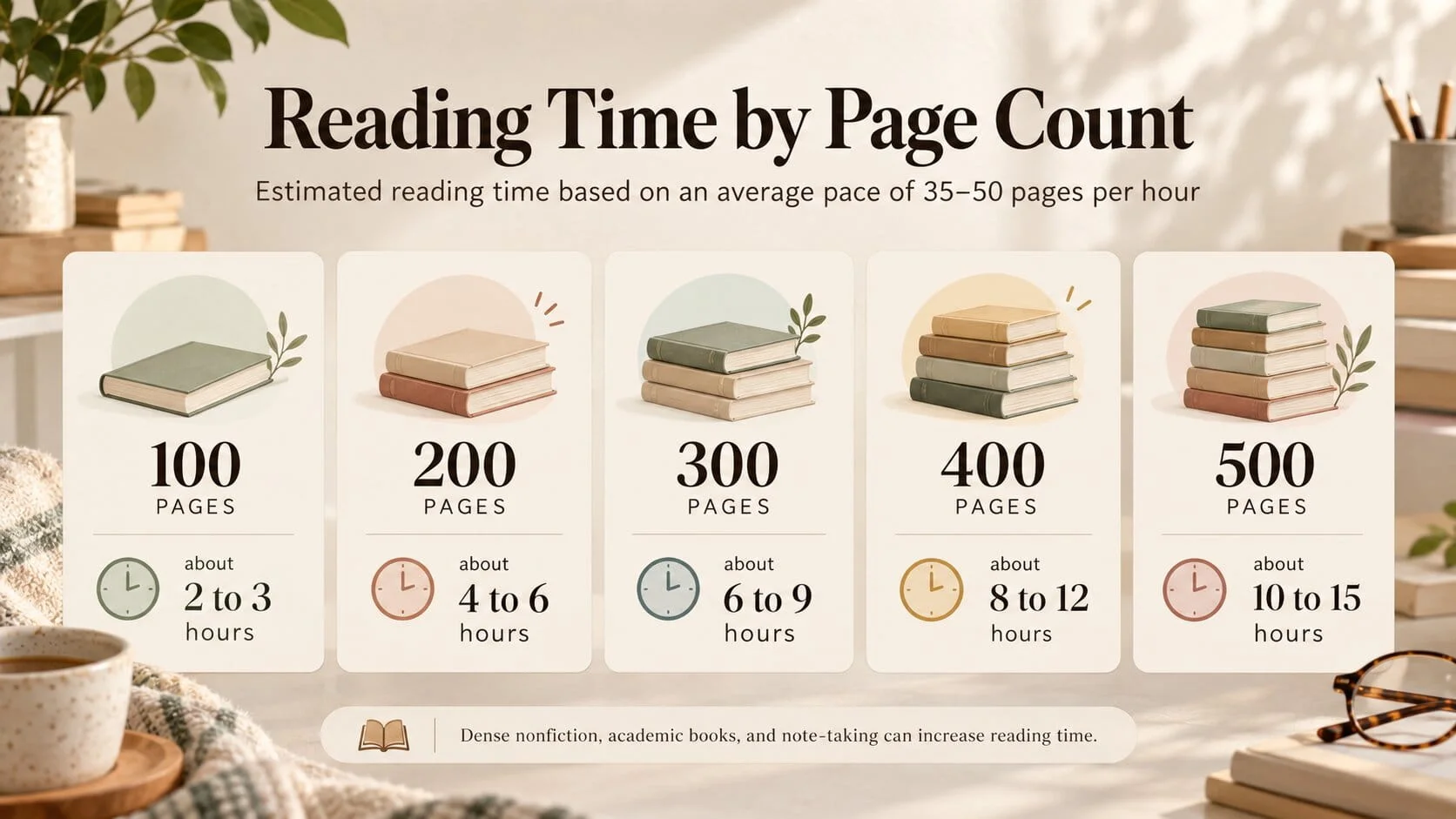
100 Pages
A short 100-page book may take roughly:
1.5 to 2.5 hours
This can often be finished in:
- one long sitting
- two evenings
- several short reading sessions
200 Pages
A 200-page book may take approximately:
3 to 5 hours
At 30 minutes per day, that could mean roughly:
6 to 10 days
300 Pages
A typical 300-page book may take approximately:
5 to 7 hours
At 30 minutes per day:
around 10 to 14 days
At one hour per day:
around 5 to 7 days
400 Pages
A 400-page book may take around:
6 to 9 hours
At 30 minutes per day:
around 12 to 18 days
At one hour per day:
around 6 to 9 days
500 Pages
A 500-page book may require around:
8 to 11 hours
At 30 minutes per day:
around 16 to 22 days
At one hour per day:
around 8 to 11 days
700 Pages or More
Large books become much harder to estimate from page count alone.
A readable fantasy novel may move quickly despite its size.
A dense 700-page history book may take dramatically longer.
For long books, calculating from actual word count and your own pace becomes more useful.
How Long Does It Take to Read 100 Pages?
For many readers, 100 pages may take somewhere around 1.5 to 3 hours.
But that changes considerably based on the book.
One hundred pages of a fast thriller may pass quickly.
One hundred pages of technical nonfiction may require:
- highlighting
- rereading
- note-taking
- looking up unfamiliar ideas
- breaks for reflection
The number of pages is the same.
The mental work is not.
How Long Does It Take to Read 200 Pages?
A 200-page book is relatively manageable for most reading schedules.
If it takes around 3 to 5 hours total, you could finish it with:
20 minutes per day: roughly 9 to 15 days
30 minutes per day: roughly 6 to 10 days
60 minutes per day: roughly 3 to 5 days
That is why even a small daily reading habit can move you through books surprisingly steadily.
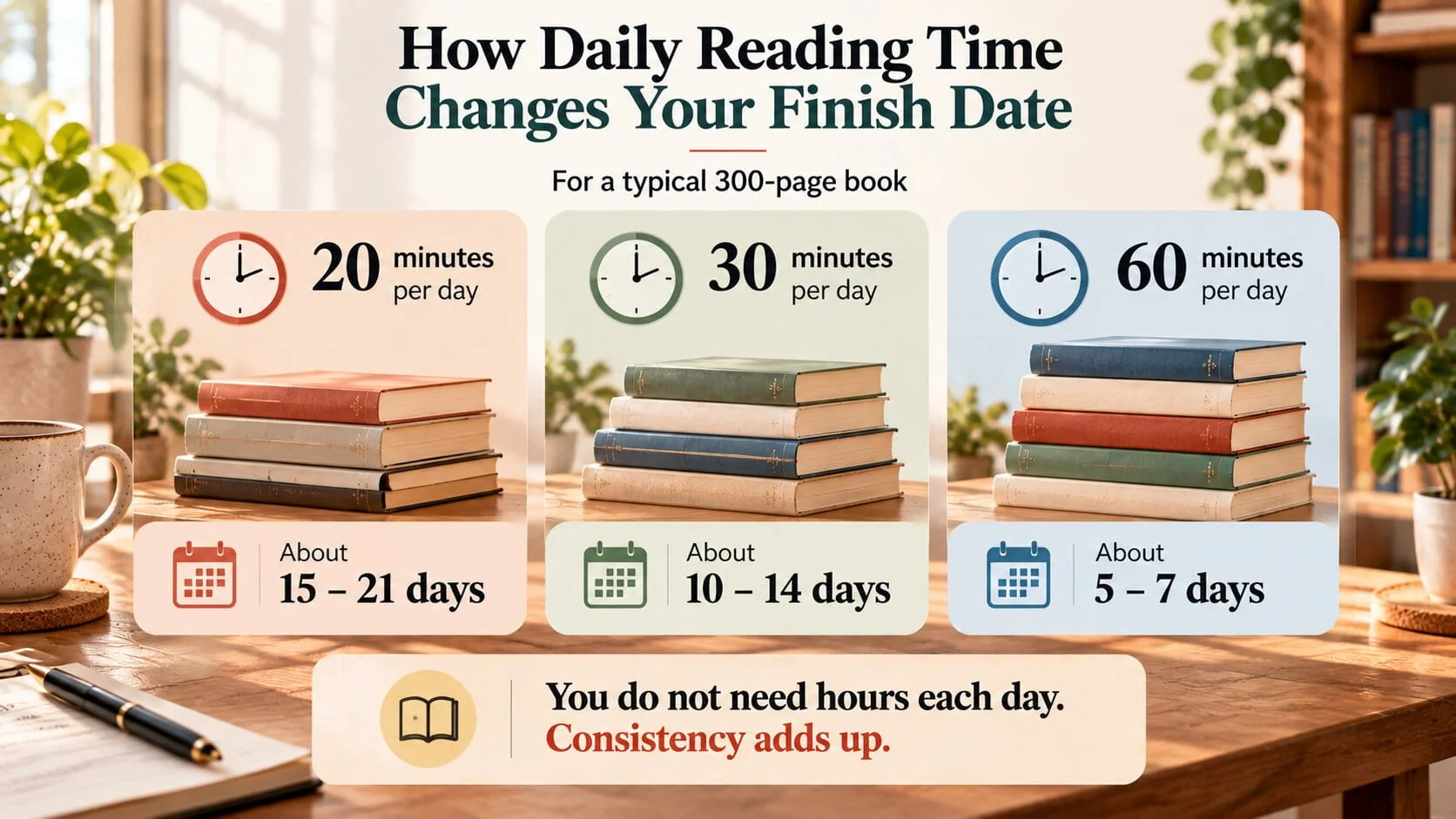
How Long Does It Take to Read 300 Pages?
A 300-page book is a useful benchmark because many popular novels fall somewhere around this general size.
If the book requires about 5 to 7 hours:
20 minutes per day: roughly 15 to 21 days
30 minutes per day: roughly 10 to 14 days
60 minutes per day: roughly 5 to 7 days
You do not need hours of free time every day.
Consistency often matters more.
How Long Does It Take to Read 400 Pages?
For a 400-page book requiring roughly 6 to 9 hours:
20 minutes per day: roughly 18 to 27 days
30 minutes per day: roughly 12 to 18 days
60 minutes per day: roughly 6 to 9 days
This is where daily reading time starts making a noticeable difference.
How Long Does It Take to Read 500 Pages?
A 500-page book may look intimidating.
But if it takes around 8 to 11 hours in total:
20 minutes per day: roughly 24 to 33 days
30 minutes per day: roughly 16 to 22 days
60 minutes per day: roughly 8 to 11 days
Thinking in daily sessions can make a long book feel much more manageable.
Your Reading Speed Changes Everything
Two people can read the same book and finish hours apart.
For illustration:
At 200 words per minute
A 75,000-word book takes:
about 6 hours 15 minutes
At 250 words per minute
The same book takes:
about 5 hours
At 300 words per minute
The same book takes:
about 4 hours 10 minutes
This is why generic reading-time estimates should never be treated as exact.
You are estimating your time, not somebody else’s.
If you want to become more efficient without simply rushing through pages, read our guide on how to read faster without losing comprehension.
How Do You Measure Your Reading Speed?
You do not need a complicated test.
Choose a normal book that is representative of what you usually read.
Then:
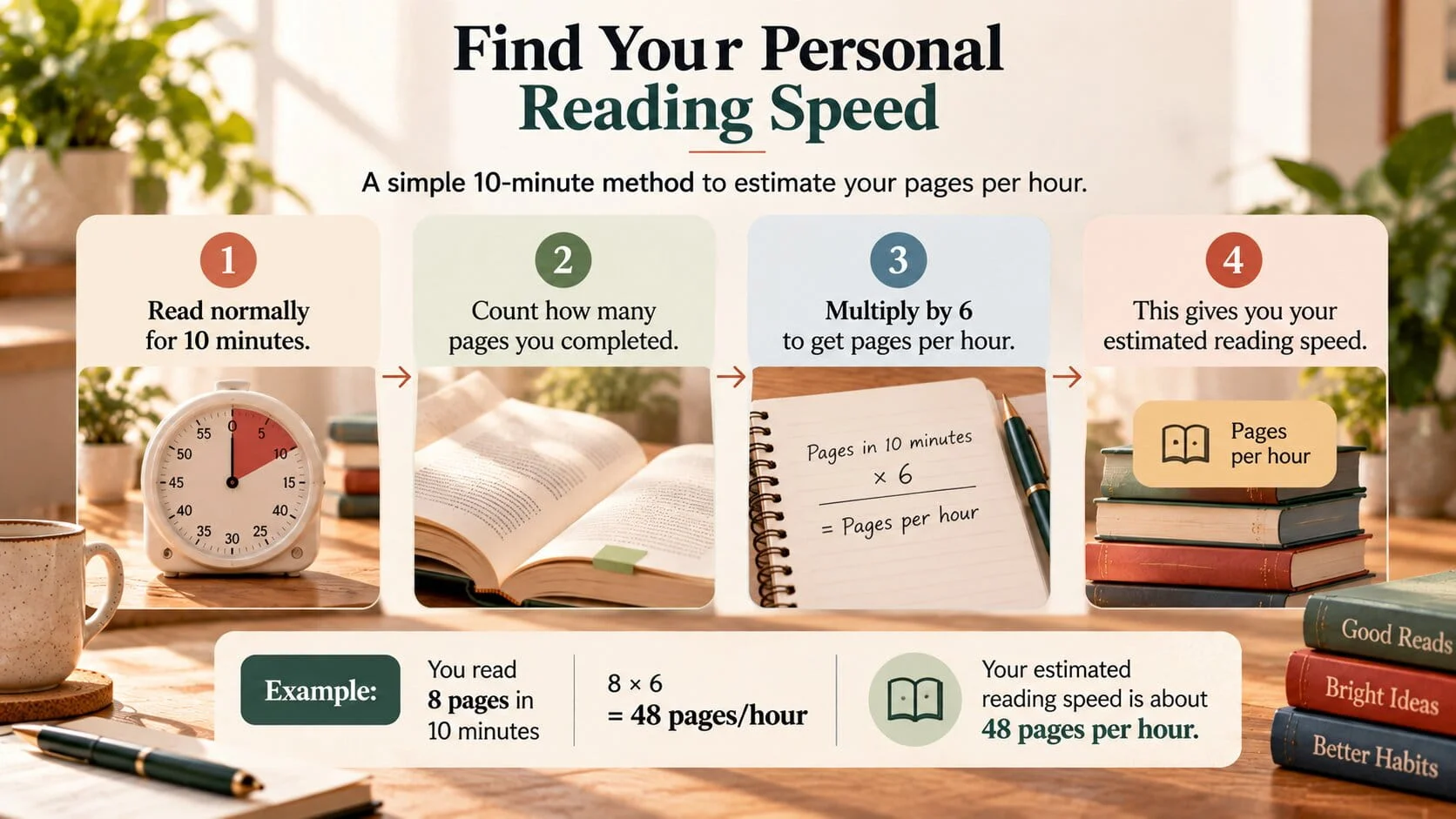
- Set a timer for 10 minutes.
- Read at your normal comfortable pace.
- Count how many pages you completed.
- Repeat this on another section if you want a better estimate.
- Use your average pages per 10 minutes to predict longer sessions.
For example:
If you read 8 pages in 10 minutes, that is:
48 pages per hour
A 300-page book at that pace would require approximately:
6 hours 15 minutes
This method is often easier than calculating words per minute.
Pages Per Hour Can Be More Useful Than Words Per Minute
Words per minute is useful for formulas.
But everyday readers may find pages per hour easier.
You can quickly estimate:
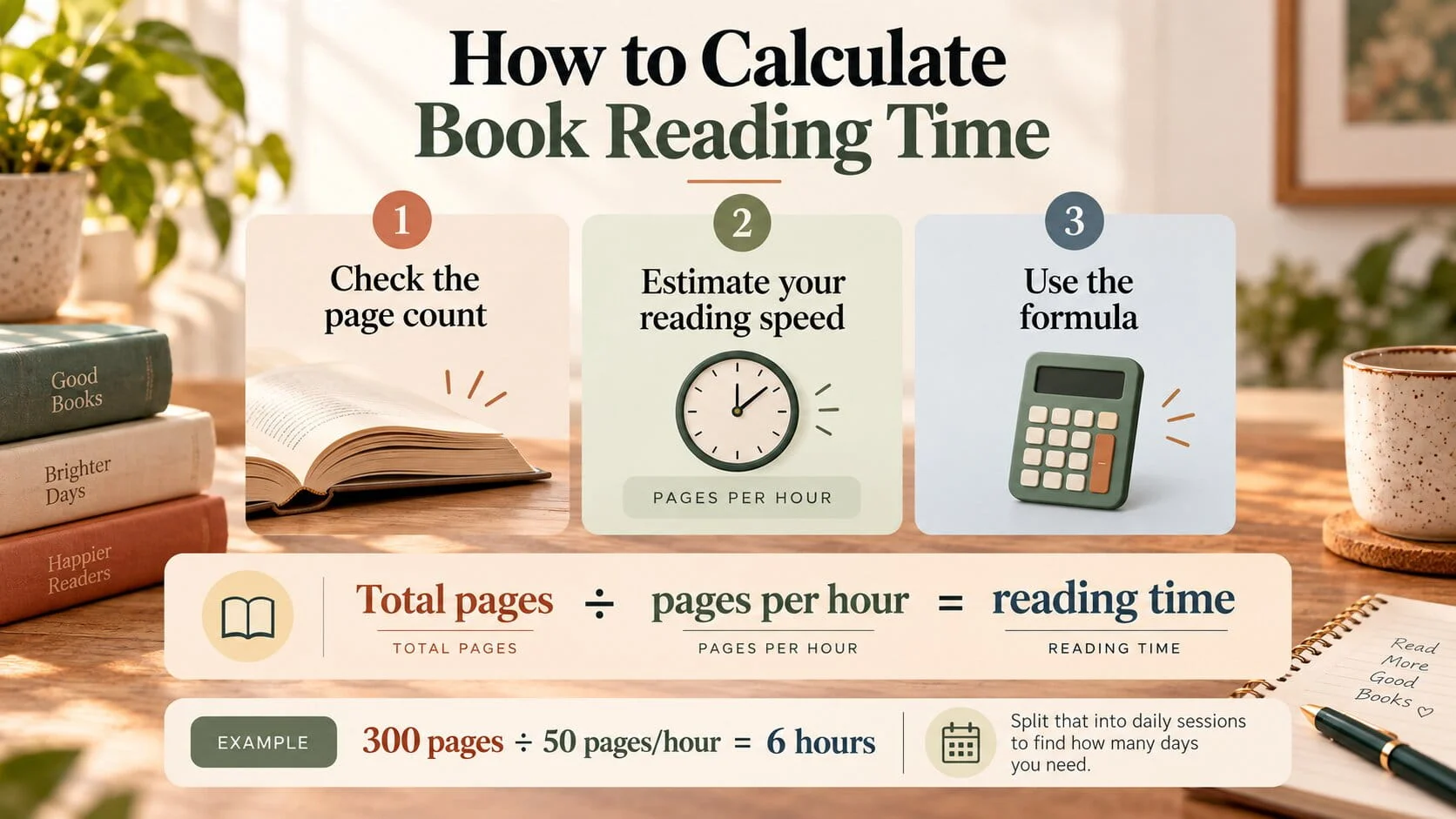
Book pages ÷ pages per hour = approximate reading hours
Example:
300-page book ÷ 40 pages per hour = 7.5 hours
Or:
300-page book ÷ 50 pages per hour = 6 hours
This number will still change from book to book, but it gives you a personal benchmark.
Fiction Usually Reads Differently From Nonfiction
A page is not a fixed unit of difficulty.
Fiction
Many novels encourage continuous reading.
Dialogue can move quickly.
Once you become immersed, you may read for long stretches without stopping.
Thrillers can feel especially fast because short chapters and cliffhangers encourage you to continue.
General Nonfiction
Nonfiction may require more pauses.
You may stop to:
- think about an idea
- highlight something
- reread a paragraph
- connect it with something you already know
Technical or Academic Books
These can take much longer.
A single page may contain enough information to require several minutes of attention.
You may also:
- take notes
- solve examples
- examine diagrams
- review previous sections
So a 250-page textbook can easily take longer than a 500-page thriller.
Difficult Writing Slows Reading Down
Some books naturally require a slower pace.
This can happen because of:
- unfamiliar vocabulary
- long sentences
- complicated structure
- unfamiliar historical context
- large casts of characters
- dense ideas
- unusual writing styles
Slowing down is not failure.
Sometimes slower reading is simply the correct way to read the material.
Interest Also Affects Reading Time
A book you love can make two hours disappear.
A book you are forcing yourself to finish can make twenty pages feel endless.
Interest affects:
- concentration
- rereading
- distraction
- session length
- willingness to return to the book
That makes engagement one of the least measurable but most important factors in reading time.
If you have stopped enjoying reading generally, the problem may be a reading slump rather than your speed. Our guide on how to get out of a reading slump can help.
Does Taking Notes Make Reading Slower?
Yes, usually.
But that does not mean it makes reading less effective.
If you are reading for:
- school
- research
- professional development
- detailed learning
- book discussion
then taking extra time may be exactly what you need.
Finishing a book quickly is not useful if you cannot remember the information that mattered.
Reading time should match your goal.
Does Rereading Count?
Of course.
Reading is not a competition based on how efficiently you move from page one to the final page.
You may reread because:
- an idea was difficult
- you became distracted
- a paragraph was beautifully written
- you missed an important clue
- you need information for study
That time is part of your actual reading experience.
How Long Does It Take to Read a Book in One Sitting?
It depends on length and pace.
A short book might reasonably be completed in one sitting.
A typical 300-page novel may require somewhere around 5 to 7 hours of actual reading for many readers.
That is technically possible in a day, but it is not necessarily comfortable or desirable.
You may enjoy the book more by dividing it into:
- two long sessions
- several one-hour sessions
- a week of shorter sessions
Finishing quickly is optional.
How Many Pages Can You Read in 30 Minutes?
This varies substantially.
If you read:
30 pages per hour: about 15 pages in 30 minutes
40 pages per hour: about 20 pages
50 pages per hour: about 25 pages
60 pages per hour: about 30 pages
The useful number is whatever you consistently achieve with good comprehension.
How Many Pages Can You Read in One Hour?
Depending on reading speed and book difficulty, you might read somewhere around:
30 to 60 pages in one hour
But do not use that range to judge yourself.
Dense material can reduce that number considerably.
A fast-moving novel may increase it.
Your personal benchmark is more useful than a general range.
How Many Books Can You Read in a Month?
Daily reading time matters more than ambition.
Suppose an average book requires around 6 hours of your actual reading time.
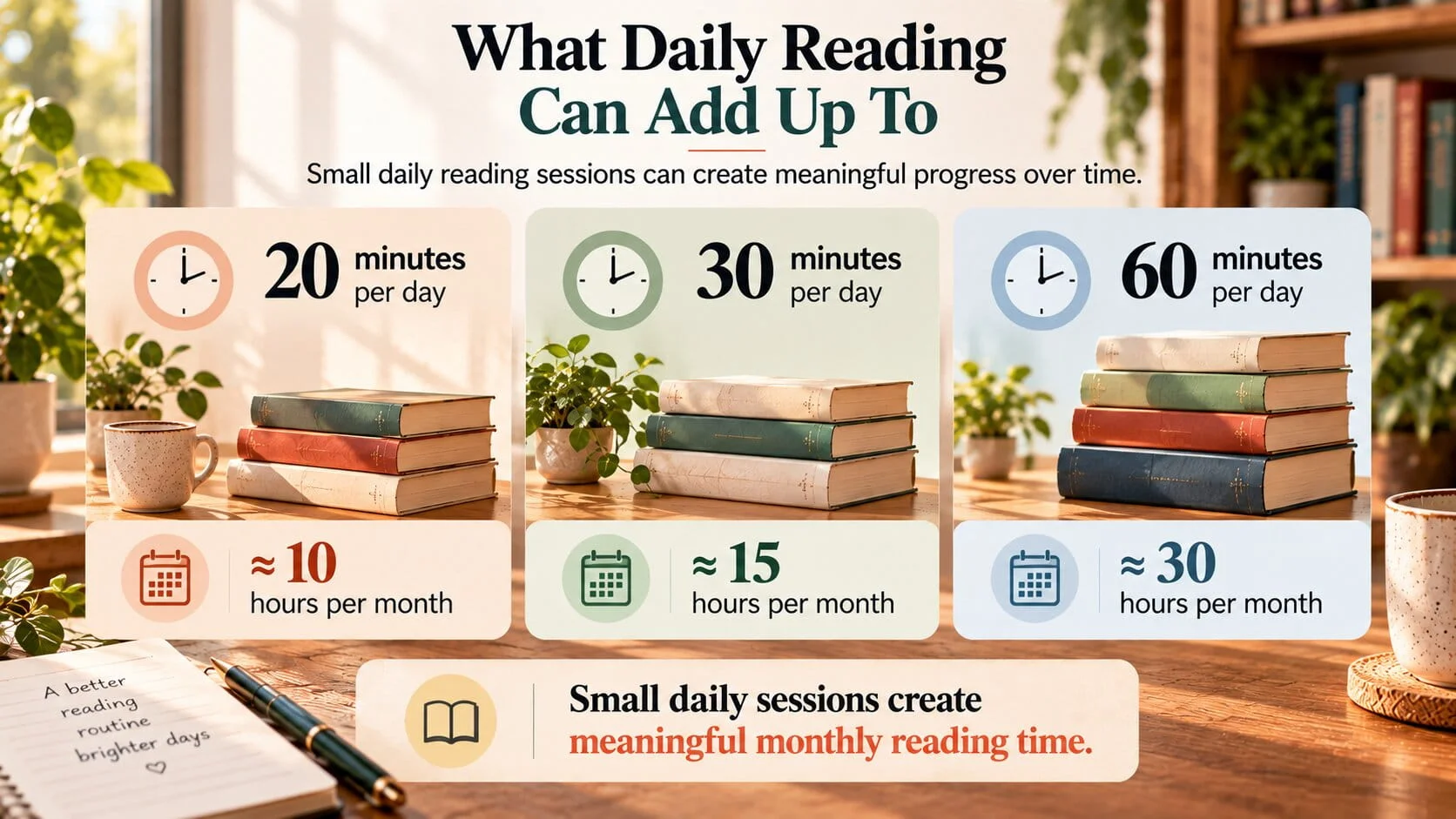
If you read:
20 minutes per day
That gives you about 10 hours per month.
Potentially around:
1 to 2 books
At:
30 minutes per day
You get about 15 hours per month.
Potentially:
2 books, sometimes more
At:
60 minutes per day
You get about 30 hours.
Potentially:
around 4 to 5 six-hour books
These are only planning examples.
Actual book length and reading difficulty will change the result.
A Better Way to Set a Reading Deadline
Instead of saying:
I need to finish this book this week.
Work backward.
Suppose:
- book length = 300 pages
- your pace = 40 pages per hour
- estimated reading time = 7.5 hours
- deadline = 10 days
You need:
45 minutes per day
Or calculate by pages:
300 pages ÷ 10 days = 30 pages per day
Both methods work.
Choose whichever feels easier to track.
Reading by Time vs Reading by Pages
There are two simple ways to build a reading habit.
Read by time
Examples:
- 20 minutes every morning
- 30 minutes before bed
- one hour every Sunday afternoon
This works well when you want consistency.
Read by pages
Examples:
- 20 pages per day
- one chapter per evening
- 50 pages every weekend
This works well when finishing a book by a particular date matters.
Neither is inherently better.
Some readers even combine them:
Read for 30 minutes or one chapter, whichever comes first.
Do Audiobooks Change Reading Time?
Yes.
Audiobook duration is already measured in hours, so estimating completion is straightforward.
A 10-hour audiobook takes approximately:
10 hours at 1× speed
At a faster playback setting, the theoretical playback time decreases.
However, listening faster is only useful if you can still comfortably follow the book.
Audiobooks also create opportunities to read during time that visual reading cannot use, such as driving or walking.
If you are deciding which format fits different situations, see our guide to audiobooks vs ebooks vs physical books.
Do Ebooks Change Reading Time?
The underlying book is still the same.
However, ebooks can change how you interact with it.
Features such as:
- adjustable text
- search
- built-in dictionary
- highlighting
- portable access
may make some parts of the reading process easier.
Page counts can also behave differently because changing font size or layout changes what appears on a screen.
For ebooks, percentage completed or estimated time remaining may be more useful than traditional page count.
A Practical Reading Time Planner
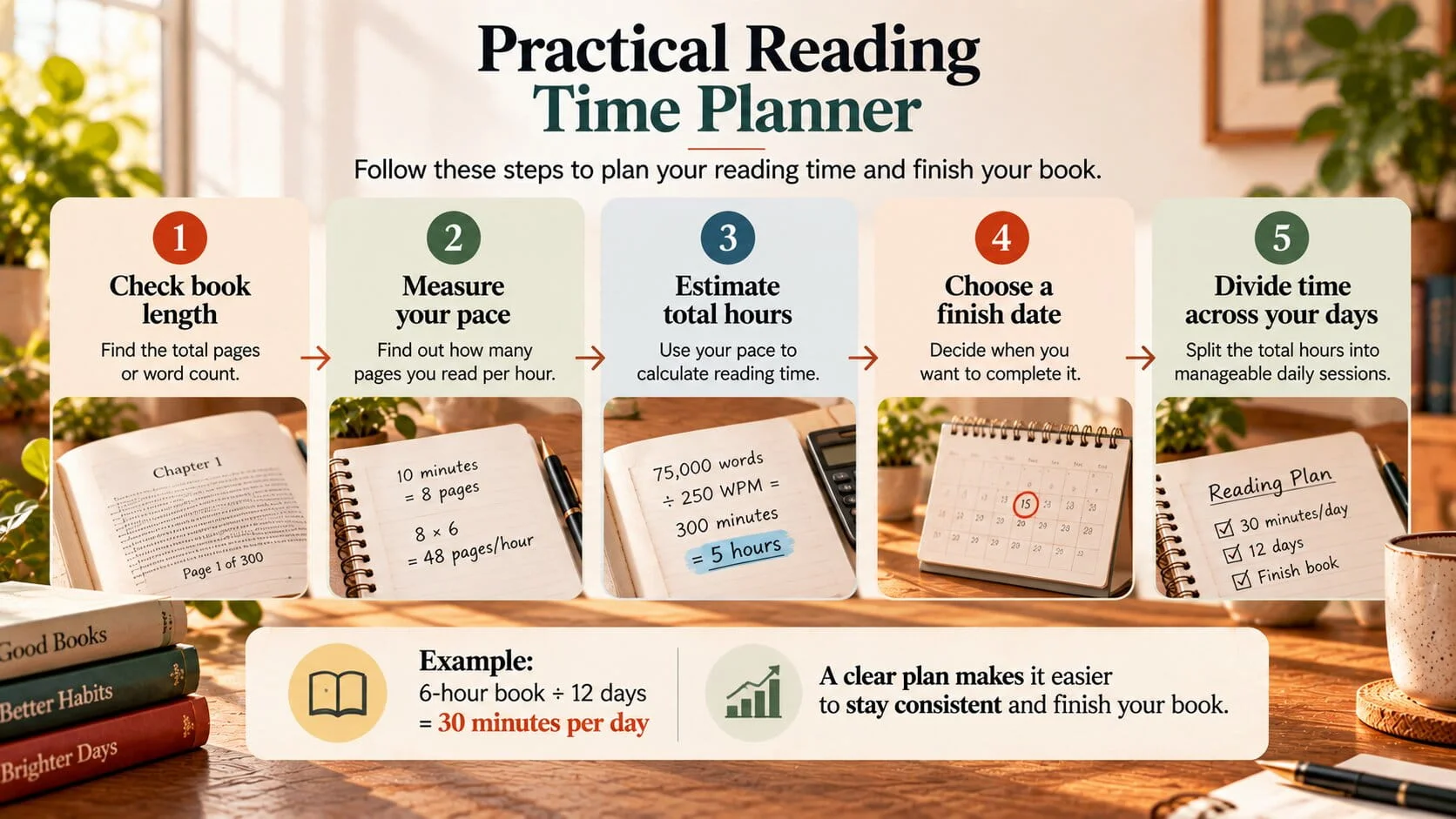
Use this simple process whenever you start a book.
Step 1: Check the length
Use page count or word count.
Step 2: Estimate your pace
Use your normal pages per hour or words per minute.
Step 3: Estimate total hours
Calculate the approximate reading time.
Step 4: Decide when you want to finish
Maybe:
- one week
- two weeks
- by the end of the month
Step 5: Divide the reading time across those days
Example:
Estimated total = 6 hours
Goal = finish in 12 days
6 hours ÷ 12 = 30 minutes per day
That is much more useful than simply telling yourself to “read more.”
Final Thoughts
So, how long does it take to read a book?
There is no single number.
A short, accessible book may take only a couple of hours.
A typical novel may require several hours.
A long or difficult book may need ten, twenty, or many more hours depending on how deeply you are reading it.
The most useful approach is:
- Estimate the book’s length.
- Learn your comfortable reading pace.
- Account for the difficulty of the material.
- Decide how much time you can realistically read each day.
- Use the estimate for planning, not pressure.
You do not need to become the fastest reader.
You need a reading pace that lets you understand the book, enjoy the experience, and return consistently.