
You finish a wonderful book, certain you will remember what made it special. A few weeks later, you can recall the broad plot, but the small moments you loved have slipped away.
A reading journal gives those thoughts somewhere to land. It records books, personal reactions, memorable moments, and the reading preferences you notice along the way.
You do not need artistic skills, an expensive notebook, or complicated layouts. If you are wondering how to start a reading journal, begin with one book and a few honest sentences. This guide will help you set up something useful in minutes.
What Is a Reading Journal?
A reading journal is a personal record of what you read and how you respond to it. It might be a notebook of reflections or a collection of notes on your phone.
- Reading journal: combines book details with your thoughts, questions, and reactions.
- Reading log: lists books you have read, usually with authors and finish dates.
- Reading tracker: follows progress, such as pages, sessions, or books finished.
- To-be-read (TBR) list: holds books you might like to read next.
You can keep all four in one place. A log and a few short reflections are enough for a first journal.
Why Start a Reading Journal?
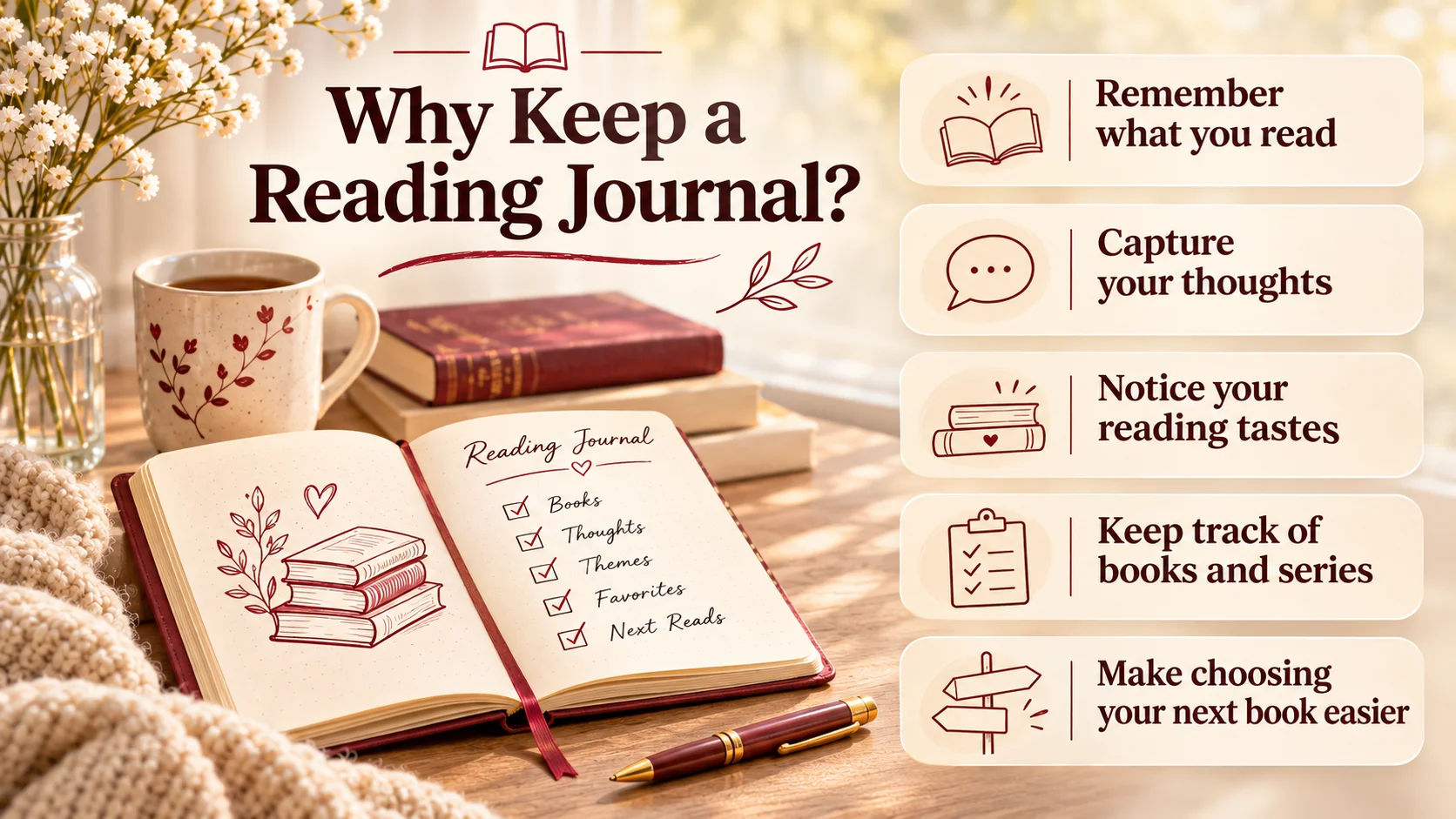
- Remember what you have read. A title and a short note give you a record to revisit. For more practical approaches, explore how to remember what you read.
- Capture thoughts before they fade. Record a question, surprising scene, or reaction while it is fresh.
- Discover your preferences. Repeated notes about dialogue or pacing can reveal what you enjoy.
- Keep track of books and series. Record the last volume finished so you know where to pick up.
- Choose future books more easily. Look back at what worked before adding another recommendation.
- Enjoy your reading journey. Revisit an old entry and see how your interests have changed.
A journal gives you something to consult. It does not need to improve your memory or increase your reading total to be worthwhile.
How to Start a Reading Journal in 6 Simple Steps
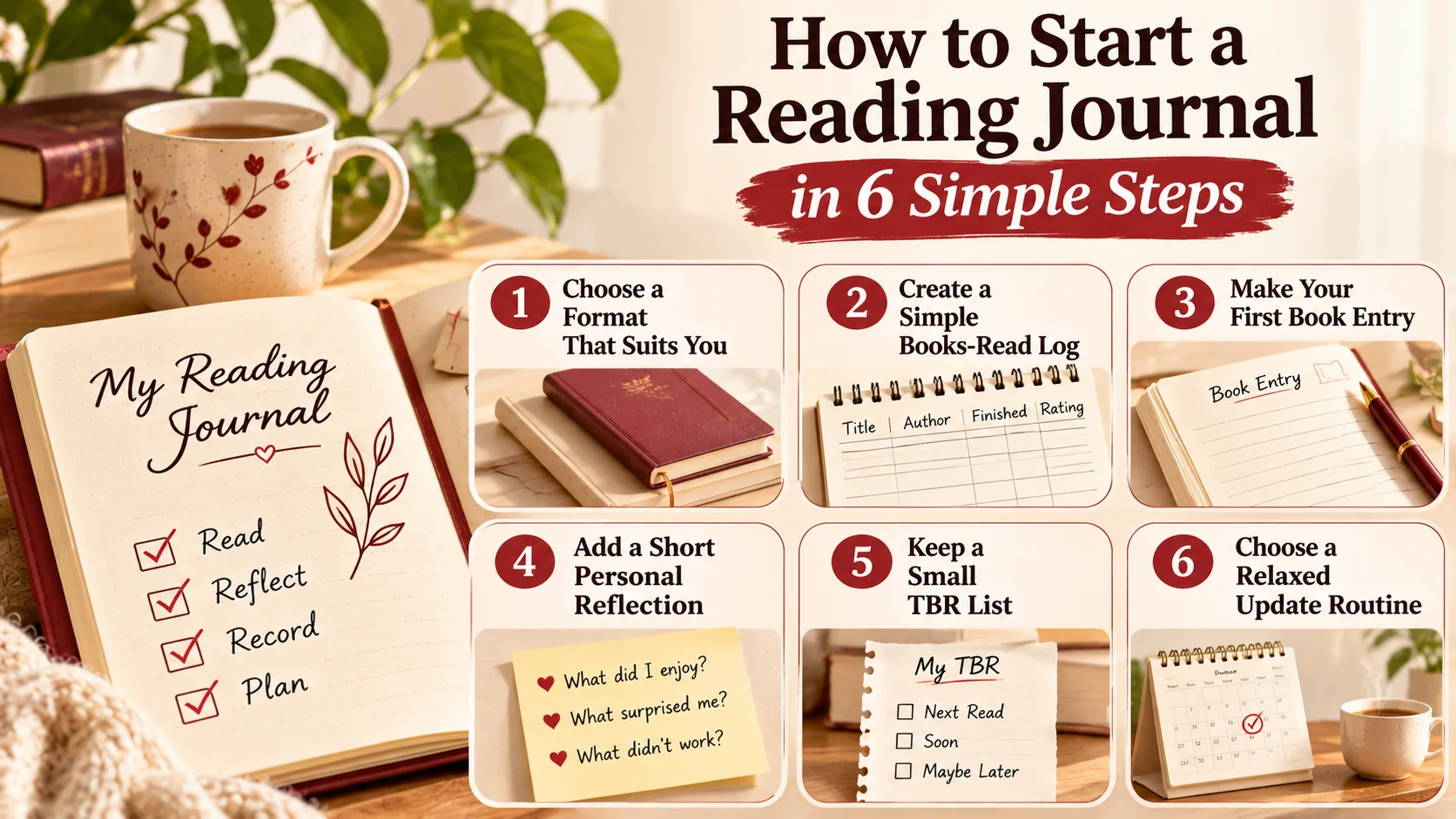
Step 1: Choose a Format That Suits You
- Physical notebook: useful if you enjoy handwriting and want a quiet place away from screens. Any spare notebook works.
- Digital journal or notes app: convenient if your phone is usually nearby. Searchable notes help you find titles and phrases later.
- Printable pages or a simple spreadsheet: helpful if you prefer repeatable fields. Print a basic layout you already have, or use spreadsheet columns for your log and a notes cell for reflections.
The best format is the one you will actually use. You can switch later without copying every old entry.
Step 2: Create a Simple Reading Log
Begin with book title, author, date finished, an optional rating, and a one-sentence reaction. Leave room for another entry rather than designing the whole year.
Compact example using a fictional book and author:
The Lantern at Willow Quay | Mara Ellery | November 1, 2026 | 4/5, optional | A gentle mystery whose seaside friendships stayed with me.
Step 3: Make Your First Book Entry
Choose a recently finished book. Write its title and author at the top of a page or note, add the finish date if you know it, and leave space for a few thoughts. Use the same title as your log so the two are easy to match.
You can skip the separate log if one entry feels simpler. You do not need a plot summary before recording your reaction.
Step 4: Write a Short Personal Reflection
Answer just one or two questions. Specific observations are more useful than trying to sound like a professional reviewer.
- What did I enjoy most?
- What surprised me?
- What did I dislike?
- Which character stayed with me?
- Would I recommend this book?
For example, “I liked the friendship between the neighbors, but the middle chapters felt slow” tells your future self more than “It was good.” Mark spoilers clearly if you include them.
Step 5: Add a Small TBR List
Write down three to five books you would like to read next. Add a few words about why each appeals to you, such as a short mystery for a busy week. Treat the list as options rather than commitments.
If choosing feels difficult, use your journal notes alongside our guide to choosing what book to read next.
Step 6: Choose an Easy Journaling Routine
Try a two-minute entry after finishing a book, or a quick weekly check-in. Daily journaling is unnecessary unless you enjoy it.
Use a simple cue: “When I finish a book, I write one thing I want to remember.” On busy days, that single sentence counts.
What Should You Include in a Reading Journal?
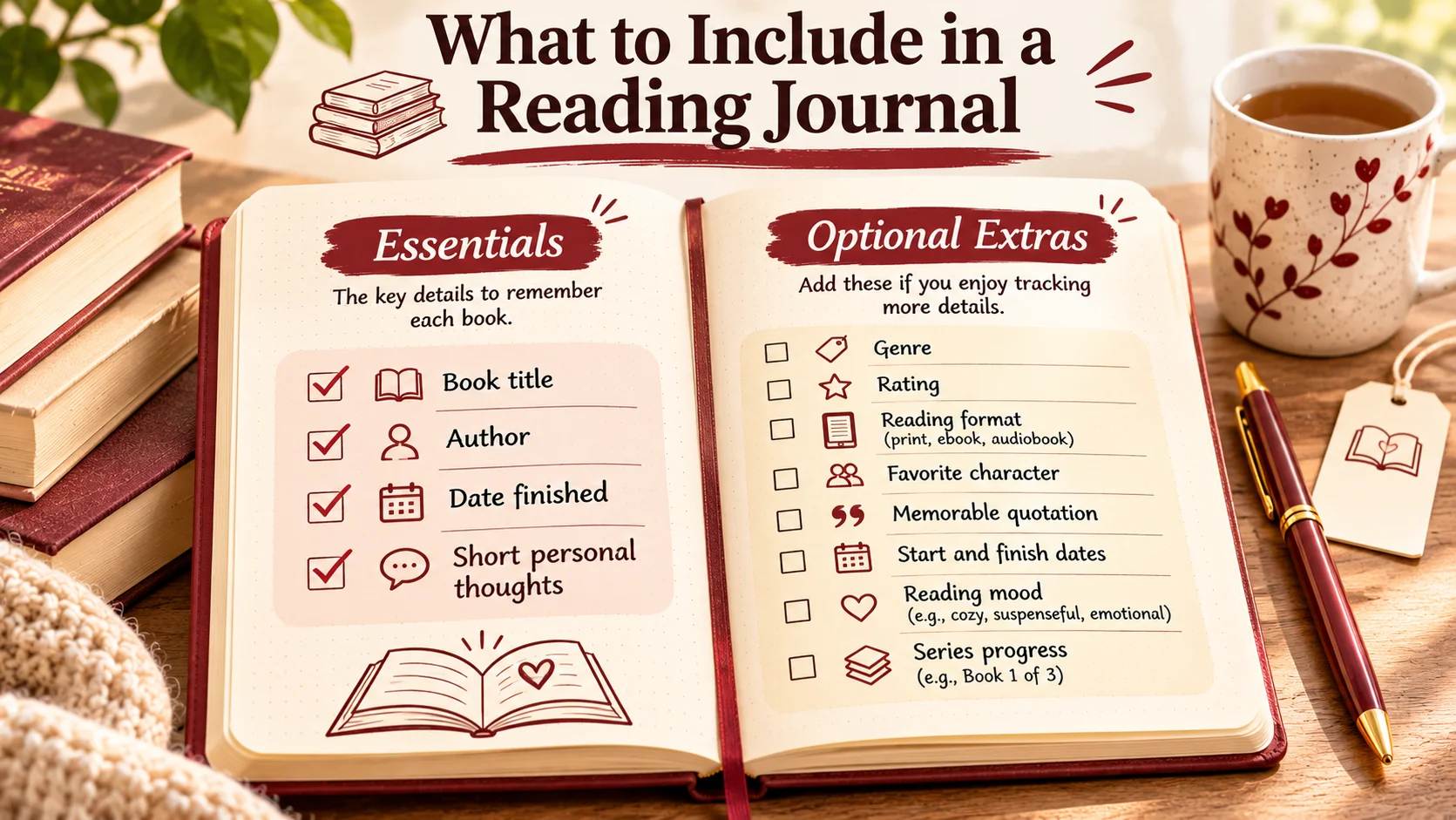
Start with the essentials and add optional details only when they help you. Leave fields blank rather than turning an entry into an assignment.
| Priority | What to record | How to use it |
|---|---|---|
| Essential starting point | Book title and author | Identify the book clearly, especially when titles are similar. |
| Essential starting point | Date finished | An approximate month is fine if you cannot recall the day. |
| Essential starting point | Short personal thoughts | Write one to three sentences about your response. |
| Optional | Genre and reading format | Note mystery, memoir, print, ebook, or audiobook when useful. |
| Optional | Rating | Use stars, words, or no rating at all. |
| Optional | Favorite character | Add a reason the character stayed with you. |
| Optional | Memorable quotation | Include the page or chapter so you can find it again. |
| Optional | Start and finish dates | Track both if you enjoy seeing how long a book takes. |
| Optional | Reading mood | Record whether you wanted comfort, suspense, or a challenge. |
| Optional | Series progress | Note the last volume finished and which comes next. |
After a few entries, remove fields you keep skipping. Personalize gradually instead of deciding everything before you start.
A Simple Reading Journal Template You Can Copy
Copy these labels into a notebook or digital app. Every field is optional except the information you want to remember; delete anything that feels unnecessary.
Book Title:
Author:
Genre:
Date Started:
Date Finished:
My Rating:
This Book in One Sentence:
What I Enjoyed:
What Didn’t Work for Me:
One Thing I’ll Remember:
Who I’d Recommend It To:
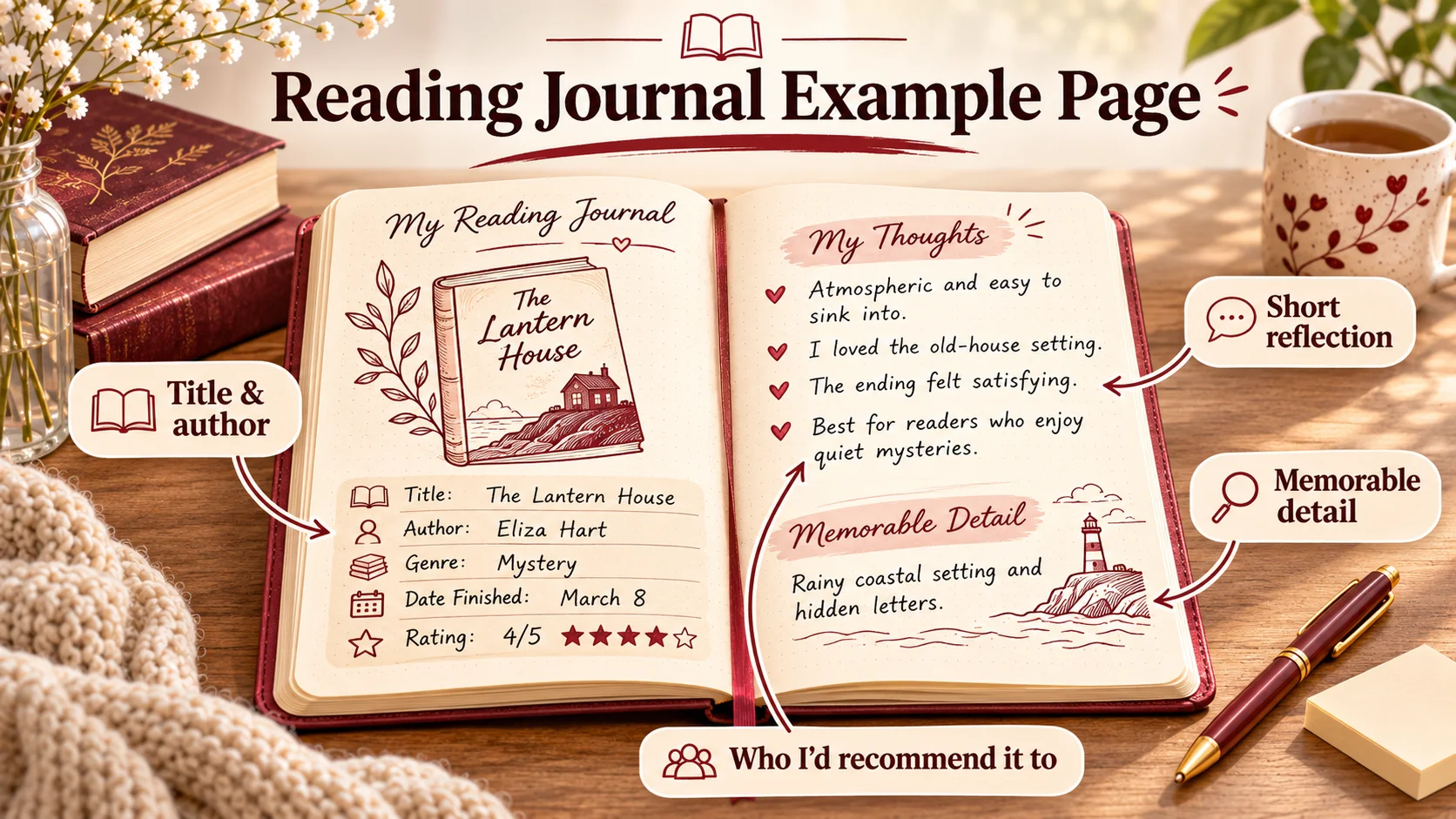
Reading Journal Example: A Completed Book Entry
This is an invented sample entry. Both the book and its author are fictional. These illustrative reflections are not a review of a real publication.
Book Title: The Lantern at Willow Quay
Author: Mara Ellery
Genre: Cozy mystery
Date Started: October 27, 2026
Date Finished: November 1, 2026
My Rating: 4/5, optional
This Book in One Sentence: A quiet seaside mystery about a missing lantern and neighbors learning to trust one another.
What I Enjoyed: The conversations between the retired boatbuilder and the new librarian felt warm and unhurried. The small harbor setting was easy to picture.
What Didn’t Work for Me: A few middle chapters repeated information I already understood.
One Thing I’ll Remember: The librarian keeps a chipped blue teacup filled with sharpened pencils on the lending desk.
Who I’d Recommend It To: Someone looking for gentle suspense, close-knit communities, and a calm weekend read.
This entry captures a reaction without revealing the solution. Yours can be much shorter.
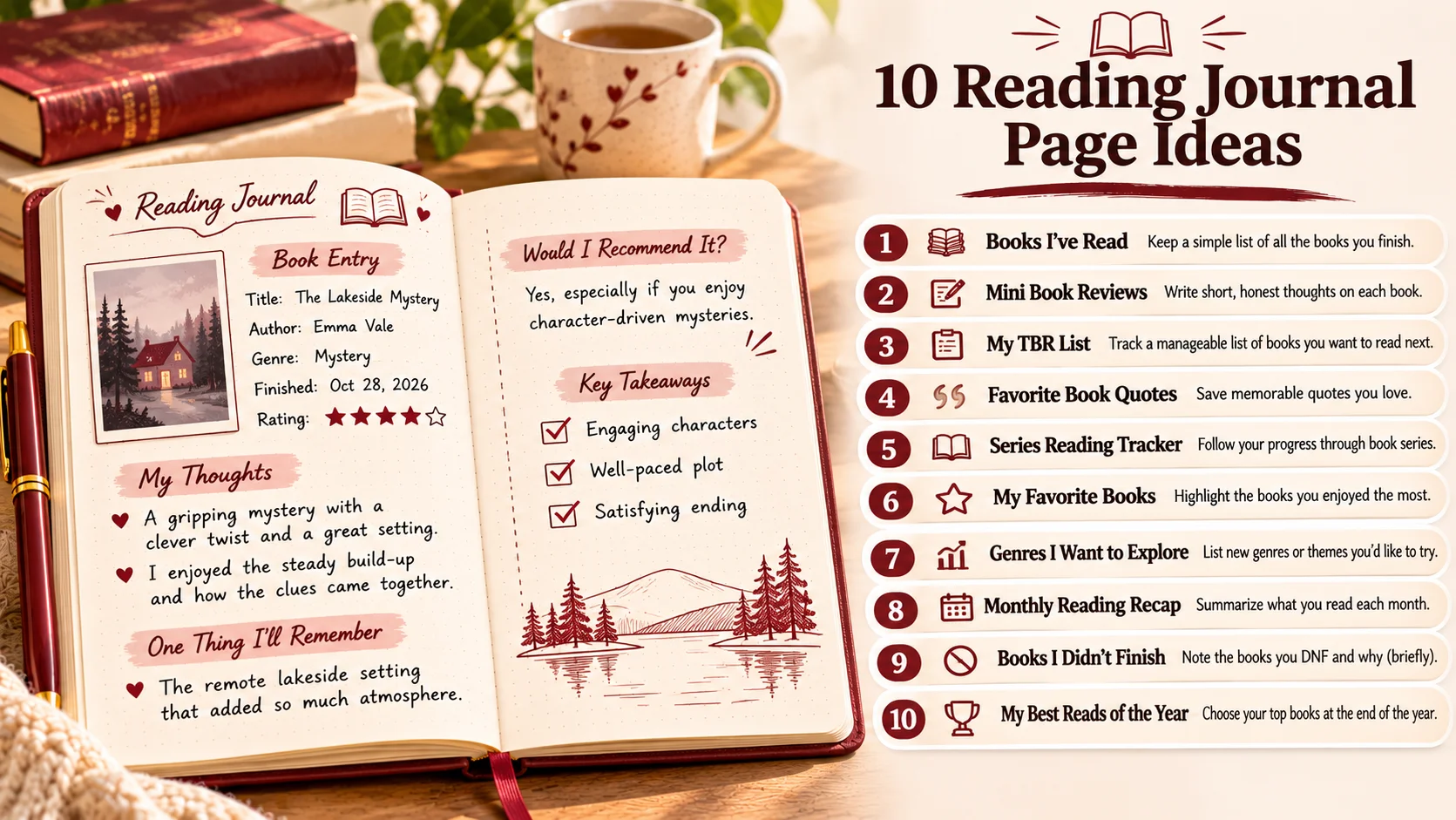
10 Reading Journal Page Ideas for Book Lovers
Pick one or two pages that solve a real need. You can add the rest later, or never.
- Books I’ve Read: keep a running list to find titles and authors quickly.
- Mini Book Reviews: write two or three sentences about what worked and who might enjoy each book.
- My TBR List: keep a small selection of possible next reads and a reason for each.
- Favorite Book Quotes: record a short quotation with the title, author, and page or chapter.
- Series Reading Tracker: list volumes finished and the next one to read.
- My Favorite Books: keep a personal favorites list with a note about why each matters.
- Genres I Want to Explore: name a few unfamiliar genres and a possible starting book for each.
- Monthly Reading Recap: record a highlight, a surprise, and what you feel like reading next.
- Books I Didn’t Finish: note where you stopped, why, and whether you might return.
- My Best Reads of the Year: choose your standouts and explain what made them memorable.
Paper vs Digital Reading Journals: Which Is Better?
Both can work well. Consider where you read, how you like to write, and whether you want to search old entries.
| Consideration | Paper journal | Digital journal |
|---|---|---|
| Convenience | No charging needed; you must carry it. | Easy to update on a device you carry; needs access and battery. |
| Customization | Draw and arrange freely; changes take space. | Move entries and edit fields; options depend on the app. |
| Searchability | Use an index or page tabs. | Search titles, authors, or words where supported. |
| Writing experience | Handwriting and a break from screens. | Quick typing or voice input where available. |
| Ease of updating | Simple for brief notes; reorganizing takes effort. | Easy to revise, sort, or duplicate a template. |
| Storage | Needs shelf space; can be lost or damaged. | Needs backups; check that you can export your notes. |
A mixed approach is fine: keep reflections in a notebook and a searchable books-read list digitally. If maintaining two places becomes a chore, choose one.
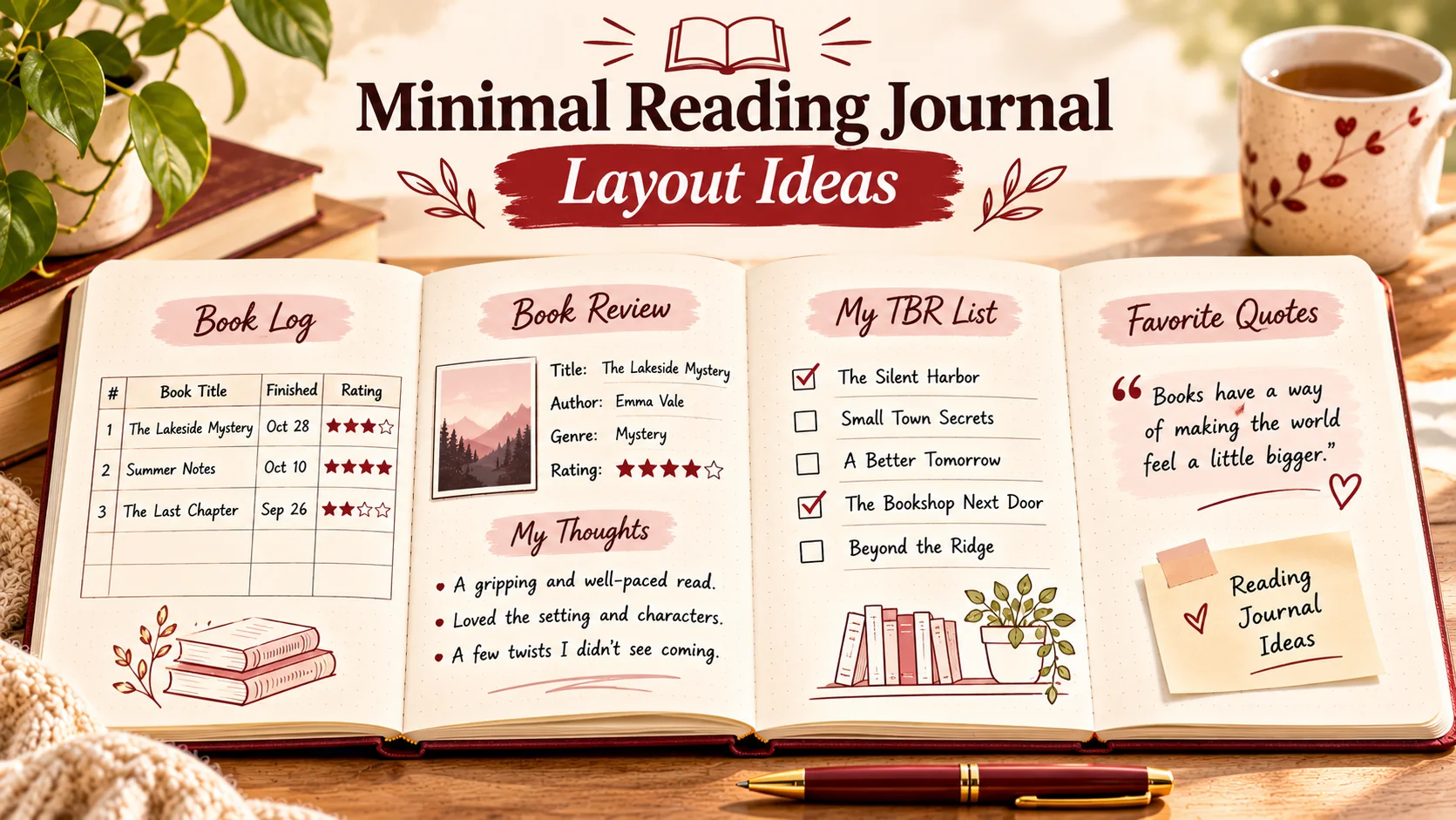
How to Make Your Reading Journal Aesthetic Without Overdoing It
An attractive journal does not require artistic talent. Start with clear pages that leave room for your words.
- Use two or three coordinated colors, such as burgundy, beige, and black.
- Keep headings consistent so book titles are easy to spot.
- Leave white space between entries rather than filling every corner.
- Add small illustrations only if you enjoy drawing.
- Use stickers or washi tape sparingly so decoration does not crowd your notes.
- Repeat an easy layout instead of designing a different spread for every book.
Write the entry before decorating it. If the plain version feels complete, you can stop there.
Common Reading Journal Mistakes to Avoid
- Creating too many pages before starting. Begin with a books-read page and one entry. Add a new page when you have something to put on it.
- Forcing long book reviews. Write one clear reaction and one memorable detail instead.
- Treating star ratings as mandatory. Try a phrase such as comforting or not for me, or skip the verdict.
- Recreating elaborate social-media layouts. Borrow one small idea that fits your time and materials.
- Feeling obligated to journal every day. Update after a finished book or during a short weekly check-in.
- Recording every book you have ever read. Start with current reading. Add an older favorite only when you want to.
- Comparing reading statistics with others. Use the journal to understand your own tastes rather than compete on totals.
How to Keep a Reading Journal Consistently
Keep the notebook beside your current book, or pin your reading note in an app. Make it easy to reach at the moment you have something to say.
After finishing a book, write two or three sentences using the same basic template. Skip details that do not help you remember the experience. If an entry takes longer than you want, shorten the next one.
Occasionally reread a few entries before choosing another book. Seeing an old note help you make a decision gives the journal a practical purpose.
After a break, add your next entry without filling the gap. You do not owe the journal a backlog. If making time for reading itself is difficult, our guide to building a reading habit that lasts offers a separate starting point.
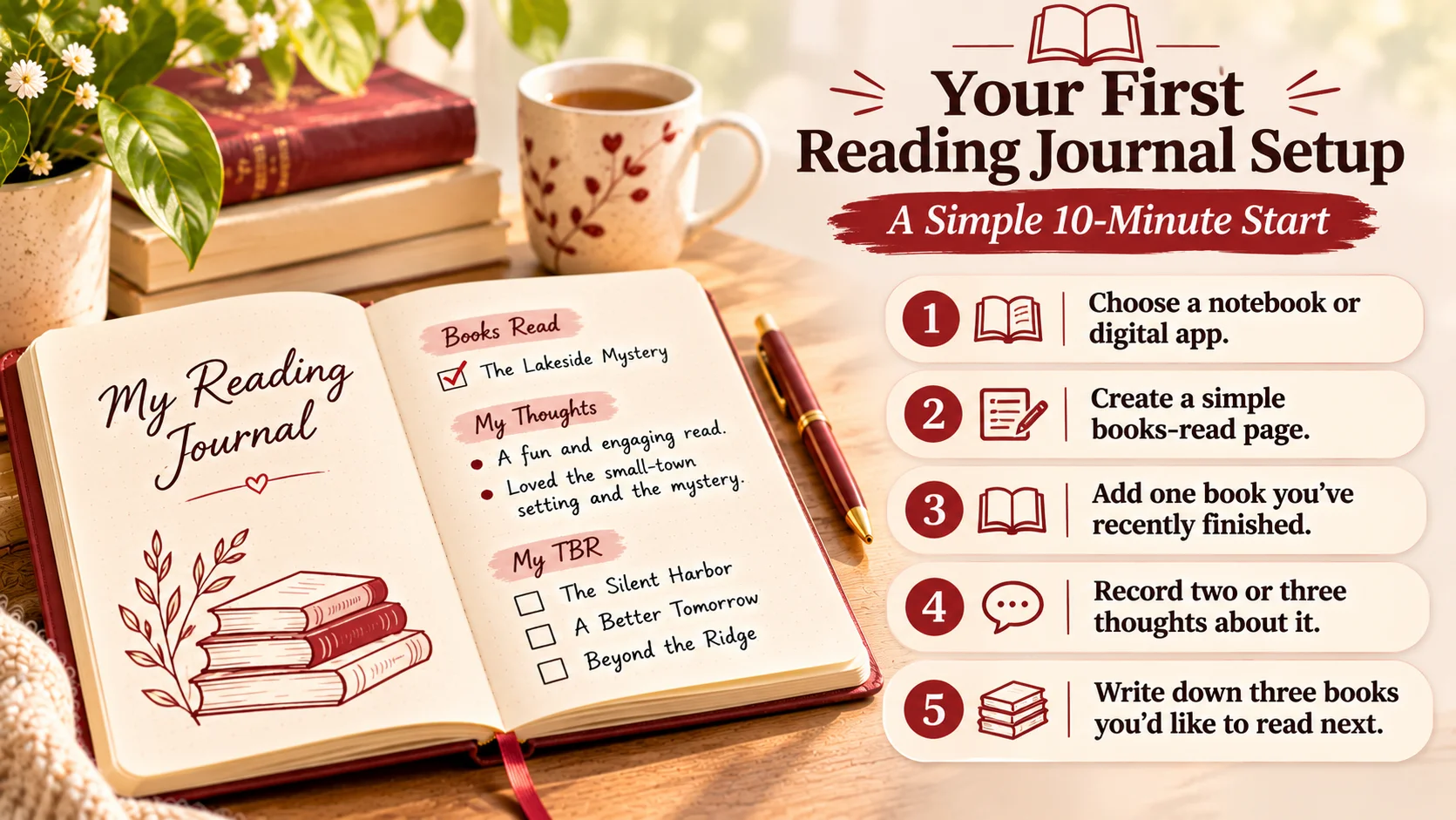
Your First 10-Minute Reading Journal Setup
- Minutes 0 to 1: Choose a notebook or digital app. Use something you already have and give it a simple title.
- Minutes 1 to 3: Create a books-read page. Add title, author, and date-finished headings. Leave ratings optional.
- Minutes 3 to 5: Add one recently finished book. Use an approximate date if needed.
- Minutes 5 to 8: Record two or three thoughts. Note what you enjoyed, what did not work, and one detail to remember.
- Minutes 8 to 10: Write down three possible next reads. Add a short reason each interests you.
That is enough to begin. Close the journal and return to your book; extra pages can wait.
Final Thoughts
The best reading journal is one you enjoy using. It can be plain, brief, and full of crossed-out words. Perfect handwriting, sophisticated layouts, and detailed reviews are optional.
Start with one book and one page. Record what you want to remember, and let the journal grow only when it adds something to your reading life.
Make Your Reading Life Easier
A reading journal works best alongside simple reading habits and a manageable list of books you genuinely want to read. Explore our other practical reading guides for more ideas.
Begin with simple reading habits or get help choosing your next book.
Frequently Asked Questions
Choose a notebook or notes app, add one recently finished book, and write a few sentences about it. Add fields only when useful.
Start with the title, author, finish date, and a short personal reaction. Ratings, characters, quotations, and series progress are optional.
No. Any spare notebook works. Choose something comfortable to write in rather than waiting for a perfect journal.
Yes. A notes app, document, or spreadsheet can hold your entries. Choose a format that is easy to update and back up.
Update after finishing a book or during a brief weekly check-in. Write daily only if you enjoy it.
No. Use a short description, write a few thoughts, or leave ratings out completely.
A reading journal focuses on thoughts and reactions. A tracker records progress, such as pages read or books finished. You can combine both.