
Reading something is easy.
Remembering it a week later is harder.
You may finish a chapter, understand it perfectly in the moment, and then struggle to explain what you actually learned a few days later.
That does not necessarily mean you have a bad memory.
Often, the problem is simply that reading has been too passive.
If you want to know how to remember what you read, you do not need to highlight every sentence or create pages of complicated notes.
A few simple habits can make a big difference.
This guide covers 10 practical strategies you can use to understand books more deeply, remember important ideas, and actually carry what you read into your everyday life.
Quick Answer: How Can You Remember More of What You Read?
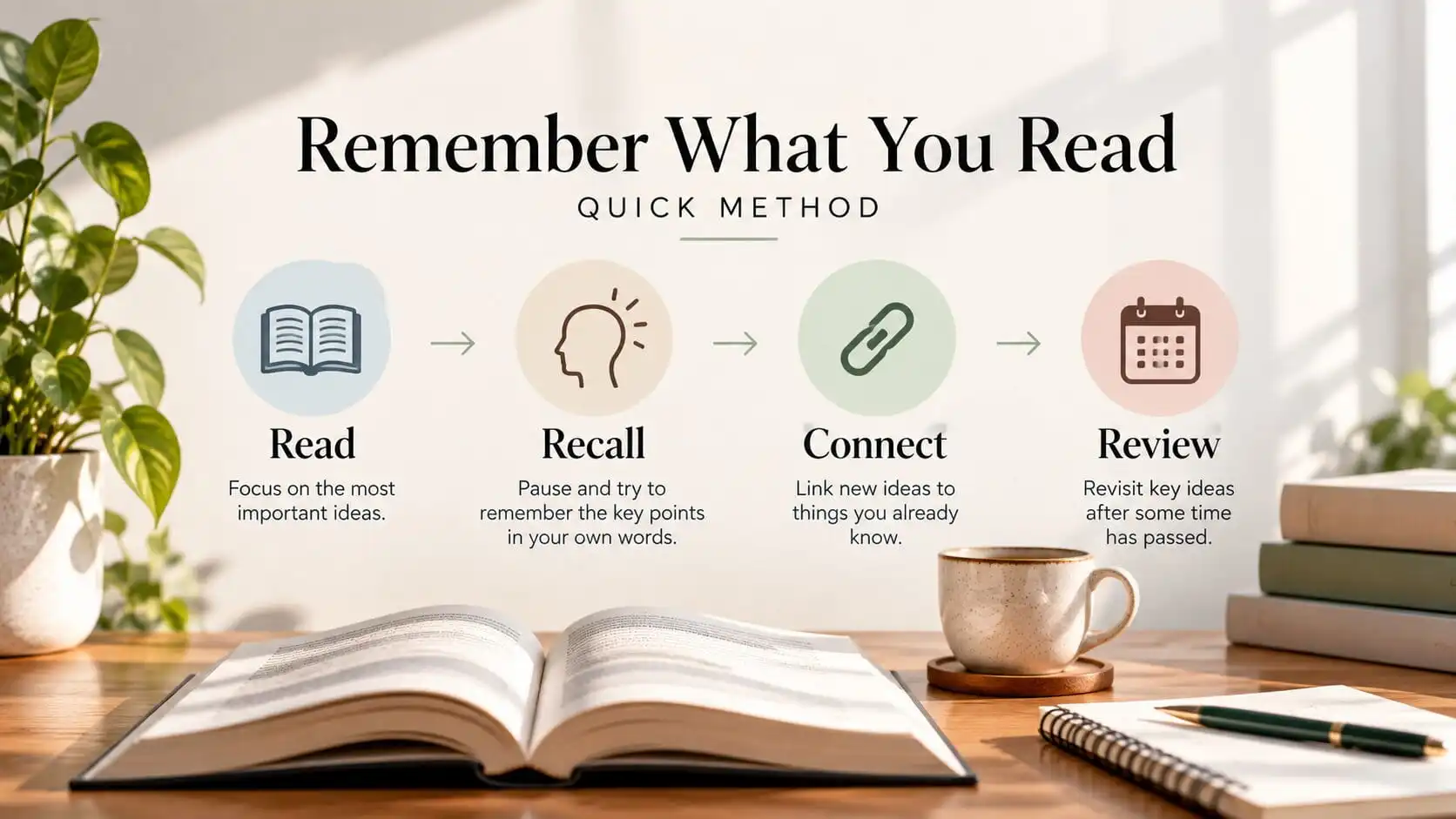
The simplest approach is to make reading more active.
Instead of only moving your eyes across the page:
- Know why you are reading the book.
- Pause after important sections.
- Recall ideas without looking back.
- Write short notes in your own words.
- Connect new ideas to things you already know.
- Review key points later.
- Explain useful ideas to someone else.
- Highlight selectively.
- Put useful ideas into practice.
- Accept that you do not need to remember everything.
The goal is not perfect recall.
It is remembering the parts that matter.
Why Do We Forget What We Read?
Forgetting is normal.
A book contains hundreds or thousands of individual details, and your brain is not trying to preserve every sentence permanently.
It tends to keep information that feels:
- important
- repeated
- emotionally meaningful
- connected to existing knowledge
- actively used
- frequently recalled
This is why you may remember the main idea of a book but forget the exact wording of individual paragraphs.
It is also why simply rereading the same page is not always the best solution.
If you want stronger retention, you need to give your brain more reasons to keep the information.
1. Decide What You Want to Remember Before You Read
Not every book needs the same level of attention.
Before starting, ask:
Why am I reading this?
Your answer might be:
- to learn a skill
- to understand a topic
- to prepare for an exam
- to improve your work
- to explore an idea
- simply to enjoy the story
That purpose changes how you should read.
If you are reading a thriller for entertainment, you probably do not need detailed notes.
If you are reading a book about business, psychology, history, or personal development, you may want to capture important ideas.
Knowing what you want from the book helps your attention filter what matters.
Try this
Before opening the book, complete this sentence:
“When I finish this book, I want to understand or remember…”
One sentence is enough.
2. Read in Smaller, Focused Sessions
Reading more pages does not automatically mean remembering more.
A 90-minute session while distracted may produce less useful recall than 20 focused minutes.
Try breaking your reading into manageable sessions.
For example:
20 minutes reading → 2 minutes thinking about what you just read
This creates natural stopping points where your brain can process the information.
Shorter sessions can also make it easier to notice when your attention has disappeared.
If you have read three pages and cannot remember any of them, continuing usually does not help.
Pause.
Reset.
Then continue.
3. Stop and Recall What You Just Read
This is one of the most useful habits you can develop.
After finishing a chapter or important section, close the book for a moment.
Ask yourself:
What were the main ideas?
Do not immediately look back.
Try to retrieve them from memory first.
You might remember:
- one main idea
- an example
- a character decision
- an argument
- a fact
- a question the chapter raised
This small act turns reading from recognition into recall.
And recalling information is much more demanding than simply seeing it again.
Simple chapter routine
At the end of a chapter, ask:
- What happened?
- What mattered?
- What surprised me?
- What do I want to remember?
You do not need to answer every question every time.
Even one can help.
4. Write Notes in Your Own Words
Copying sentences from a book can feel productive.
But copying does not always mean understanding.
Instead, translate the idea into your own language.
For example, rather than copying:
A long technical explanation about how habits are formed.
Write:
“Behaviors become easier to repeat when the cue and reward are obvious.”
Your note does not need to sound impressive.
It needs to make sense to you.
If you cannot explain an idea simply, that can be a sign that you have not fully understood it yet.
Keep notes short
For most books, you do not need pages of notes.
Try recording:
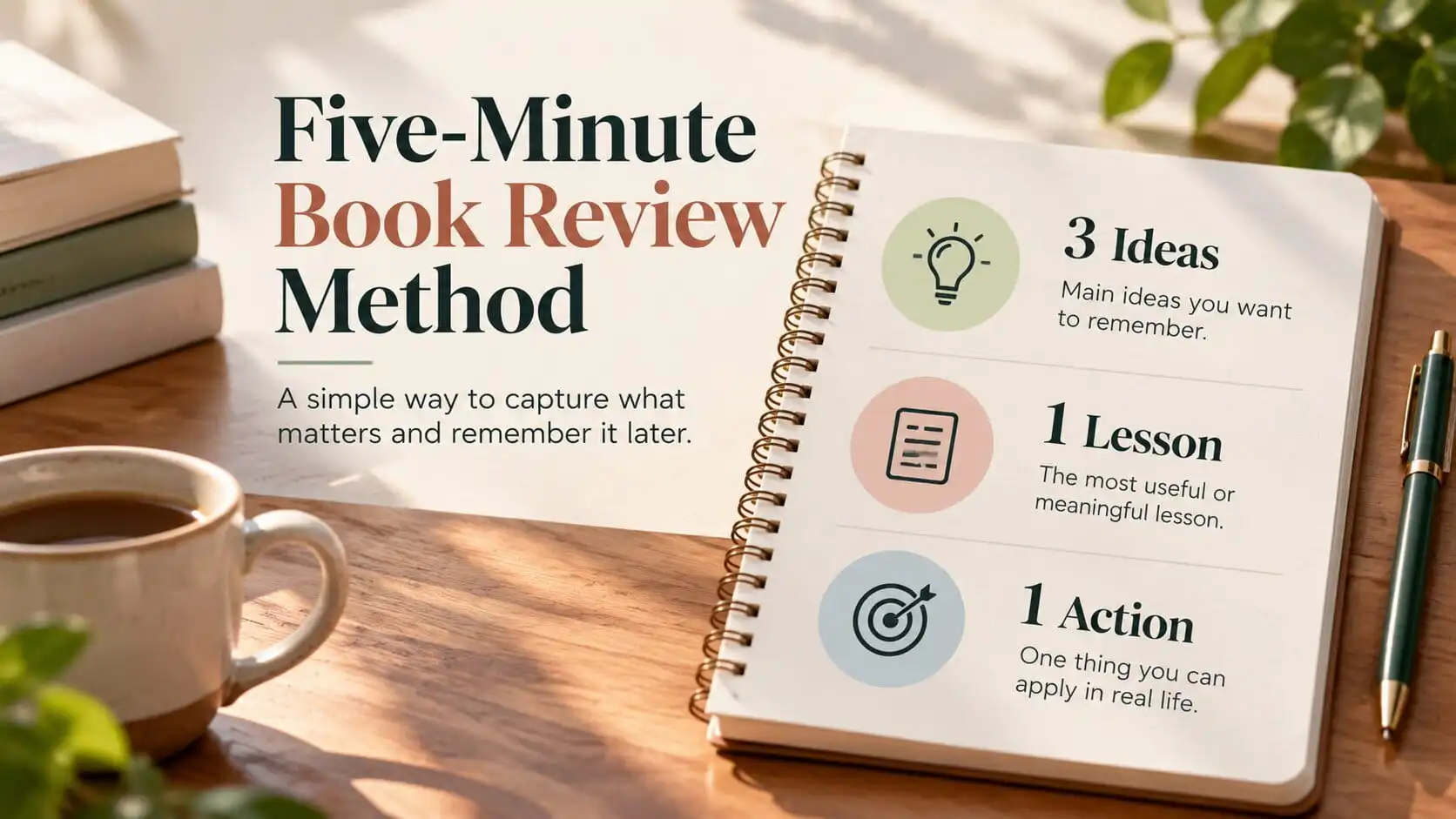
- 3 important ideas
- 1 useful example
- 1 question
- 1 action you may take
That is often more valuable than highlighting 50 passages.
5. Connect New Ideas to Things You Already Know
Information becomes easier to remember when it has somewhere to attach.
Whenever you encounter a useful idea, ask:
What does this remind me of?
You might connect it to:
- another book
- something that happened at work
- a personal experience
- a conversation
- something you already believe
- something you disagree with
These connections make the idea less isolated.
For example:
If a book explains decision fatigue, you might connect it to the difficulty of making choices after a long workday.
That personal connection makes the concept more meaningful and therefore easier to recall.
6. Highlight Less
Highlighting can help.
But highlighting almost everything defeats the purpose.
If half the page is marked, nothing stands out.
Try treating highlights as a filter.
Ask:
Would I actually want to see this sentence again later?
If the answer is no, leave it alone.
A useful rule is:
Highlight ideas, not decoration.
Look for:
- definitions
- surprising insights
- useful frameworks
- especially clear explanations
- memorable examples
- passages you genuinely want to revisit
Your highlights should make reviewing the book easier, not create another book inside the book.
7. Review Important Ideas After Some Time Has Passed
You do not need to reread the entire book.
Instead, revisit the most useful material.
For example:
One day later
Review your chapter notes.
One week later
Try remembering the main ideas before looking at your notes.
One month later
Revisit only the ideas that still matter to you.
This does not need to become a complicated system.
The simple act of returning to information after some time has passed can strengthen your memory of it.
8. Explain What You Read to Someone Else
Teaching is an excellent test of understanding.
You do not need an actual classroom.
Try explaining the idea:
- to a friend
- to a colleague
- in a journal
- in a short voice note
- in your own head
Imagine someone asks:
“What was that book actually about?”
Could you answer in two minutes?
If yes, you probably understand the main ideas fairly well.
If your explanation becomes vague, you have discovered what you need to revisit.
Try the three-sentence test
After finishing a book, explain it in three sentences:
Sentence 1: What is the book mainly about?
Sentence 2: What was the most useful or memorable idea?
Sentence 3: What changed in the way you think after reading it?
That alone can make the book much easier to remember.
9. Use What You Learn
Information becomes much easier to remember when it changes something you actually do.
If a book gives you a useful idea, apply it quickly.
For example:
If you read about productivity:
Change one part of your work routine.
If you read about communication:
Try one technique in your next conversation.
If you read a reading guide:
Change how you choose or organize your books.
If you read about money:
Review one financial habit.
Application gives information context.
The book stops being something you merely consumed and becomes something you used.
10. Do Not Try to Remember Everything
This may be the most important strategy.
You are not supposed to remember every sentence.
For most books, remembering these things is enough:
- the central idea
- a few important lessons
- memorable examples
- how the book made you think
- anything you plan to use
Think about a book you read years ago.
You probably do not remember every chapter.
But you may remember:
- one idea
- one scene
- one character
- one argument
- one feeling
That does not mean the book was wasted.
A book can influence you even when you cannot reproduce its contents word for word.
A Simple System to Remember Any Book
If you want a practical routine, use this five-step method.
Before Reading
Write down:
Why am I reading this book?
During Reading
Highlight only genuinely useful ideas.
After Each Chapter
Recall the main point without looking back.
After Finishing
Write:
- 3 ideas I want to remember
- 1 thing I learned
- 1 thing I want to use
One Week Later
Try explaining the book again without opening it.
That is enough for most readers.
You do not need an elaborate note-taking system unless you genuinely enjoy maintaining one.
Fiction and Nonfiction Need Different Approaches
You do not have to read every type of book the same way.
For Nonfiction
Focus on:
- concepts
- frameworks
- arguments
- practical ideas
- useful examples
Notes and review can be helpful.
For Fiction
You may care more about:
- characters
- themes
- relationships
- major events
- atmosphere
- emotional impact
You usually do not need chapter summaries unless you are studying the book.
For casual fiction, simply pausing occasionally and thinking about what has changed can improve recall.
How to Remember Characters in a Novel
If you often forget who is who, try keeping a tiny character list.
For example:
Anna: journalist
Jack: detective, Anna’s ex-husband
Rachel: Anna’s sister
Do not write detailed biographies.
Just enough information to reconnect the name with the person.
This is especially helpful for:
- fantasy
- historical fiction
- family sagas
- mysteries with large casts
How to Remember Long Books
Long books can feel difficult because earlier sections start fading before you finish.
Try creating a short checkpoint every 100 pages.
Write:
What has happened so far?
Keep it to five lines or fewer.
When you return after a break, read that short summary instead of flipping through dozens of pages.
Should You Take Notes While Reading?
Sometimes.
But not always.
Notes are most useful when:
- you are learning something
- the book contains complex ideas
- you expect to use the information later
- you are studying the book
- you enjoy writing about what you read
You probably do not need extensive notes when:
- reading purely for entertainment
- the story is straightforward
- note-taking interrupts your enjoyment
The best system is one you will actually continue using.
Is It Better to Highlight or Take Notes?
They serve different purposes.
Highlighting helps you find important passages again.
Notes force you to process the idea.
For stronger retention, notes in your own words generally require more thinking.
A useful combination is:
highlight first → summarize later
This keeps reading relatively smooth while still giving you an opportunity to process the material afterward.
Does Reading Slowly Help You Remember More?
Not automatically.
Reading more slowly may help with complex material, but simply reducing speed does not guarantee better memory.
Attention matters more.
You can read slowly while thinking about something completely unrelated.
A better approach is:
slow down when the material is difficult, speed up when it is simple, and pause when something deserves thought.
Your reading speed should change with the book.
What If You Forget a Book Completely?
Do not assume that means reading it was pointless.
Ask yourself:
Do I remember anything?
Maybe you remember:
- the overall argument
- one scene
- the ending
- how the book made you feel
- one decision you made because of it
That is still retention.
If the book is important enough to revisit, your old highlights or a short summary may quickly reactivate much more of it.
A Better Reading Retention Routine
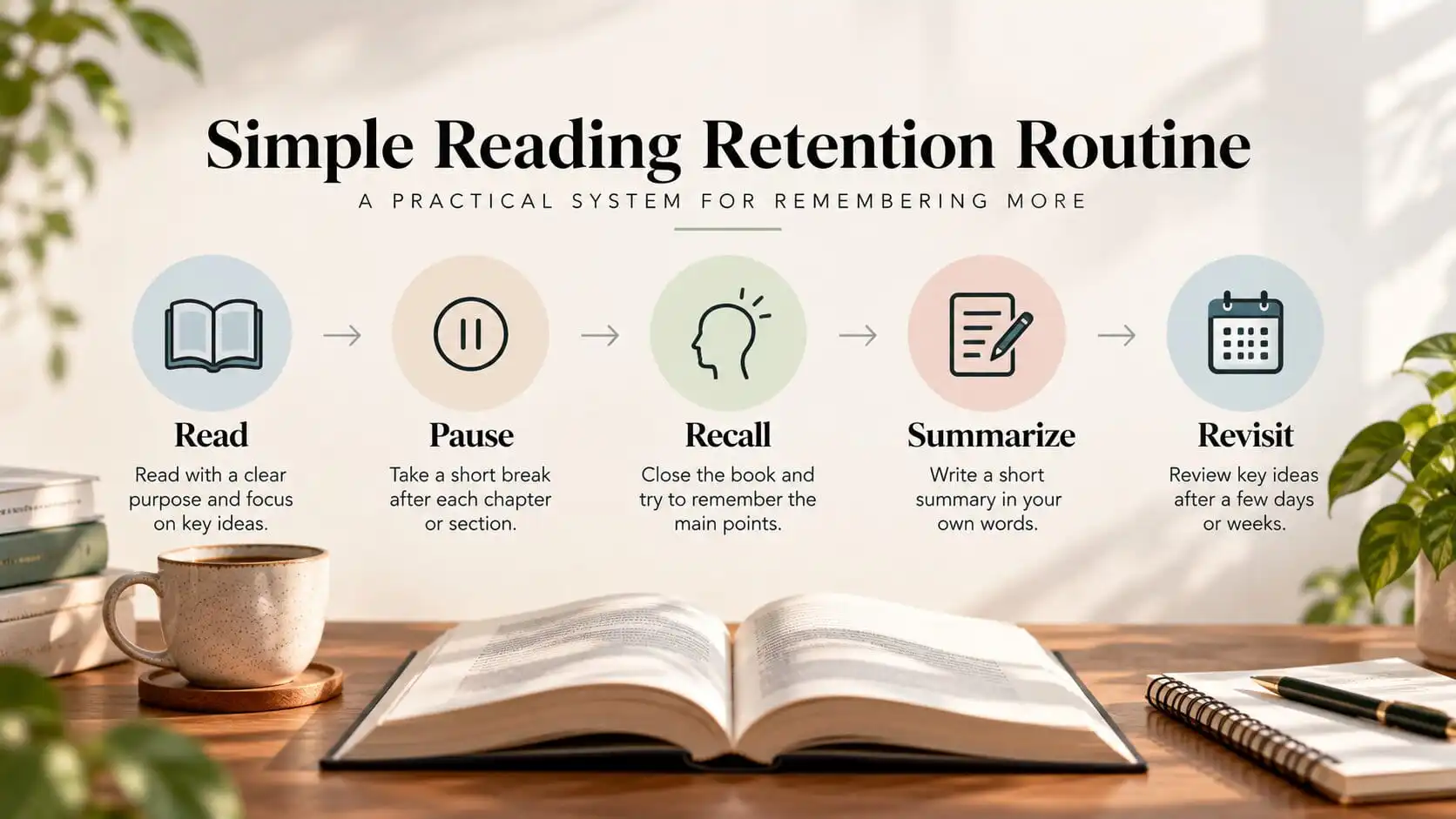
Here is a simple routine you can use without turning reading into homework.
While reading
Read normally and mark only genuinely important ideas.
At the end of a chapter
Pause for 30 seconds and recall the main point.
At the end of the book
Write a five-minute summary.
One week later
Ask yourself what you still remember.
Later
Return only if the book contains ideas worth using again.
Simple systems tend to survive longer than complicated ones.
How This Fits Into a Better Reading Habit
Remembering more begins with reading consistently.
If you are still trying to create that routine, read:
How to Build a Reading Habit That Lasts
If you want to increase how much you read:
How to Read More Books: 12 Simple Habits That Actually Work
And if choosing your next book slows you down:
How to Choose What Book to Read Next
These guides should gradually become our broader Reading Guides content hub, rather than isolated articles.
Final Thoughts
You do not remember books by trying harder to memorize every page.
You remember more when you interact with what you read.
Pause.
Recall.
Summarize.
Connect.
Explain.
Use.
And revisit the ideas that genuinely matter.
You will still forget plenty.
Everyone does.
But if you finish a book remembering its central ideas and carrying even one useful insight into your life, that book has already done something valuable.