
A luxury cruise promises distance from ordinary worries. In Ruth Ware’s The Woman in Cabin 10, that distance becomes the problem. Travel journalist Lo Blacklock believes a woman has been thrown overboard, yet the passengers are all accounted for. Raising the alarm brings questions about her credibility rather than a straightforward investigation.
This The Woman in Cabin 10 review examines the premise, atmosphere, protagonist, pacing, and critical reservations without explaining the mystery. It draws on verified author and publisher material and independent published criticism, rather than claiming a firsthand reading experience.
Early verdict: This is an appealing choice for readers who enjoy confinement, an elegant setting made threatening, and a witness struggling to prove what happened. Readers who dislike sustained emotional intensity, restricted knowledge, or a heightened final act may find it less satisfying.
The Woman in Cabin 10 by Ruth Ware: Book Details
| Detail | Book information |
|---|---|
| Title | The Woman in Cabin 10 |
| Author | Ruth Ware |
| Original publication | 2016 |
| Genre | Psychological thriller / mystery |
| Setting | The Aurora, a small luxury cruise ship |
| Protagonist | Laura “Lo” Blacklock |
| Series | Lo Blacklock, Book 1 |
| Sequel | The Woman in Suite 11 (2025) |
| Review type | Spoiler-free |
Page counts vary by edition. The novel has its own central mystery, but it is no longer accurate to describe Lo’s story as having no sequel.
What Is The Woman in Cabin 10 About?
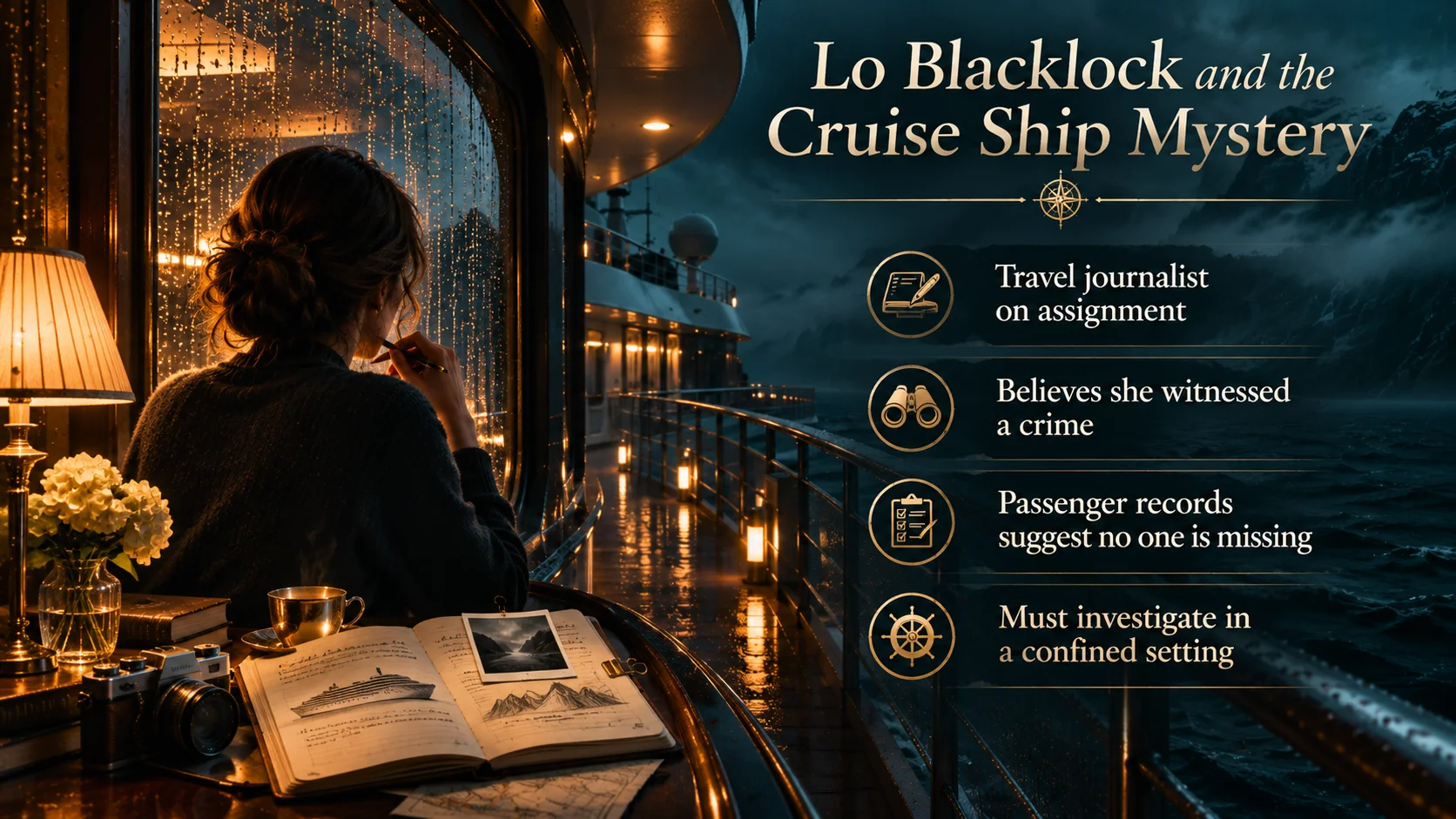
After a frightening break-in at her London home, Lo leaves on a travel-journalism assignment aboard the Aurora. The small luxury ship is sailing in northern waters, through the North Sea toward the Norwegian fjord region. The assignment offers professional opportunity, but she arrives already shaken.
A disturbing event involving the neighboring cabin convinces her that a woman has gone overboard. The apparent evidence contradicts the ship’s records: nobody is missing. Lo must persuade others that a crime may have occurred while remaining aboard the very vessel she wants investigated.
That is the spoiler-free starting point established by the publisher’s description. The appeal lies in the contradiction, not in knowing its explanation before boarding.

The Woman in Cabin 10 Review: What Works Well?
1. A Claustrophobic Setting at Sea
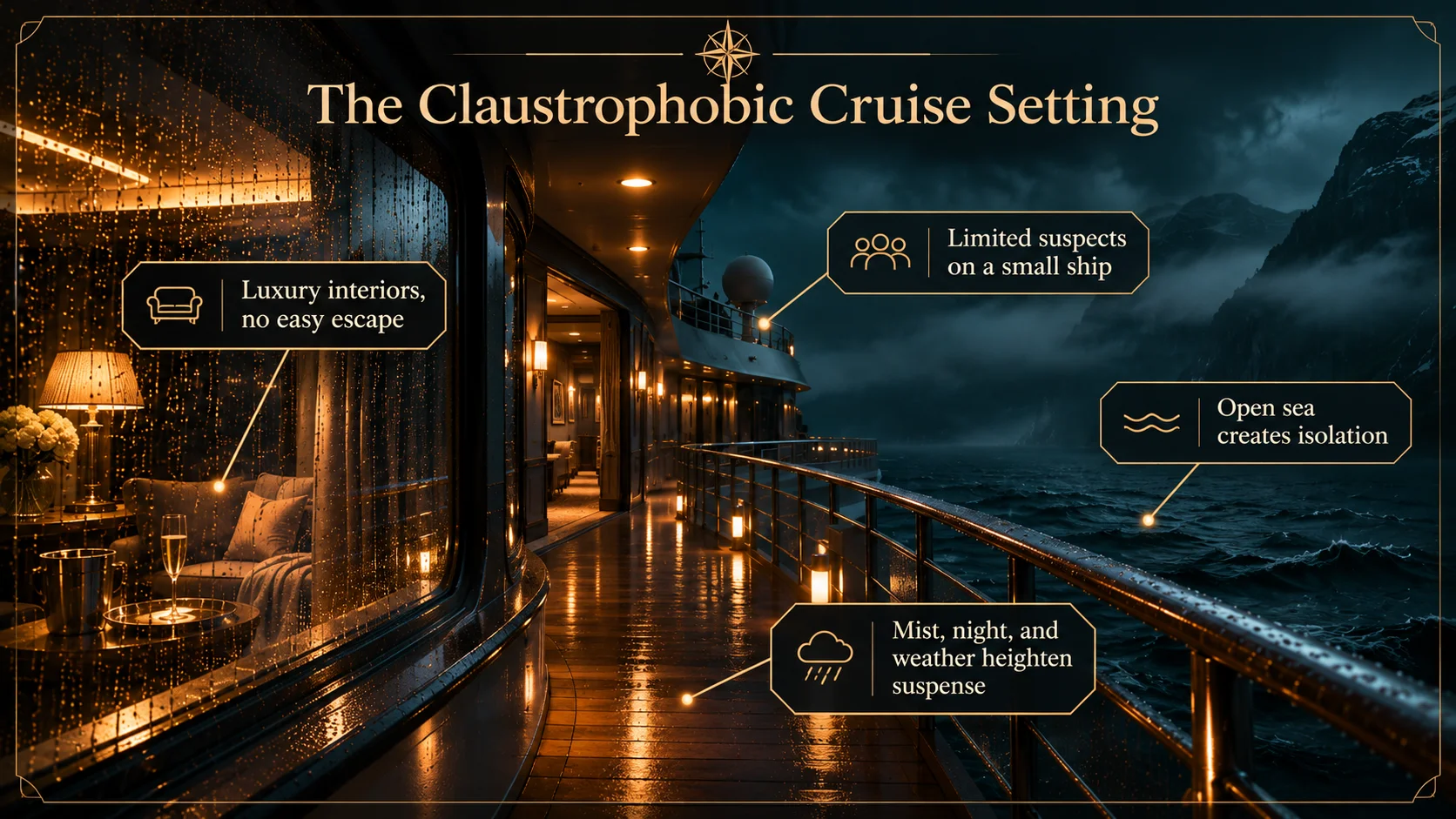
The cruise setting makes an attractive escape feel like restricted territory. A comfortable cabin does not provide the freedom of being able to leave. Corridors connect people who must continue sharing the same small world, while the surrounding sea makes ordinary distance feel consequential.
2. A Missing-Passenger Mystery
An ordinary disappearance begins with an acknowledged absence. Here, Lo faces an earlier hurdle: establishing that there is an absence at all. The passenger record is not merely background administration; it challenges the basis on which her alarm should be believed.
Our editorial assessment is that this makes the setup especially inviting for readers who like conflicting forms of evidence. Personal observation and an official account pull in different directions, so even defining the problem becomes part of the mystery.
3. Constant Uncertainty
Lo’s limited knowledge prevents readers from standing comfortably outside the dispute. The question is not simply which suspect looks suspicious, but what can be established when a witness cannot obtain agreement about the event itself.
That is not the same as confirming that Lo imagined everything. Keeping those possibilities open is part of the premise. Readers who enjoy testing an account while remaining emotionally close to its teller are the natural audience.
4. The Contrast Between Luxury and Danger
Exclusive travel depends on the promise that every detail is managed. A possible crime threatens that promise. Elegance can therefore become unsettling rather than reassuring: a polished environment supplies appearances, not necessarily reliable answers.
Status also shapes the voyage: guests, visiting journalists, and crew do not have identical access or authority. That difference gives the confined social setting practical consequences.
Where The Woman in Cabin 10 May Disappoint Some Readers
Lo’s Repeated Distress May Divide Readers
Fear, exhaustion, and uncertainty keep the emotional pressure close to the surface. Some readers will find that proximity compelling; others may feel that repeated alarm holds the story in a similar register. If you prefer a calm investigator, this is an important qualification.
Distress does not establish dishonesty. The useful criticism concerns how the narrative sustains intensity, not whether anxiety makes someone unworthy of belief.
The Mystery Requires Some Patience
Suspense built around disputed observations needs space for questioning and frustration. The promise is not an uninterrupted sequence of action scenes. Readers who want each encounter to produce clear new evidence may find the uncertainty less rewarding than readers who enjoy accumulated suspicion.
The Final Act May Feel Heightened
Kirkus praises the mystery’s subtle construction while finding the concluding drama excessive. That identifies a potential trade-off: the pleasure of a restrained puzzle may not be identical to the pleasure of a dramatic payoff. No resolution details are needed to make that distinction.
Not Every Reader Will Enjoy the Narrative Perspective
A viewpoint closely tied to Lo’s access can create urgency, but it also restricts independent verification. If your enjoyment depends on surveying the investigation from several reliable angles, confinement to one person’s uncertainty may feel frustrating rather than immersive.
Lo Blacklock: Is She a Compelling Main Character?
Lo’s professional position gives her a reason to be aboard beyond the demands of a mystery plot. The assignment matters to her career, and the recent break-in means she does not enter it from a position of ease. Work and vulnerability coexist.
Her persistence supplies a reason to follow the dispute: she cannot simply accept the official picture while believing something terrible has happened. Yet a journalist on assignment is not a police detective with authority to demand cooperation. The gap between responsibility and access is central to her appeal.
Whether that makes her compelling depends partly on what you want from a protagonist. Readers may value determination under pressure without finding her comfortable company. The relevant question is whether her limited position interests you, not whether every reaction appears composed.
The Woman in Cabin 10 Characters and Suspects
The social group includes professional contacts and other travel writers, wealthy guests and investors, and the crew. Publishers Weekly confirms those broad divisions in its account of the novel. Their different relationships to the voyage give Lo more to navigate than a list of strangers.
For a spoiler-free reading, pay attention to who has access, who can authorize an answer, and whose account carries weight. A limited passenger group narrows the social field without making its relationships transparent. This review avoids naming supporting characters or assigning secret motives.
Is The Woman in Cabin 10 Scary?
It is primarily psychological suspense and mystery, not supernatural horror. The premise draws on isolation, suspicion, confined space, an apparent crime at sea, and the fear of reporting danger without being believed.
Those elements may feel more disturbing to some readers than a conventional horror setup. At the same time, describing the book as tense does not mean promising graphic horror. If home intrusion or threatened safety at sea are difficult subjects for you, consider those premise-level elements when deciding whether it suits your mood.
Is The Woman in Cabin 10 Fast-Paced?
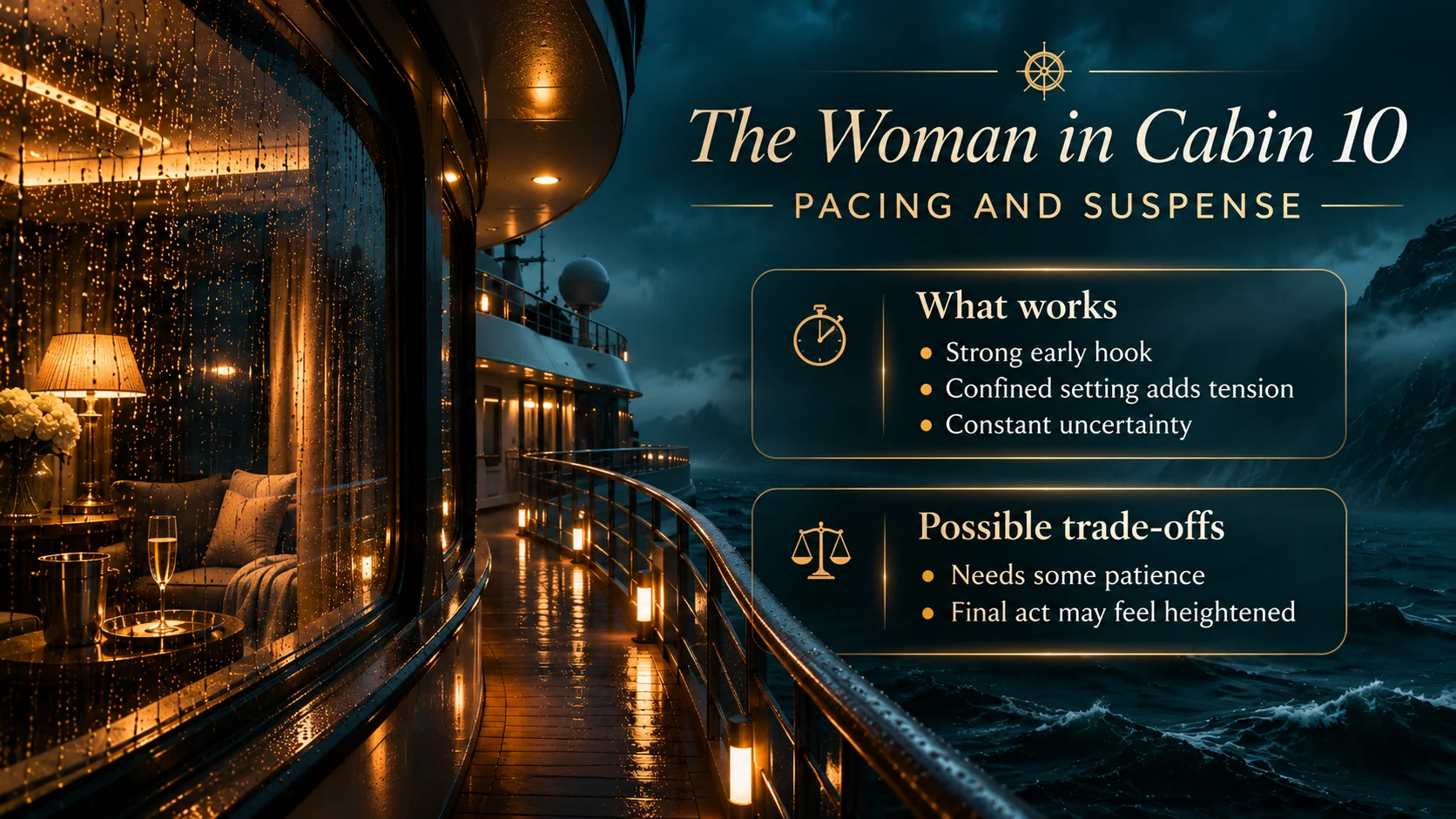
The central contradiction provides a clear hook: how can someone be missing when everyone is accounted for? But a hook and a constant action pace are different things. Much of the appeal rests on wanting clarification, not on receiving an immediate succession of answers.
The contained setting can make a conversation feel consequential because the people involved remain nearby afterward. That supports suspense without guaranteeing that every reader will find the middle brisk. Readers who enjoy questioning and atmosphere are better placed to appreciate the pace than those seeking nonstop movement.
Are the Twists in The Woman in Cabin 10 Satisfying?
The setup creates a demanding expectation: the explanation must address both what Lo believes happened and the official absence of a missing person. Readers attracted by that puzzle may care especially about whether the eventual account feels supported rather than merely surprising.
Independent assessments differ. Kirkus responds positively to the underlying conundrum but qualifies that praise over the finale. Publishers Weekly is less enthusiastic overall and cautions readers expecting a Christie-style puzzle. Neither response justifies calling the payoff universally brilliant or universally disappointing.
The practical recommendation is to weigh how much satisfaction you draw from the journey of uncertainty against how strictly you judge a final explanation. This review leaves the clues, identities, and resolution untouched so you can make that assessment yourself.
Is The Woman in Cabin 10 a Locked-Room Mystery?
A traditional locked-room mystery presents an apparently impossible crime within a tightly defined physical situation. A closed-circle mystery limits the possible suspects, often by isolating a group. The terms overlap in conversation, but they do not promise exactly the same experience.
The Woman in Cabin 10 draws on both attractions: an impossible-seeming contradiction and a small group at sea. It is safer to recommend it for closed-circle psychological suspense than to promise a textbook demonstration of locked-room mechanics.
If the appeal is the feeling of being trapped among people whose accounts do not align, the premise fits. If you want a rigorously technical puzzle above everything else, the mixed critical reception deserves more weight.
The Woman in Cabin 10 vs Other Ruth Ware Thrillers
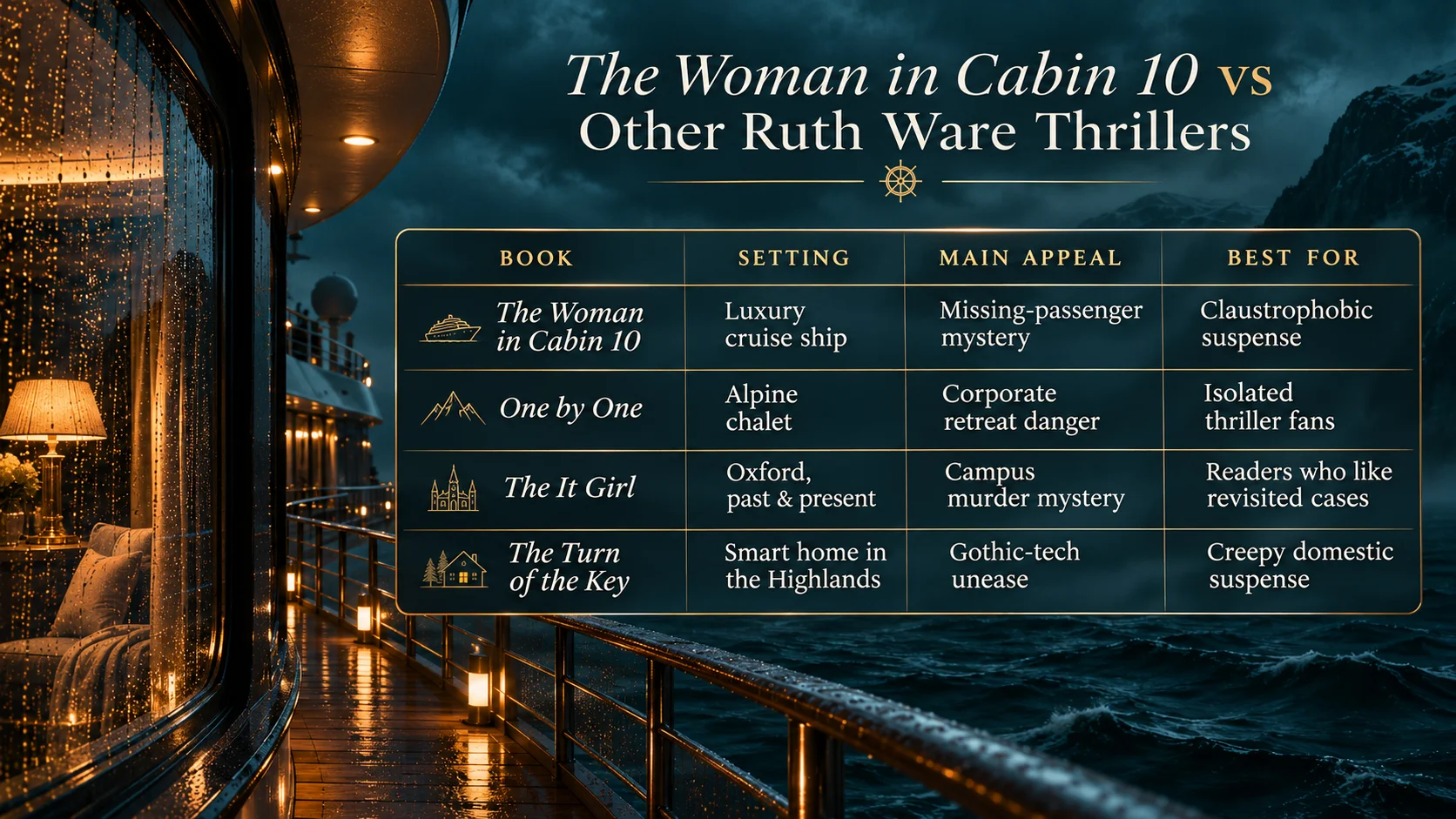
These high-level distinctions follow Ware’s official book descriptions. The “best for” column is an editorial guide to preferences, not a ranking of quality.
| Book | Setting | Main appeal | Best for |
|---|---|---|---|
| The Woman in Cabin 10 | A small luxury cruise ship | An apparent missing passenger and contested testimony | Confinement at sea and psychological uncertainty |
| One by One | A remote alpine chalet during a corporate retreat | Workplace conflict and mounting danger | Snowbound group suspense |
| The It Girl | An Oxford-era murder revisited years later | Reexamining an earlier account | Campus history and retrospective investigation |
| The Turn of the Key | An isolated Scottish smart home | A nanny’s position becomes a disturbing mystery | Domestic unease and gothic atmosphere |
Explore our One by One review for the alpine alternative, or use Ruth Ware Books in Order to compare the wider bibliography. Choose the setting and kind of uncertainty you want rather than assuming the books deliver identical experiences.
The Woman in Cabin 10 Book vs Netflix Movie
Ware’s original novel appeared in 2016. The separate Netflix film adaptation, starring Keira Knightley as Lo Blacklock, was released in October 2025. Netflix’s adaptation coverage confirms that it is already released; the production company’s film page records the release date.
This article reviews the novel, not the movie. Choose the book if you want to encounter the suspense through prose and narrative perspective. Watching the adaptation is not evidence that its events or character details can automatically be attributed to the original novel.
Do You Need to Read The Woman in Cabin 10 Before The Woman in Suite 11?
Yes, start here if you plan to follow Lo’s story. Ware’s official page confirms that The Woman in Suite 11 was published in 2025 as a sequel. The first novel establishes the character and earlier experiences on which the continuation builds.
The original mystery offers a complete first story, but the presence of a sequel matters when choosing reading order. Read The Woman in Cabin 10 before The Woman in Suite 11. Our Ruth Ware reading-order guide explains the connection without requiring the rest of her novels first.
Who Should Read The Woman in Cabin 10?
Read It If You Enjoy Isolated Mysteries
The ship keeps a small social world in close proximity. Choose it if the inability to leave is part of what makes a mystery appealing to you.
Read It If You Like Psychological Uncertainty
The distance between a witness’s conviction and what others accept is the central attraction. You need to enjoy that unsettled space, not just tolerate it until a solution arrives.
Read It If You Enjoy Luxury Settings With Dark Secrets
An exclusive voyage offers a polished surface against which danger can feel especially disruptive. The appeal is the instability of that promise of comfort.
Consider Another Book If You Prefer Traditional Detective Work
Lo investigates from a limited position rather than through a police procedural’s formal methods. Readers seeking methodical evidence-gathering may prefer a different type of mystery.
Consider Another Book If You Dislike Prolonged Uncertainty
If you want a consistently clear view of what is happening, the narrative’s restricted knowledge may frustrate you. That is a matter of fit, not a failure to appreciate suspense.

Is The Woman in Cabin 10 Worth Reading?
Yes, conditionally: it is a good option for readers drawn to an atmospheric, claustrophobic mystery about a witness trying to establish what happened. The small luxury cruise and missing-passenger contradiction distinguish it from a generic remote-retreat thriller.
The qualifications are equally relevant. Lo’s emotional intensity, the gradual accumulation of uncertainty, and a final act that divided critics may work against readers who want calm detection or a restrained puzzle from beginning to end. Start for the setting and predicament, rather than for a guaranteed reaction to the ending.
Final Thoughts
A beautiful voyage becomes unsettling when one passenger reports something terrible and cannot secure agreement that it happened. That clash between luxury, limited evidence, and danger gives Ware’s premise its staying power.

Looking for More Suspenseful Mysteries?
From remote retreats to mysterious disappearances, explore our Ruth Ware reviews and thriller recommendations to find another story filled with secrets and suspense.
- Ruth Ware Books in Order
- One by One Review
- Books Like One by One
- The Guest List Review
- The Hunting Party Review
Frequently Asked Questions
Travel journalist Lo Blacklock believes a woman has gone overboard during a luxury cruise, but the passenger records indicate nobody is missing. She tries to establish what happened while others question her account.
It is a strong fit for readers who enjoy claustrophobic settings and disputed testimony. Readers who prefer clear, methodical detection may find its uncertainty less satisfying.
It is psychological suspense rather than supernatural horror. Isolation, threatened safety, and the fear of not being believed provide the tension.
The premise offers an early hook, while suspense develops through questioning and uncertainty. It is not a promise of uninterrupted action.
It combines impossible-seeming circumstances with closed-circle suspense. Expect an isolated passenger group rather than every convention of a technical locked-room puzzle.
The narrative makes uncertainty about knowledge and interpretation part of the experience. Lo’s distress should not be treated as proof of dishonesty; explaining the eventual answer would spoil the mystery.
Yes. The Woman in Suite 11 was published in 2025 and continues Lo Blacklock’s story.
Yes. The Woman in Suite 11 is the 2025 sequel featuring Lo. Read The Woman in Cabin 10 first for the intended sequence.
The 2016 novel and the Netflix film released in 2025 are separate versions of the story. Keira Knightley plays Lo in the adaptation; this article assesses the book without cataloguing film changes.