
Books Like Verity: 12 Thrillers to Read Next
If Verity kept you hooked because you never felt completely sure who to believe, the best book to read next is not necessarily another romance-heavy story.
What makes Verity work is the combination of:
- psychological tension
- hidden documents and secrets
- morally complicated characters
- a house full of unanswered questions
- shifting trust
- an ending that invites debate
Colleen Hoover describes Verity as a standalone romantic thriller centered on writer Lowen Ashleigh, the Crawford family, and a manuscript that completely changes how she sees the people around her.
The books below are not copies of Verity. Some lean more domestic, some more gothic, and some more psychological, but each recreates part of that unsettling feeling of never having the full story.
This guide stays spoiler-light.
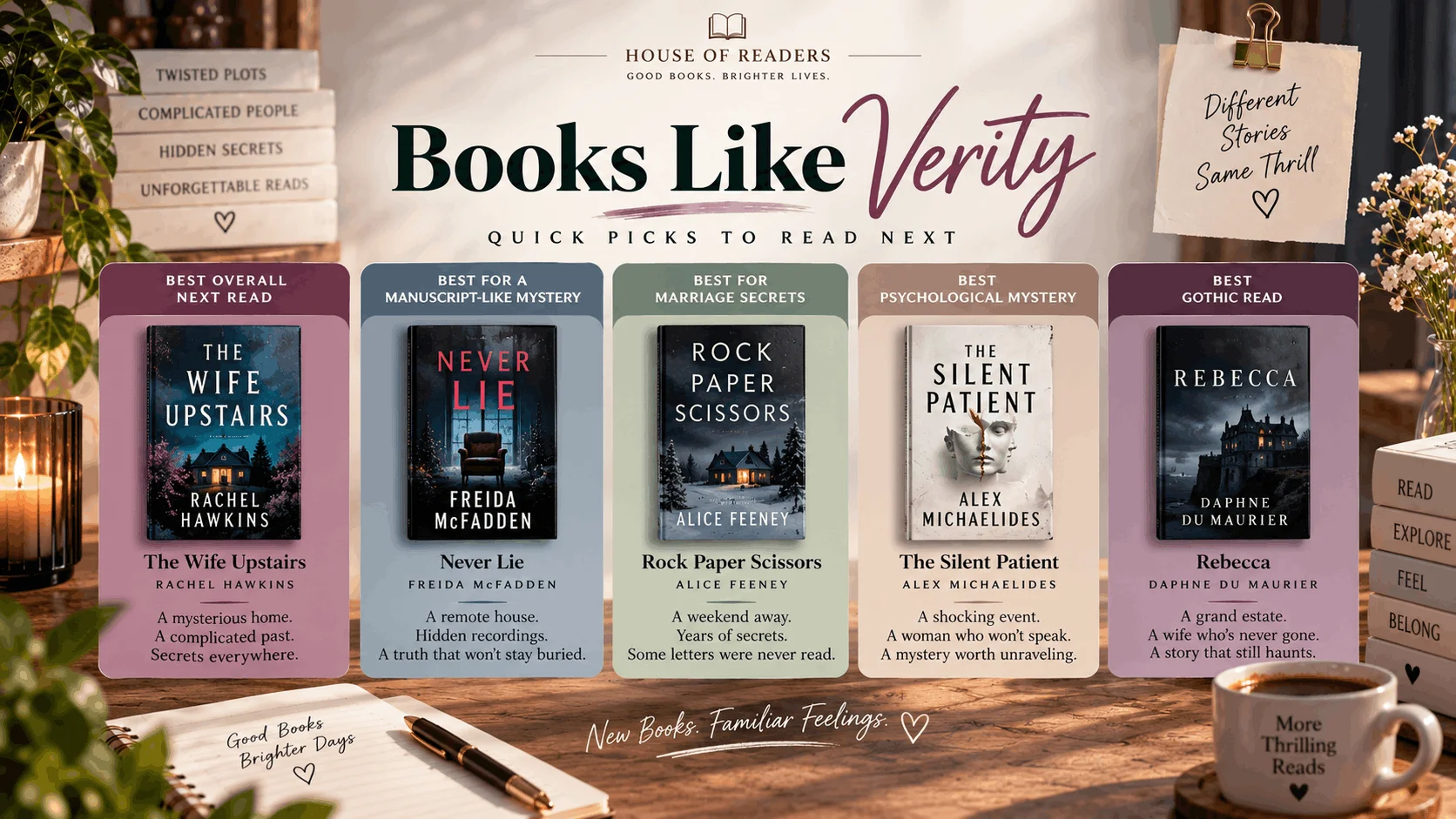
Quick Picks: What Should You Read After Verity?
If you do not want to compare all 12 books, start here.
Best overall next read
The Wife Upstairs by Rachel Hawkins
It combines a mysterious home, a complicated relationship, a wife whose presence still hangs over everything, and characters who are hiding far more than they initially reveal. Macmillan describes it as atmospheric domestic suspense with murder, ambition, and romance woven through the story.
Best for a manuscript-like mystery
Never Lie by Freida McFadden
A couple becomes trapped at a remote manor where recordings left behind by a missing psychiatrist gradually reveal what happened there. It has the same appealing idea of discovering someone else’s private record and wondering how much of it can be trusted.
Best for marriage secrets
Rock Paper Scissors by Alice Feeney
A married couple spends a weekend in an isolated Scottish setting, while years of secrets and unread letters begin to surface.
Best psychological mystery
The Silent Patient by Alex Michaelides
A therapist becomes obsessed with discovering why a woman stopped speaking after a shocking event involving her husband.
Best gothic choice
Rebecca by Daphne du Maurier
A young woman arrives at an isolated estate where the memory of her husband’s first wife seems to occupy every room.
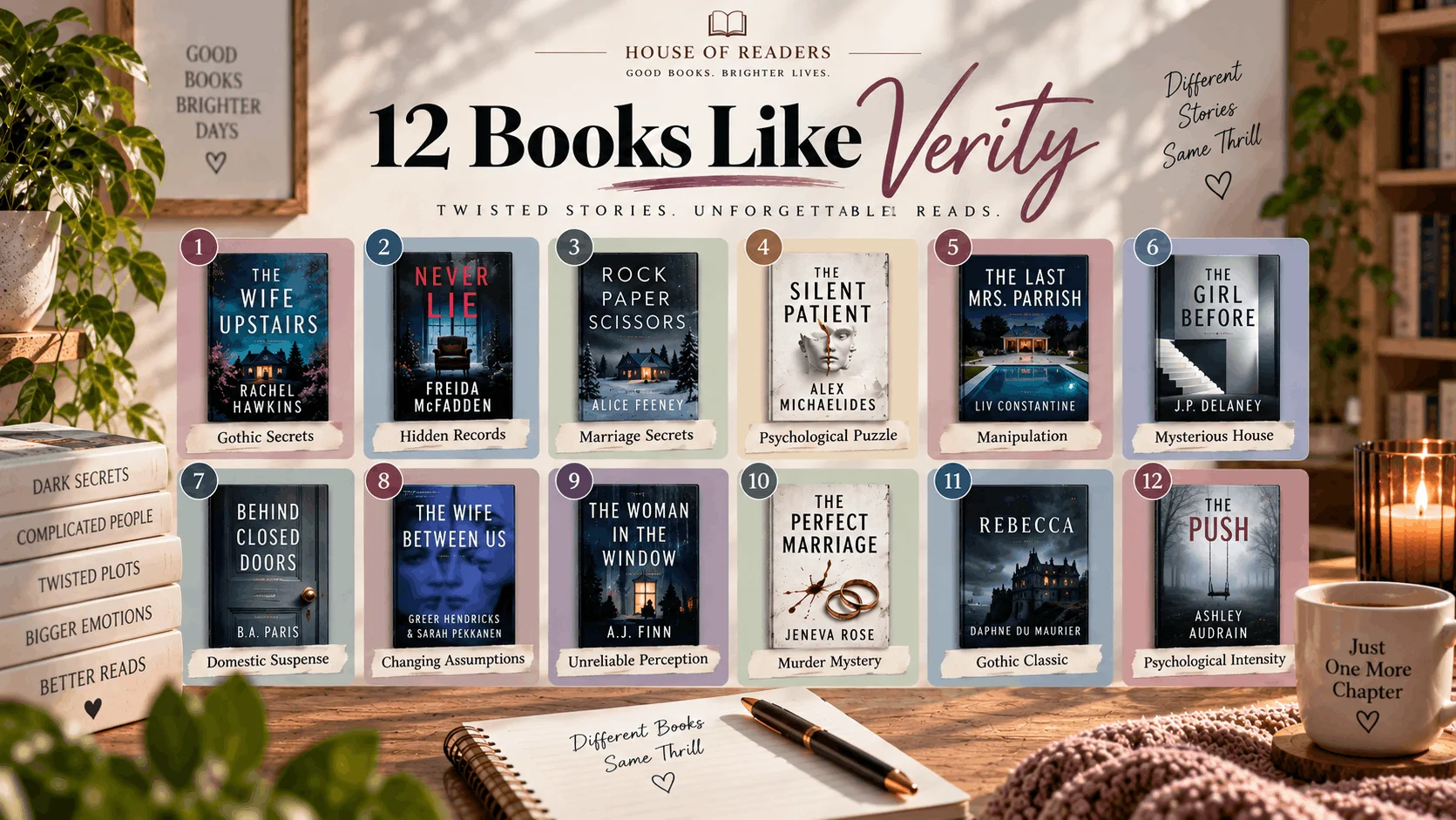
1. The Wife Upstairs by Rachel Hawkins
If you enjoyed the uncomfortable relationship dynamics and sense that something was wrong inside the Crawford household, The Wife Upstairs is one of the strongest places to go next.
Jane arrives in an affluent Alabama community and becomes involved with Eddie, a wealthy widower whose wife disappeared after a boating accident.
But the more Jane learns about Eddie and his previous marriage, the less straightforward the situation becomes.
Macmillan describes the novel as a modern gothic thriller combining domestic suspense, ambition, attraction, and murder.
Why Verity readers may like it
You get:
- a wealthy home
- a mysterious wife
- uncomfortable relationships
- changing assumptions
- hidden pasts
- gothic atmosphere
It is one of the closest matches on this list in terms of overall mood.
Best for: readers who loved the Crawford-house atmosphere.
2. Never Lie by Freida McFadden
Newlyweds Tricia and Ethan visit an isolated manor while looking for a new home.
A storm traps them there.
The property once belonged to psychiatrist Adrienne Hale, who disappeared years earlier.
When Tricia discovers recordings of Hale’s sessions with patients, those recordings begin revealing what happened before the psychiatrist vanished.
Why it feels similar to Verity
The strongest connection is obvious:
A character finds private material that was never meant for them.
In Verity, it is a manuscript.
In Never Lie, it is recorded sessions.
Both stories then ask you to decide what those discoveries actually mean.
You also get:
- an isolated house
- secrets from the past
- fast pacing
- shifting suspicion
- major reveals
Best for: readers who loved the hidden-manuscript element.
3. Rock Paper Scissors by Alice Feeney
Adam and Amelia travel to Scotland for an anniversary weekend that is supposed to help their struggling marriage.
Instead, the isolated setting begins exposing years of secrets.
Every anniversary, Amelia has written Adam a letter he has never read.
That detail becomes increasingly important as the weekend unfolds.
Why Verity readers may enjoy it
Both books explore the idea that knowing someone closely does not necessarily mean knowing them completely.
You get:
- relationship tension
- unread letters
- an isolated setting
- secrets accumulated over years
- multiple reasons to question what you are being told
Best for: readers who loved relationship uncertainty.
4. The Silent Patient by Alex Michaelides
Alicia Berenson appears to have an enviable life.
Then a shocking event involving her husband changes everything.
Afterward, Alicia refuses to speak.
Psychotherapist Theo Faber becomes determined to understand why.
Why it belongs on this list
Verity constantly pushes the reader toward one question:
What actually happened?
So does The Silent Patient.
Both stories are built around missing information and the danger of becoming too confident in one interpretation.
The tone is more clinical and mystery-driven than Verity, but the psychological puzzle is excellent.
Best for: readers who liked questioning every version of the truth.
5. The Last Mrs. Parrish by Liv Constantine
Amber Patterson wants the wealthy, polished life Daphne Parrish appears to have.
So she carefully works her way into Daphne’s world and into the Parrish family.
But the situation is far more complicated than Amber understands.
The author’s official site describes it as a psychological thriller about manipulation, wealth, deception, and a carefully planned attempt to enter a seemingly perfect marriage.
Why it works after Verity
The similarity is less about setting and more about character motives.
Everyone appears to want something.
Not everyone is telling the truth.
And your understanding of the relationships changes as the book progresses.
Best for: manipulation and shifting power.
6. The Girl Before by J.P. Delaney
After a traumatic experience, Emma moves into an extraordinary minimalist house designed by a controlling architect.
Later, Jane moves into the same property and begins discovering disturbing similarities between her own experience and Emma’s.
Penguin Random House describes the story as psychological suspense built around two women, a highly controlled home, deception, and a mysterious death.
Why Verity readers may like it
The house matters.
The past matters.
And one person’s experience begins changing another person’s understanding of what is happening.
It has the same feeling that the physical setting is holding information the protagonist has not yet uncovered.
Best for: mysterious houses and parallel stories.

7. Behind Closed Doors by B.A. Paris
Jack and Grace appear to have the kind of marriage other people admire.
But small details do not fit.
Grace is rarely seen without Jack.
She is difficult to contact independently.
And one bedroom window has bars.
B.A. Paris describes the book around a simple idea: sometimes the perfect marriage is the perfect lie.
Why it belongs here
If the household tension was what interested you most in Verity, this is a natural recommendation.
Both stories place the reader inside a home where the public version of a relationship and the private reality may be very different.
Best for: claustrophobic domestic suspense.
8. The Wife Between Us by Greer Hendricks and Sarah Pekkanen
This is the kind of thriller where the reader’s assumptions become part of the trick.
At first, the relationships may seem easy to understand.
Then the book begins changing the context.
Macmillan explicitly warns readers to “assume nothing,” positioning the story around hidden complexities inside an apparently understandable relationship.
Why Verity readers may enjoy it
If you liked finishing a chapter of Verity and realizing you needed to reconsider what you thought you knew, this should appeal to you.
It is particularly good for readers who enjoy:
- perspective shifts
- unreliable assumptions
- relationship secrets
- carefully withheld information
Best for: readers who enjoy being deliberately misled.
9. The Woman in the Window by A.J. Finn
Anna Fox lives alone and spends much of her time observing the neighborhood from her home.
Then she sees something disturbing through a window.
The problem is that proving what she witnessed becomes increasingly difficult.
The author’s official description repeatedly asks the reader to question what is real, imagined, dangerous, or under someone’s control.
Why it fits this list
This recommendation is about uncertainty.
The reader has information.
But can that information be trusted?
That makes it a strong match for anyone who enjoyed constantly reconsidering the manuscript and the people surrounding it in Verity.
Best for: unreliable perception and psychological suspense.
10. The Perfect Marriage by Jeneva Rose
Sarah Morgan is a successful criminal defense attorney.
Her husband Adam is struggling professionally.
Then a woman is found dead at the couple’s lake house and Adam becomes the primary suspect.
Sarah is left facing a case that is also deeply personal.
Why Verity readers may like it
The novel combines:
- marriage secrets
- a writer character
- suspicion
- competing explanations
- a central mystery
- major revelations
It is more crime-focused than Verity, but the relationship uncertainty makes it a good fit.
Best for: readers who want a stronger murder-mystery angle.
11. Rebecca by Daphne du Maurier
A young woman marries wealthy widower Maxim de Winter and moves with him to Manderley, his isolated estate.
But the memory of Maxim’s first wife, Rebecca, seems impossible to escape.
The estate, its staff, and Maxim himself all appear shaped by something that happened before the new Mrs. de Winter arrived.
Penguin Random House describes the novel as a chilling story in which she becomes determined to uncover the secrets surrounding Rebecca and Manderley.
Why Verity readers should consider it
Rebecca is much older and more atmospheric than Verity, but the connection is fascinating.
You get:
- a large house
- a mysterious wife
- a new woman entering an established relationship
- a past that refuses to stay buried
- information revealed gradually
gothic tension
If you want to see an earlier literary version of some of the ideas modern domestic thrillers still use, this is an excellent choice.
Best for: gothic atmosphere and slow-building tension.
12. The Push by Ashley Audrain
Blythe Connor becomes increasingly convinced that something is wrong within her family.
Her husband repeatedly questions her interpretation of events, which causes Blythe to question herself as well.
Penguin Random House describes The Push as a tense psychological drama built around family relationships, uncertainty, and whether the protagonist’s understanding of events can be trusted.
Why it works for Verity fans
This is one of the darker and more emotionally intense books on the list.
Its connection to Verity comes from uncertainty rather than plot.
The reader is repeatedly forced to ask:
Whose version of reality should I trust?
If that question was your favorite part of Verity, this is worth considering.
Best for: psychologically intense family drama.
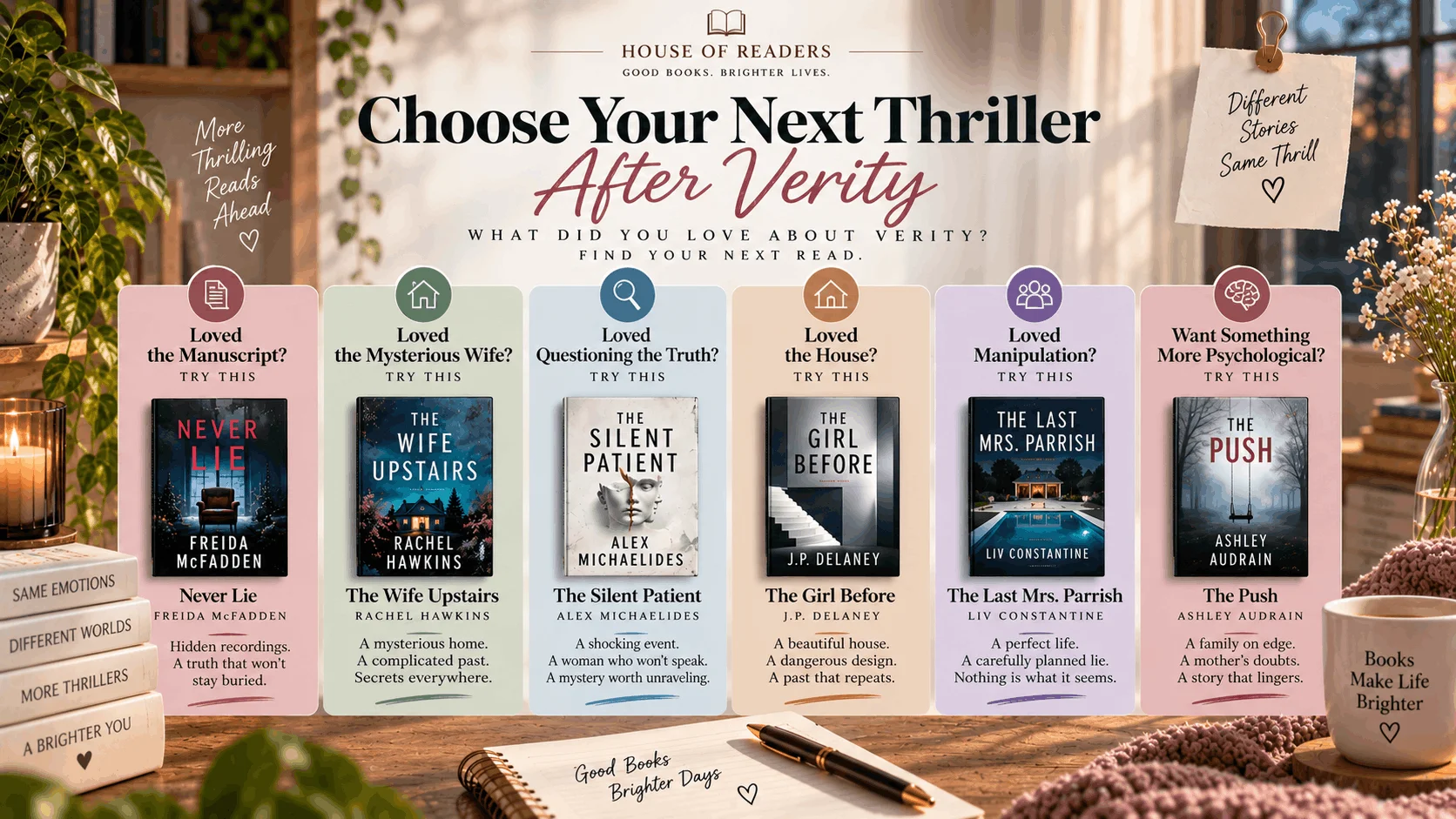
Choose Your Next Book Based on What You Loved About Verity
The easiest way to choose is to think about which part of Verity kept you reading.
If You Loved the Secret Manuscript
Read:
Never Lie
The cassette recordings provide the same feeling of discovering private information that was never intended for you.
You could also try:
Rock Paper Scissors
The unread anniversary letters slowly reveal another side of the marriage.
If You Loved the Mysterious Wife
Choose:
The Wife Upstairs
or:
Rebecca
Both center heavily on a woman trying to understand a relationship already shaped by another woman’s presence.
If You Loved Questioning the Truth
Try:
The Silent Patient
The Woman in the Window
The Wife Between Us
All three make uncertainty central to the reading experience.
If You Loved the House Setting
Start with:
The Girl Before
or:
Behind Closed Doors
Both use the home itself as part of the suspense rather than just as a background location.
If You Loved Manipulative Characters
Choose:
The Last Mrs. Parrish
It is one of the strongest recommendations here if you enjoy watching characters manipulate one another while hiding their true intentions.
If You Want Something More Psychological
Try:
The Push
It is less twist-driven than some of the other books here, but much more focused on perception, doubt, and emotional uncertainty.
Which Book Is Most Like Verity?
My overall choice is:
The Wife Upstairs
It has the strongest combination of:
- domestic suspense
- complicated relationships
- a mysterious wife
- secrets from the past
- attraction mixed with suspicion
- a house that matters to the story
It does not recreate Verity, but the emotional and psychological atmosphere feels familiar.
My second choice is:
Never Lie
Choose this if the manuscript itself was your favorite part of Verity.
The discovery of private recordings creates a similarly irresistible feeling of uncovering something you were never meant to know.
And my third choice is:
Rock Paper Scissors
Especially if relationship secrets and wondering what one partner knows about the other were what kept you interested.
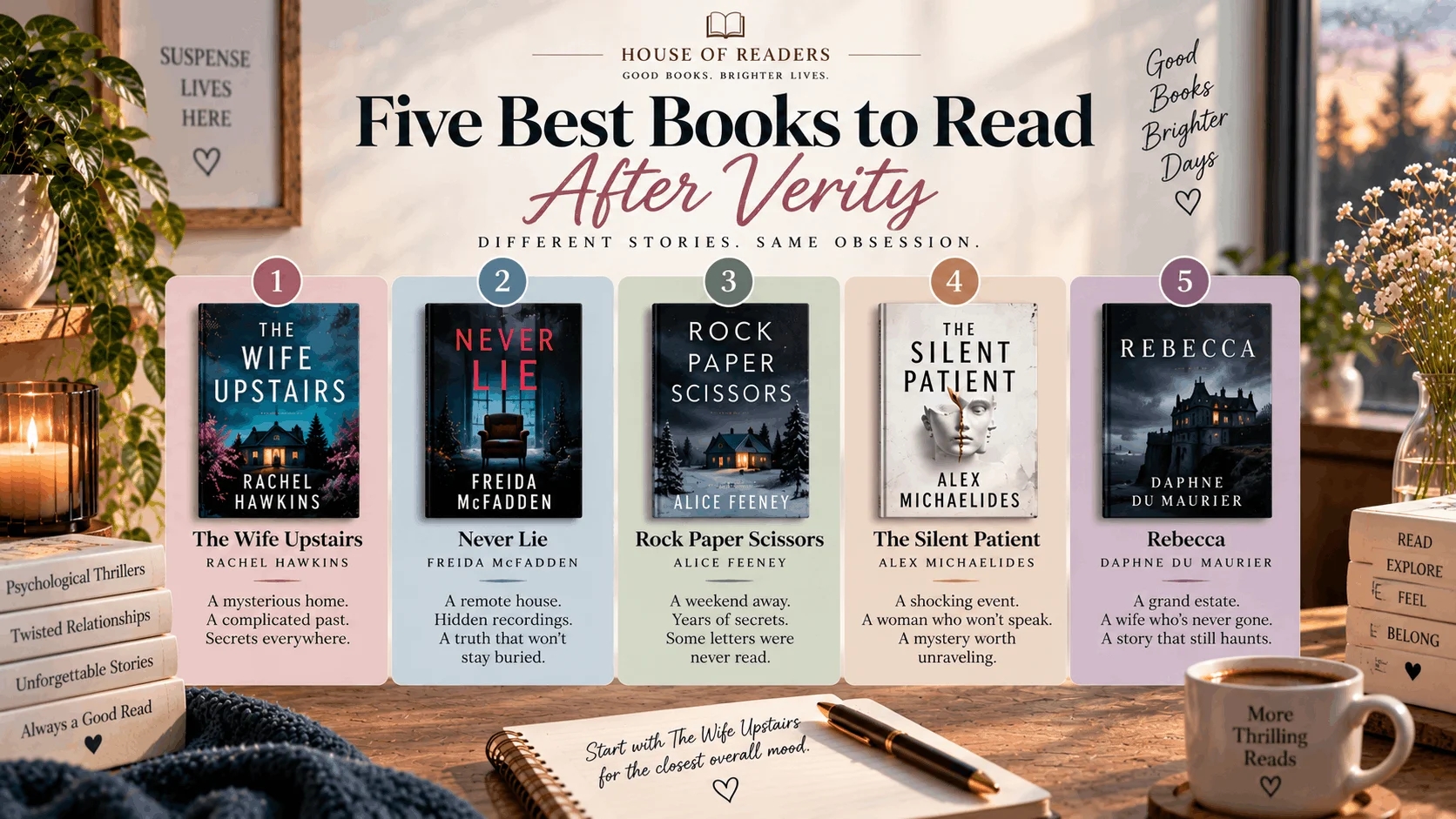
Five Best Books to Read After Verity
If you only want my final shortlist:
1. The Wife Upstairs
Best overall
2. Never Lie
Best for secret records
3. Rock Paper Scissors
Best relationship thriller
4. The Silent Patient
Best psychological mystery
5. Rebecca
Best gothic choice
Should You Read Another Colleen Hoover Book After Verity?
You certainly can, but there is something important to know.
Verity is not representative of every Colleen Hoover novel.
Her official site describes it as a standalone romantic thriller, while much of her wider catalogue focuses more heavily on contemporary and relationship-centered fiction.
So if what you specifically loved was the psychological suspense, moving directly into another thriller may make more sense.
If you want to explore more of her work instead, use our:
Colleen Hoover Books in Order: Complete 2026 Reading Guide
And if you have not read our spoiler-light review yet:
Verity Review: Is Colleen Hoover’s Thriller Worth Reading?
That gives us a clean content cluster:
Verity Review → Colleen Hoover Books in Order → Books Like Verity
Are These Books as Dark as Verity?
Some are.
Others are more traditional psychological thrillers.
If you want something closest to Verity’s unsettling atmosphere, I would prioritize:
- The Wife Upstairs
- Never Lie
- Behind Closed Doors
- The Push
- Rebecca
If you want something more puzzle-focused and less emotionally heavy:
- The Silent Patient
- The Wife Between Us
- The Woman in the Window
And if you mainly want twists:
- Rock Paper Scissors
- The Last Mrs. Parrish
- The Perfect Marriage
This makes it easier to choose based on your tolerance for darker material without making sensitive content the focus of the recommendation.
Final Recommendation
If you finished Verity wanting another story with a mysterious home, complicated relationships, and a wife whose presence shapes everything around her, read The Wife Upstairs.
If the secret manuscript was what fascinated you most, choose Never Lie.
If the relationship deception interested you more, try Rock Paper Scissors.
If you want a pure psychological puzzle, read The Silent Patient.
And if you want something slower, more atmospheric, and gothic, go back to Rebecca.
The best follow-up to Verity is not necessarily the book with the closest plot.
It is the book that recreates the particular kind of uncertainty that made you keep turning pages.
Frequently Asked Questions
My first recommendation is The Wife Upstairs by Rachel Hawkins because it combines domestic suspense, relationship secrets, a mysterious wife, and gothic atmosphere.
The Wife Upstairs is my closest overall match. Never Lie is the stronger choice if the hidden manuscript was specifically what you enjoyed most.
Try Never Lie, where recordings belonging to a missing psychiatrist gradually reveal what happened before her disappearance.
Try The Silent Patient, The Wife Between Us, or Rock Paper Scissors. All are built around information that changes how the reader understands earlier events.