
The Fury Review: Is Alex Michaelides’ Island Mystery Worth Reading?
The Fury is Alex Michaelides’ third novel, following The Silent Patient and The Maidens.
This time, he moves away from therapy rooms and university corridors and into something more glamorous:
a private Greek island, a famous former movie star, a small circle of old friends, buried resentment, and a murder.
At first glance, it sounds like a classic locked-room mystery.
But The Fury is less interested in simply asking who did it?
It is more interested in asking:
Who is telling the story, why are they telling it this way, and how much should you believe them?
That makes it a very different Alex Michaelides novel.
It is theatrical, self-aware, deliberately manipulative, and built around one of the most unreliable narrators in his work.
The result is clever and atmospheric, though it may frustrate readers who prefer mysteries that play completely straight.
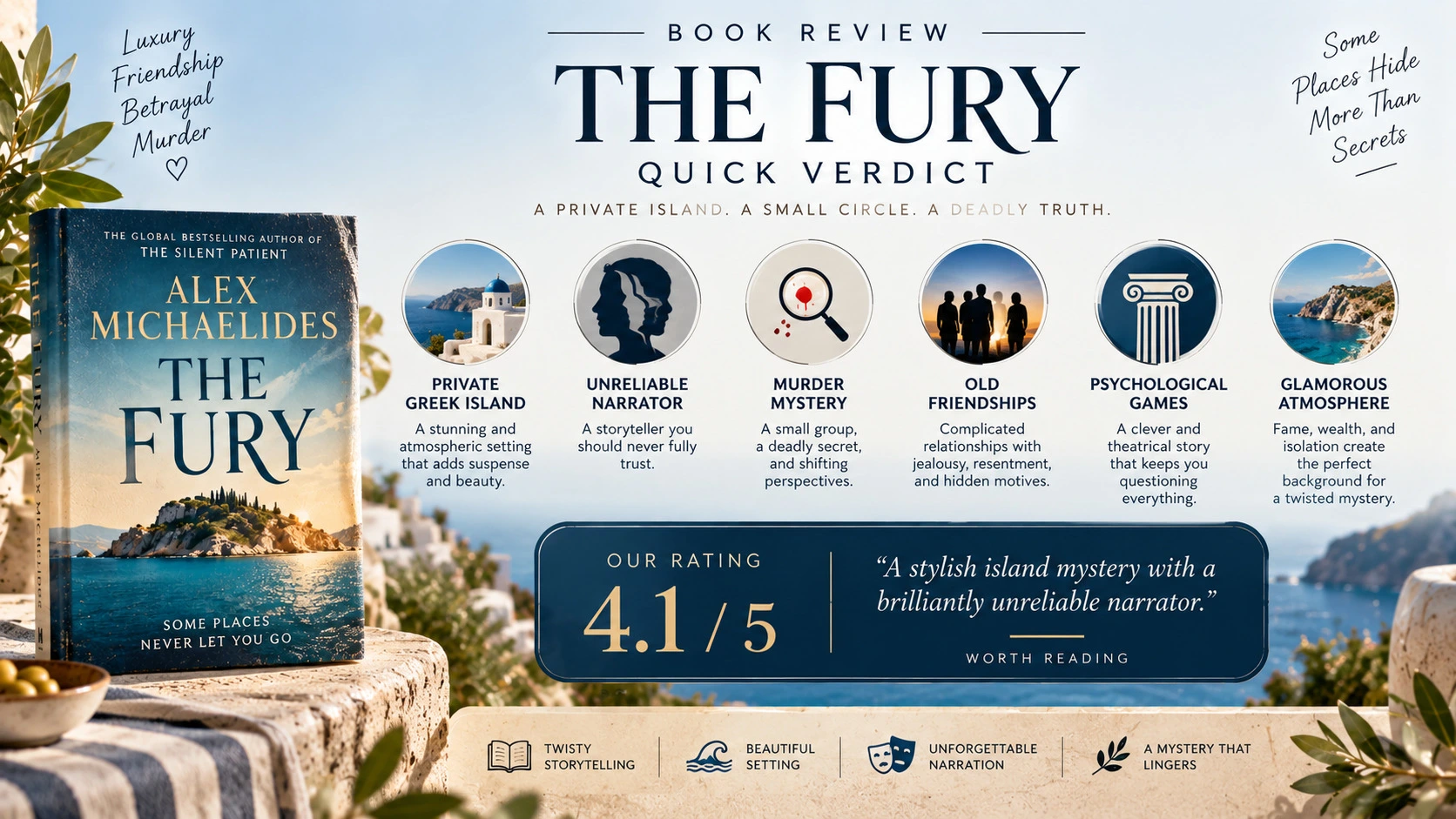
Quick Verdict
Rating: 4.1 out of 5
The Fury is a stylish island mystery built around unreliable storytelling rather than a traditional detective structure.
Its biggest strengths are:
- the private Greek island setting
- an unusual and highly unreliable narrator
- elegant, theatrical storytelling
- a small cast with complicated relationships
- shifting perspectives on what really happened
- strong atmosphere
- a satisfying sense that the story is constantly changing underneath you
Its biggest weakness is also its central idea.
The narration is so deliberately manipulative that some readers may feel the book is playing games rather than allowing them to solve the mystery fairly.
If you enjoy unconventional mysteries, unreliable narrators, Agatha Christie-style settings, and stories where the way something is told matters as much as what happened, The Fury is worth reading.
What Is The Fury About?
The story centers on Lana Farrar, a reclusive former movie star who invites a small group of close friends to spend Easter on her private Greek island.
It should be an escape from the English weather.
Instead, the island becomes the setting for murder.
The group finds itself isolated overnight as old friendships, jealousy, resentment, and hidden motives begin surfacing.
But the story is not told in a conventional way.
The narrator is Elliot Chase, one of the people on the island.
He tells us immediately that this is his version of events.
And that distinction matters.
Elliot constantly shapes the story.
He interrupts.
He explains.
He rewinds.
He reframes things you thought you understood.
And he repeatedly reminds you that storytelling itself can be a form of manipulation.
The publisher describes the novel as a thriller about a reclusive ex-movie star, her famous friends, a private Greek island, and a murder, with Elliot Chase narrating what happened.
The Greek Island Setting Is Excellent
One of the strongest parts of The Fury is the setting.
The island feels beautiful but unstable.
There is:
- sun
- sea
- isolation
- luxury
- wind
- old friendships
- emotional tension
Michaelides uses the Greek island atmosphere extremely well.
The beauty of the location makes the increasingly hostile relationships feel even more uncomfortable.
There is something appealing about a murder mystery taking place somewhere that looks like paradise.
That contrast gives the book much of its personality.
The publisher’s synopsis specifically emphasizes the private Greek island and the group being trapped there overnight by the wind.
The Narrator Is the Real Mystery
The most interesting thing about The Fury is not necessarily the murder.
It is Elliot.
From the beginning, you know he is controlling the story.
He speaks directly to the reader.
He decides what information you receive.
He changes emphasis.
He comments on storytelling.
He sometimes seems more interested in performing the story than simply telling it.
That creates an unusual relationship between reader and narrator.
You keep asking:
Is Elliot lying?
Is he hiding something?
Is he exaggerating?
Does he even understand his own motivations?
This is where The Fury feels most different from a standard mystery.
The book asks you to investigate the storyteller as much as the crime.
The Structure Is Very Theatrical
Michaelides has a background in screenwriting, and The Fury often feels deliberately staged.
The story is divided and presented almost like a performance.
Characters enter.
Relationships are revealed.
Scenes are reconsidered.
Important moments are replayed from new angles.
That approach works particularly well because many of the characters are connected to performance, celebrity, and image.
There is a sense that everyone is playing some kind of role.
Elliot is simply the person controlling the stage.

The Cast Is Small, Which Helps the Mystery
A limited cast works well in this kind of story.
There are fewer people to track.
That means the book can spend more time examining:
- relationships
- jealousy
- resentment
- power
- loyalty
- betrayal
Every person on the island potentially matters.
That creates the classic closed-circle mystery feeling where suspicion moves from one person to another.
The difference is that instead of simply asking which character is guilty, you are also questioning whether Elliot has described everyone accurately.
Lana Farrar Gives the Story Its Glamour
Lana is a former movie star who has withdrawn from public life.
That immediately gives the story a touch of old-Hollywood glamour.
She is wealthy.
Famous.
Private.
And surrounded by people whose relationships with her are more complicated than they first appear.
Her celebrity adds another layer to the story because image becomes important.
There is a difference between:
who someone appears to be
and:
who they actually are
That theme fits perfectly with the unreliable narration.
The Book Is More About Relationships Than Investigation
Readers expecting a detective-style murder investigation should know this before starting.
The Fury is not primarily about collecting clues.
It spends more time exploring:
- romantic tension
- emotional dependence
- resentment
- friendship
- jealousy
- obsession
- manipulation
The murder matters.
But the emotional history between the characters matters just as much.
In that sense, the book is closer to a psychological drama wrapped inside a murder mystery.
How Is the Pacing?
The pacing is unusual.
The book moves quickly in terms of chapter length and readability.
But the story itself frequently pauses to reconsider previous events.
Elliot may tell you something.
Then return to it.
Then explain why the original version was incomplete.
That means the plot is constantly moving forward and backward at the same time.
Some readers will find that clever.
Others may feel impatient.
I would describe the pacing as:
fast to read, but deliberately winding in structure.
Is The Fury Easy to Read?
Yes.
The prose is accessible.
The chapters are manageable.
The cast is relatively small.
The setting is easy to visualize.
The complexity comes from the narrative structure rather than difficult writing.
You may occasionally need to reconsider what you thought happened, but the book itself is not dense.
Is The Fury Scary?
No.
It is a mystery and psychological thriller rather than horror.
The tension comes from:
- isolation
- unpredictable relationships
- unreliable narration
- murder
- hidden resentment
- manipulation
The atmosphere can become tense, but the novel is more clever and theatrical than frightening.
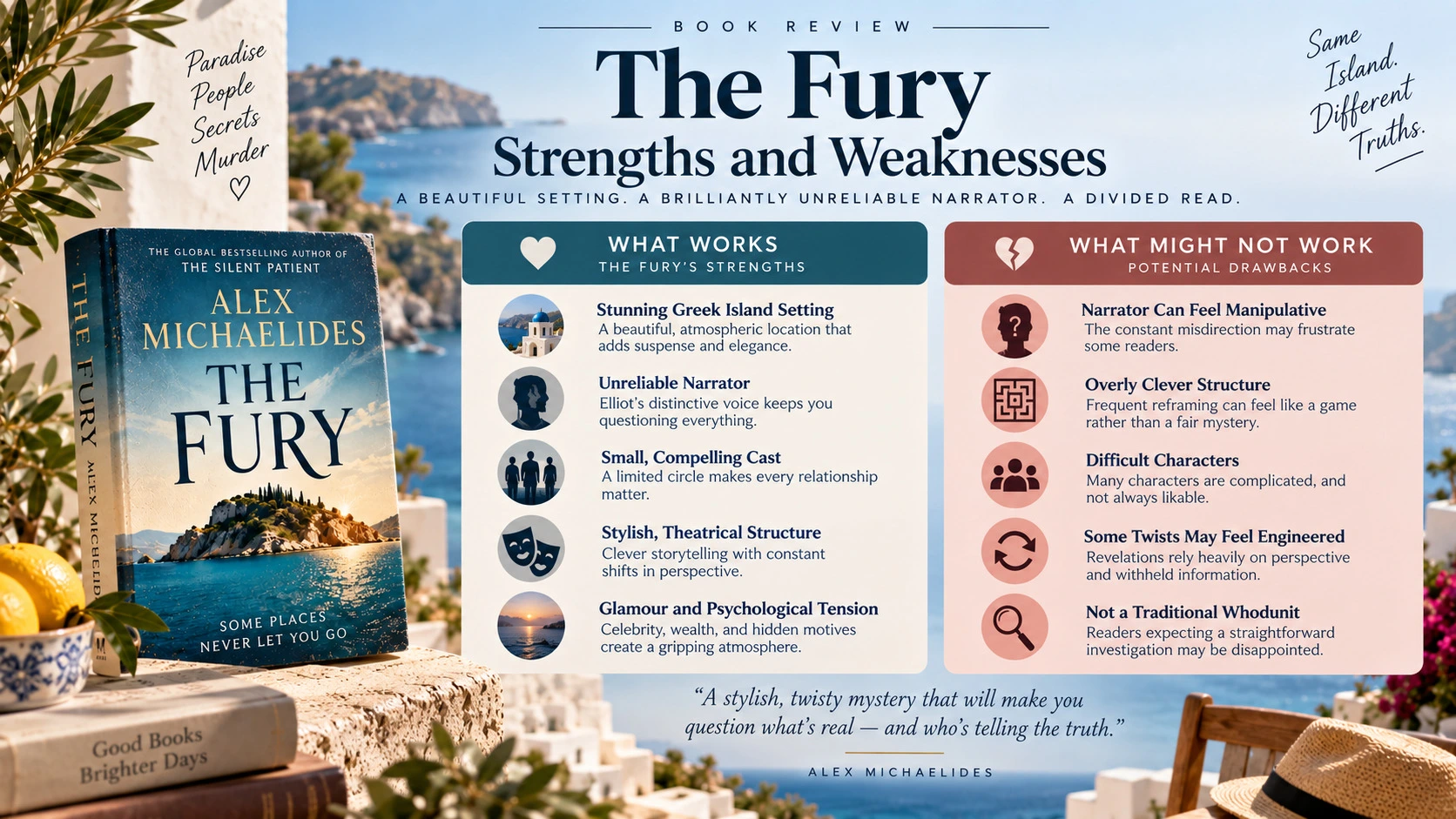
What Works Best
1. The Greek island atmosphere
This may be the strongest element of the book.
The island feels luxurious, isolated, and increasingly dangerous.
2. Elliot’s narration
Whether you trust him or not, his voice gives the novel a strong identity.
3. The structure
The book constantly reshapes what you think you know.
4. The small cast
The limited group makes every relationship matter.
5. Psychological manipulation
Michaelides understands how to make readers question their assumptions.
6. The glamorous setting
Celebrity, wealth, old friendships, and private-island isolation give the book an elegant murder-mystery feel.
What Might Not Work for Everyone
1. The narrator can feel manipulative
That is intentional.
But not everyone enjoys a book that repeatedly changes the rules.
2. The structure can feel overly clever
Some readers may feel the novel is more interested in surprising them than letting the mystery develop naturally.
3. The characters are not always deeply likable
The relationships are compelling, but several characters are difficult people.
4. Some twists may feel engineered
The book relies heavily on perspective and withheld information.
5. It is not a traditional whodunit
Readers expecting a straightforward clue-based mystery may be disappointed.
The Fury vs The Silent Patient
These books feel very different.
- Therapy setting
- Psychological mystery
- More contained
- Mystery around silence
- Stronger psychological focus
- Dark clinical atmosphere
The Fury
- Private Greek island
- Closed-circle murder mystery
- More theatrical
- Mystery around storytelling
- Strong unreliable narrator focus
- Glamorous Mediterranean atmosphere
If you want a tighter psychological thriller, choose The Silent Patient.
If you want a more playful, theatrical mystery, choose The Fury.
The Fury vs The Maidens
The difference here is also significant.
The Maidens
- Cambridge University
- Dark academia
- Greek tragedy references
- More traditional investigation
- Slower academic atmosphere
- Suspicious professor
The Fury
- Private Greek island
- Mediterranean glamour
- Classic murder-mystery influence
- More experimental narration
- Faster and more theatrical
- Suspicious storyteller
I think The Maidens has the stronger setting if you love dark academia.
But The Fury is more structurally ambitious.
Do You Need to Read The Silent Patient or The Maidens First?
No.
The Fury works as a standalone novel.
You can read it without reading Alex Michaelides’ earlier books.
However, I still recommend publication order if you plan to read all three:
- The Silent Patient
- The Maidens
- The Fury
Michaelides’ official site currently lists those three novels in that sequence.
You can see our full guide here:
Alex Michaelides Books in Order: Complete Reading Guide
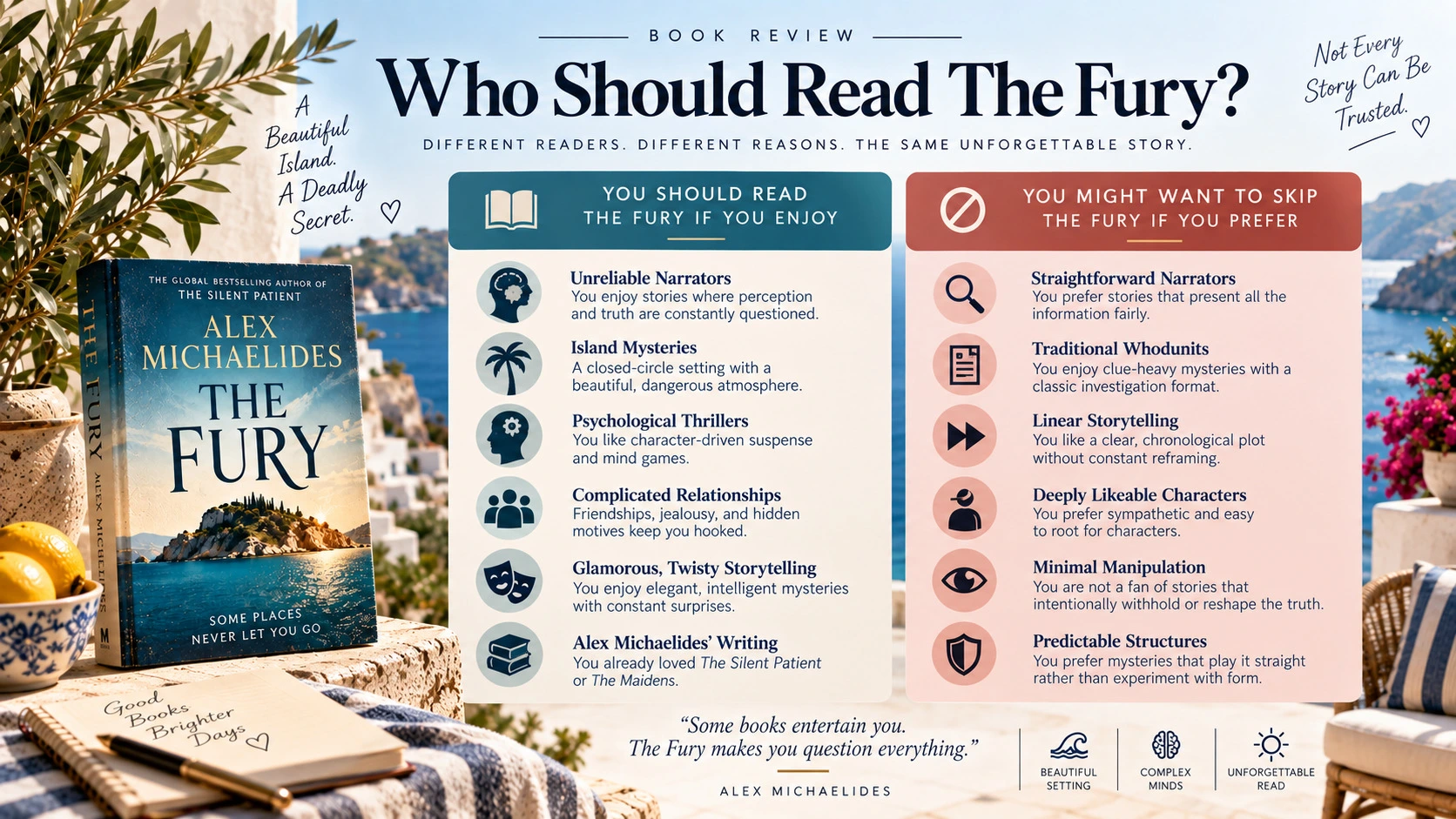
Who Should Read The Fury?
You should consider The Fury if you enjoy:
- unreliable narrators
- Greek island settings
- closed-circle mysteries
- wealthy and complicated characters
- psychological manipulation
- old friendships with hidden resentment
- glamorous murder mysteries
- stories that constantly change perspective
- Agatha Christie-style setups with a modern psychological approach
Who Might Want to Skip It?
It may not be the best fit if you strongly prefer:
- straightforward narrators
- clue-heavy detective fiction
- traditional chronological storytelling
- deeply sympathetic characters
- mysteries where all information is presented fairly from the beginning
The book deliberately plays with narrative reliability.
If that kind of storytelling frustrates you, The Fury may not work.
Is the Twist Good?
Without spoilers, The Fury does not rely on just one final twist.
The entire story is built around reinterpretation.
Something happens.
Then you learn more.
Then your understanding changes.
Then Elliot changes the frame again.
That makes the ending feel less like:
Here is the one big secret
and more like:
Here is the final version of the story you thought you understood.
I enjoyed that approach.
But it is also why the book may divide readers.
If you enjoy being manipulated by an unreliable narrator, it is fun.
If you want the story to play completely fair, you may find it frustrating.
Is The Fury Worth Reading?
Yes.
Especially if you approach it as an unconventional psychological mystery rather than a traditional whodunit.
The setting is memorable.
The narration is distinctive.
The structure keeps changing.
And the private island creates exactly the kind of closed environment this story needs.
The book was published on January 16, 2024, and is Michaelides’ third novel.
It is not my favorite Alex Michaelides novel.
I still think The Silent Patient is the strongest overall.
But The Fury may be his most playful experiment with storytelling.
Final Rating
4.1/5
Atmosphere: 4.5/5
The Greek island setting is one of the book’s biggest strengths.
Mystery: 4/5
Interesting and unpredictable, though less traditional than some readers may expect.
Characters: 3.8/5
Complicated and useful to the story, although not always deeply sympathetic.
Pacing: 4/5
Fast to read despite the constant narrative reframing.
Narration: 4.4/5
Distinctive, manipulative, and central to the entire experience.
Ending: 4/5
Clever and satisfying if you enjoy the book’s storytelling games.
Overall: 4.1/5
The Fury is a stylish, self-aware murder mystery with a beautiful setting and a narrator you should never fully trust.
For readers who enjoy psychological games as much as solving the crime itself, it is an easy recommendation.

What to Read After The Fury
If you have not read Michaelides’ earlier novels, the natural next choices are:
The Silent Patient Review: Is It Worth Reading?
and:
The Maidens Review: Is Alex Michaelides’ Thriller Worth Reading?
For the complete reading sequence:
Alex Michaelides Books in Order: Complete Reading Guide
If you want similar psychological thrillers instead:
Frequently Asked Questions
It is a standalone novel. You do not need to read The Silent Patient first.
It can also be read independently from The Maidens. If you plan to read all three Michaelides novels, publication order is still my preferred sequence.