How to Choose What Book to Read Next
Choosing your next book should feel exciting.
But sometimes it does not.
You finish one book, open your reading list, scroll through dozens of options, and somehow end up choosing nothing.
The problem is usually not a lack of books.
It is too many choices.
The easiest way to decide what to read next is to stop asking:
What is the best book?
and start asking:
What kind of reading experience do I want right now?
Once you answer that, choosing becomes much easier.
Quick Answer: How Do You Choose What Book to Read Next?
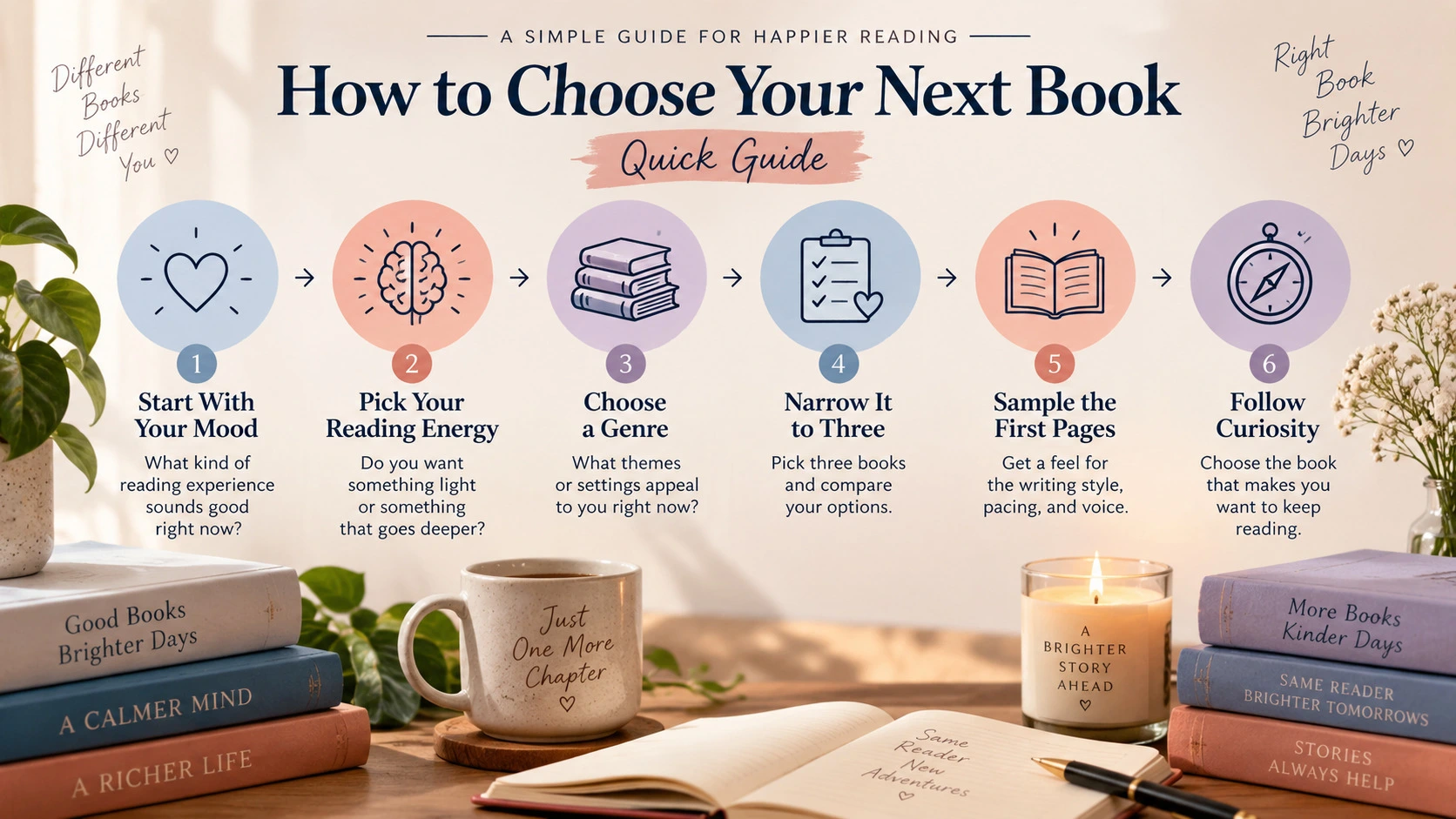
Start with five questions:
- What mood are you in?
- Do you want something fast or immersive?
- How much time and attention do you have?
- What genre sounds appealing right now?
- Do you want something familiar or completely different?
Then reduce your options to three books.
Read the descriptions.
Open the first few pages if possible.
Choose the one you feel most curious about.
That is usually a better method than choosing the book you think you should read.
1. Start With Your Mood
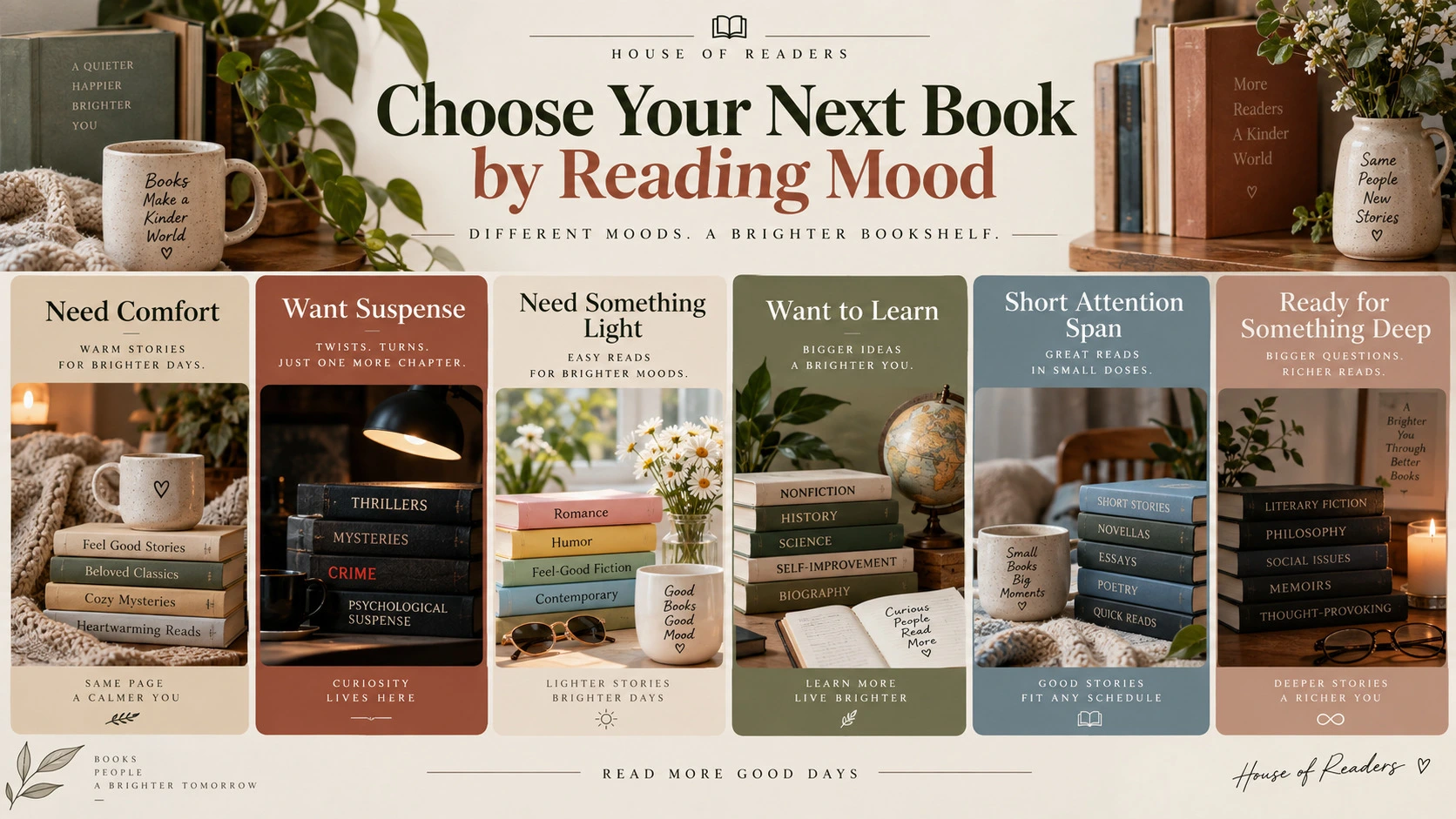
Mood is one of the easiest ways to narrow down your choices.
Ask yourself what kind of experience sounds good right now.
Maybe you want:
- something exciting
- something comforting
- something mysterious
- something emotional
- something funny
- something immersive
- something easy to read
Your mood does not need to match what you normally read.
You may usually love thrillers but currently want something calm.
Or you may normally prefer romance but suddenly want a mystery.
That is completely fine.
Choosing by mood helps you pick the book that fits the version of you who is reading today.
2. Decide How Much Mental Energy You Have
Not every book requires the same level of attention.
Some books are easy to fall into.
Others ask more from you.
Think about how much focus you realistically have.
If you are tired, busy, or mentally overloaded, you may prefer:
- shorter chapters
- simpler prose
- faster pacing
- familiar genres
- straightforward plots
If you have more time and energy, you may enjoy:
- longer novels
- complex fantasy worlds
- literary fiction
- slower stories
- books with larger casts
There is nothing wrong with choosing an easier read.
The right book is the one that fits your life right now.
3. Ask Whether You Want Fast or Immersive
Some days you want a book that pulls you forward immediately.
Other days you want somewhere to stay for a while.
A fast read may work best if you want:
- short chapters
- strong suspense
- quick plot movement
- immediate stakes
- an easy weekend read
An immersive read may suit you if you want:
- detailed worldbuilding
- slower character development
- atmosphere
- a longer story
- more emotional investment
Neither is better.
They simply create different reading experiences.
4. Choose the Experience Before the Genre
Genre is useful.
But sometimes the experience matters more.
Instead of saying:
I want a thriller
try saying:
I want something tense and twisty.
Instead of:
I want fantasy
try:
I want somewhere completely different from real life.
Instead of:
I want romance
try:
I want something warm and emotionally satisfying.
This can open up books you may not have considered.
5. Think About What You Just Finished
Your previous book can help you decide what comes next.
Ask:
Do I want more of this, or do I want the opposite?
If you just finished a dark thriller, you may want another intense mystery.
Or you may want something completely lighter.
If you just finished a long fantasy novel, you may prefer a short contemporary book next.
There is no rule that says your reading has to stay consistent.
Sometimes contrast is exactly what keeps reading enjoyable.
6. Narrow Your Choices to Three Books
Too many options make decisions harder.
Instead of looking through your entire reading list, choose only three.
For example:
Option 1: familiar genre
Option 2: something different
Option 3: the book you have been meaning to read
Then compare only those three.
This removes a lot of unnecessary decision-making.
If one immediately feels more exciting than the others, you probably already have your answer.
7. Read the First Few Pages
A description tells you what the book is about.
The first pages tell you what reading it actually feels like.
Pay attention to:
- writing style
- pacing
- voice
- atmosphere
- how quickly you become curious
You do not need to analyze it deeply.
Just ask:
Do I want to keep reading?
That simple question can be more useful than reviews, ratings, or popularity.
8. Do Not Let Ratings Choose for You
Ratings can be helpful.
But they should not make the decision for you.
A book with a huge average rating may still be completely wrong for your current mood.
A lower-rated book may be exactly what you want.
Reader opinions are influenced by:
- genre preferences
- expectations
- pacing preferences
- writing-style preferences
- personal taste
Use ratings as additional information.
Do not treat them as instructions.
9. Use Reviews to Check Fit, Not Just Quality
The most useful question in a review is not always:
Is this book good?
A better question is:
Is this book good for me?
Look for reviews that explain:
- pacing
- atmosphere
- writing style
- character focus
- mystery level
- emotional intensity
- who the book suits
That is why our House of Readers reviews focus heavily on what to expect and who should read it.
A book can be excellent and still not be what you want today.
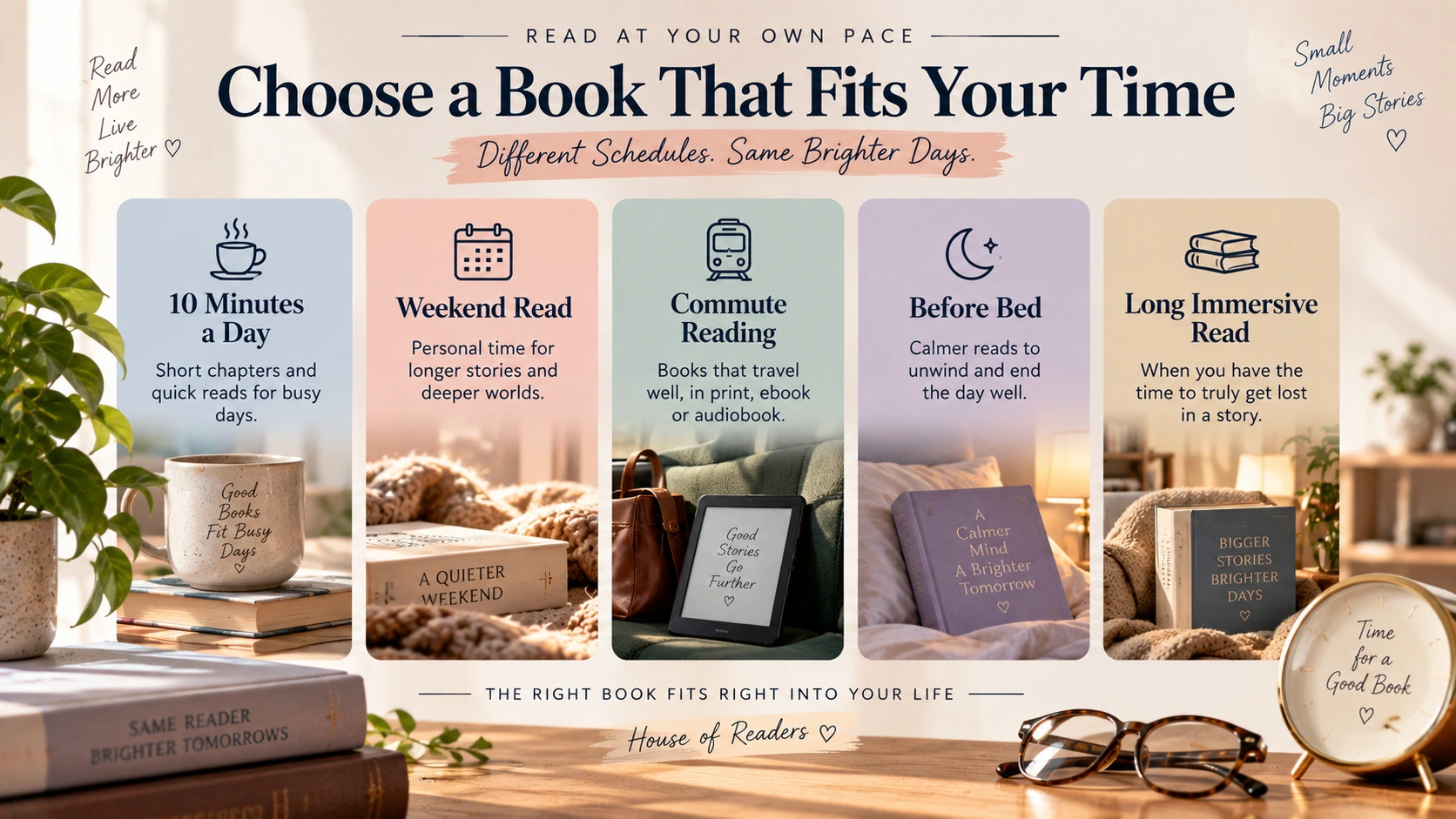
10. Pick a Book That Matches Your Available Time
Your schedule matters.
If you have a quiet weekend ahead, a longer novel may be perfect.
If you only have small reading windows, you may prefer:
- short chapters
- a novella
- an audiobook
- an ebook you can carry anywhere
- a faster thriller
Choosing based on real life makes it much easier to actually finish the book.
11. Keep a Small Ready-to-Read List
A huge reading list can become overwhelming.
Instead, keep a smaller list of books you genuinely want to start soon.
Think of it as your next five, not your entire TBR.
Your list might include:
- one thriller
- one comfort read
- one longer book
- one wildcard
- one book from an author you already like
When you finish a book, choosing from five is much easier than choosing from fifty.
12. Follow Curiosity
This may be the most important rule.
If one book keeps pulling your attention back, choose it.
You may not have the perfect logical reason.
You may simply like:
- the premise
- the cover
- the setting
- the first page
- the author
- the mood
That is enough.
Reading should not always need justification.
Curiosity is a perfectly good reason to begin.
What If You Have Too Many Books to Choose From?
Use a quick elimination method.
Remove anything that:
- feels too long for your current schedule
- does not match your mood
- feels like an obligation
- you have repeatedly avoided
- no longer interests you
Then choose from what remains.
Your reading list is not a contract.
You are allowed to change your mind.
What If Nothing Sounds Good?
Sometimes this is not a book-selection problem.
You may simply be tired.
Instead of forcing yourself to choose something ambitious, try:
- rereading an old favorite
- a short story collection
- a novella
- an audiobook
- a graphic novel
- something from a familiar author
The goal is to make reading feel easy again.
Should You Read a Popular Book Just Because Everyone Else Is?
Only if it genuinely interests you.
Popularity can be useful because it introduces you to books you might otherwise miss.
But popularity does not guarantee personal enjoyment.
If the premise sounds good, try it.
If not, skip it.
You are not behind because you have not read every trending book.
Should You Choose a Book by Genre or Author?
Both can work.
Choose by genre when you want a specific mood or style.
Choose by author when you already trust their writing.
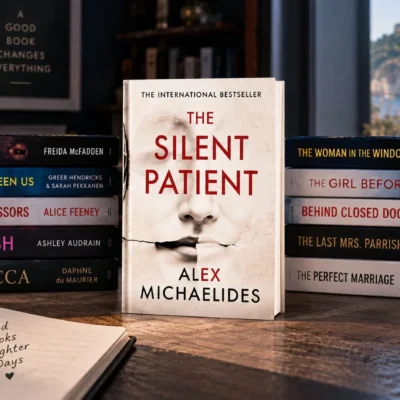
For example, if you enjoyed The Silent Patient, continuing with Alex Michaelides is an easy path.
You can use our:
Alex Michaelides Books in Order: Complete Reading Guide
If you enjoyed The Housemaid, you may want:
Freida McFadden Books in Order: Complete 2026 Guide
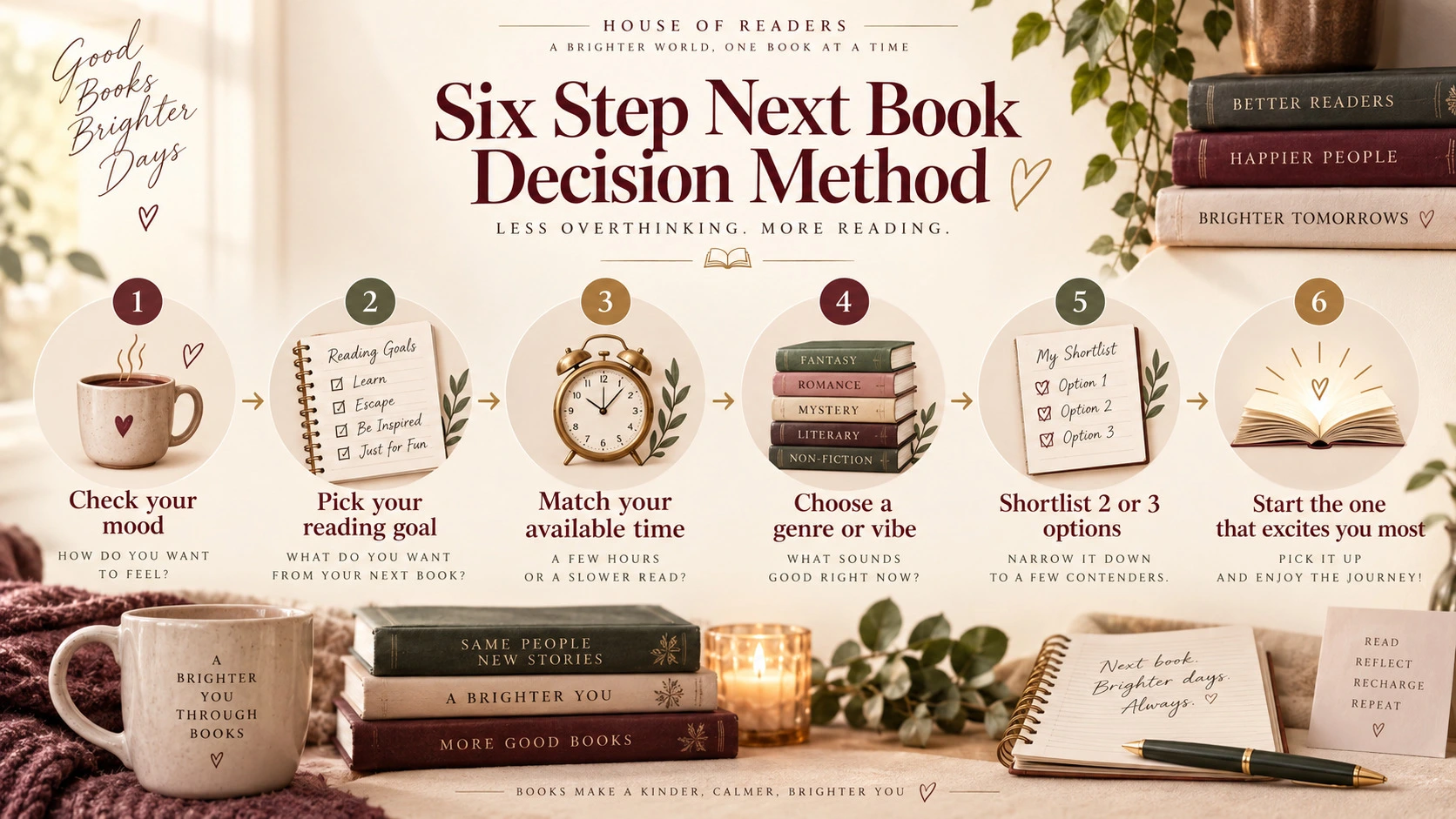
A Simple Next-Book Decision Method
Use this whenever you cannot decide.
Step 1
Choose your mood.
Step 2
Decide whether you want fast or immersive.
Step 3
Choose three books.
Step 4
Read each description.
Step 5
Sample the first few pages.
Step 6
Pick the book you are most curious about.
If you still cannot decide, choose one randomly from the final two.
The goal is not to make the perfect choice.
It is to start reading.
Books to Try Based on Your Mood
If you want something psychological and twisty:
Read our review:
If you want dark academia and atmosphere:
If you want fast domestic suspense:
If you want psychological tension and relationship secrets:
These are useful starting points if you already know the type of reading experience you want.
Final Thoughts
Choosing what to read next becomes much easier when you stop searching for the perfect book.
Start with your mood.
Be realistic about your time and attention.
Narrow your choices.
Read the first few pages.
And choose the book that makes you want to continue.
The best next book is not always the highest rated, most popular, or most impressive.
It is the one you are genuinely excited to open.