
Daisy Darker is the kind of thriller that immediately tells you what sort of experience it wants to deliver.
A dysfunctional family.
A crumbling house on a tiny private island.
Halloween.
A tide that cuts everyone off from the mainland.
And then, one by one, people start dying.
Alice Feeney uses that setup to create a closed-circle mystery built around family resentment, old secrets, unreliable memories, and the uncomfortable feeling that everyone knows more than they are saying.
If you enjoy isolated-house thrillers, family mysteries, and stories where every character could be hiding something, Daisy Darker is an easy book to consider.
The bigger question is whether the mystery stays satisfying once the major reveals arrive.
For me, mostly yes.
Quick Verdict
Rating: 4.3 out of 5
Daisy Darker is a clever, atmospheric family thriller with one of Alice Feeney’s strongest settings.
Its biggest strengths are:
- the isolated Cornish island
- the tide-cut house
- the dysfunctional family
- a small group of suspects
- strong atmosphere
- dark family history
- steady reveals
- an ending designed to reframe the story
The biggest weakness is that the novel sometimes depends heavily on misdirection, and the final reveal may work better for some readers than others.
But if you enjoy locked-room-style mysteries with complicated families and a slightly gothic atmosphere, this is one of Feeney’s more distinctive thrillers.
Feeney’s official site describes the Darker family gathering at Seaglass, a crumbling house on a tiny private island in Cornwall, where the incoming tide cuts them off from the mainland for eight hours and someone among them is a killer.

What Is Daisy Darker About?
Daisy Darker arrives at her grandmother’s home for an unusual family gathering.
The occasion is Nana’s eightieth birthday.
The date is Halloween.
And the location is Seaglass, an old house sitting on its own tiny island off the Cornish coast.
The family has not all been together for years.
That alone creates tension.
Then the tide rises.
The island becomes inaccessible.
Everyone is trapped together until the water recedes.
And before that can happen, someone dies.
Then someone else.
The question quickly becomes:
Who is killing the Darker family, and why?
Feeney’s official description emphasizes the isolated island, the Darker family reunion, and the eight-hour period during which the tide cuts them off completely.
The Setting Is One of the Book’s Biggest Strengths
The house does a lot of work.
Seaglass feels old.
Uncomfortable.
Cut off.
And full of memories.
The island setting makes every family conflict feel more intense because there is nowhere to go.
No one can simply leave.
No one can escape an argument.
And once the deaths begin, the physical isolation becomes much more threatening.
The tide is especially effective because it creates a natural deadline.
The family knows they are trapped.
The reader knows they are trapped.
And everyone has to survive until morning.
The Darker Family Is Full of Resentment
This is not a warm family reunion.
Old grudges surface quickly.
Relationships are complicated.
People remember the past differently.
And almost everyone has reasons to be angry, defensive, or suspicious.
That gives the book much of its tension.
The mystery is not only:
Who is killing people?
It is also:
What happened in this family long before tonight?
That second question becomes increasingly important.
Daisy Is an Interesting Point-of-View Character
Daisy is not simply observing the chaos.
Her own family history matters.
Her relationships matter.
Her childhood memories matter.
And the way she understands the family becomes central to the story.
This makes the novel feel personal rather than purely procedural.
You are not just watching a group of suspects.
You are watching one character revisit a family she has never fully escaped.
The Closed-Circle Structure Works Well
A good closed-circle mystery needs a few things:
- a limited number of suspects
- a believable reason nobody can leave
- old tensions between characters
- enough secrets to keep suspicion moving
- a setting that adds pressure
Daisy Darker has all of them.
The tide solves the escape problem naturally.
The family history supplies motive.
And the house keeps everyone physically close.
That makes the mystery easy to follow while still leaving room for suspicion to shift.

The Atmosphere Is Stronger Than the Violence
This is not a book that depends mainly on graphic scenes.
The tension comes from:
- the isolated house
- the incoming tide
- family hostility
- secrets from childhood
- uncertainty about who can be trusted
- the feeling that the past is still present
That gives the novel a slightly gothic quality without turning it into horror.
The house feels haunted by memory even when nothing supernatural is happening.
The Family History Matters as Much as the Murder Mystery
One of the most effective parts of the book is how the past slowly changes the present.
The family has been carrying old wounds for years.
As those memories come back, they help explain:
- why people behave the way they do
- why certain relationships are so strained
- why some characters distrust each other
- why the reunion feels uncomfortable before anyone dies
That gives the story more emotional weight than a simple whodunit.
How Is the Pacing?
The pacing is steady rather than extremely fast.
The beginning spends time establishing the family and the house.
The middle gradually increases suspicion.
The final section becomes much quicker as the story starts revealing what has really been happening.
I would describe it as:
slowly tightening rather than constantly accelerating.
Readers who want immediate action may find the opening slower than Rock Paper Scissors.
But the atmosphere helps carry it.
Are the Twists Good?
Mostly.
Alice Feeney is clearly interested in changing how the reader interprets earlier scenes.
That means the book uses:
- withheld information
- unreliable assumptions
- memories
- perspective
- family secrets
Some reveals are easier to accept than others.
The final twist is the kind of reveal that will probably divide readers.
Some will think it cleverly explains everything.
Others may feel it asks them to reinterpret too much.
But it is certainly memorable.
Is Daisy Darker Scary?
Not really.
It is eerie rather than frightening.
The atmosphere comes from:
- isolation
- darkness
- the sea
- a crumbling house
- family secrets
- people dying one by one
There is tension, but this is primarily psychological suspense and murder mystery rather than horror.
Is Daisy Darker Easy to Read?
Yes.
The cast is relatively contained.
The premise is easy to understand.
The chapters move well.
And the central mystery stays clear.
The family relationships require attention, but the book is not difficult to follow.
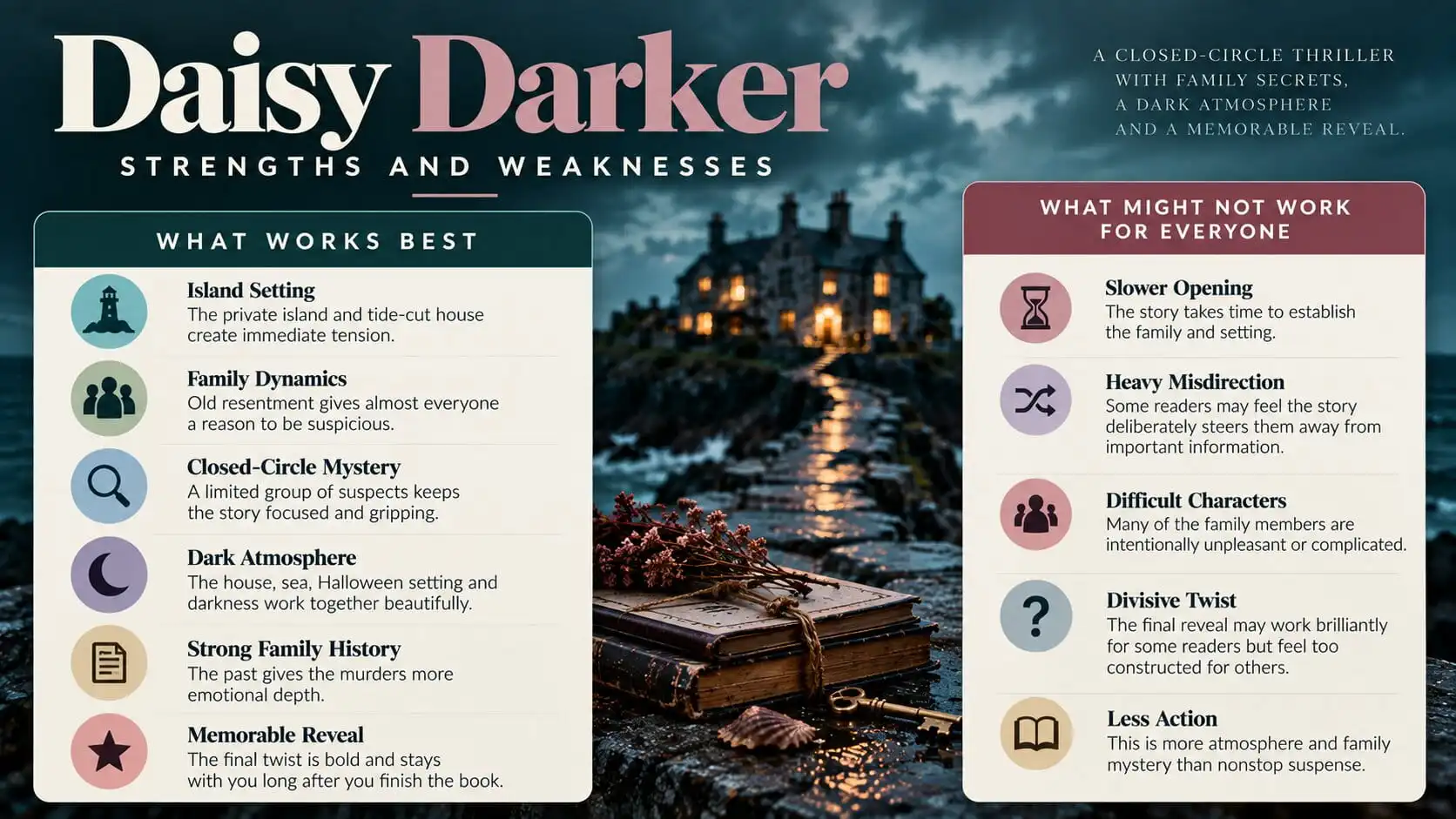
What Works Best
1. The island setting
The tide-cut house creates immediate tension.
2. The family dynamics
Old resentment gives almost everyone a reason to feel suspicious.
3. The closed-circle structure
The small group keeps the mystery focused.
4. The atmosphere
The house, sea, Halloween setting, and darkness work together extremely well.
5. The family history
The past gives the murders more emotional context.
6. The final reveal
Whether you love it or not, it is memorable.
What Might Not Work for Everyone
1. The opening is slower
The book spends time establishing relationships before the mystery accelerates.
2. Heavy misdirection
Some readers may feel the story is deliberately steering them away from important information.
3. Difficult family members
Many of the characters are intentionally unpleasant or emotionally complicated.
4. The final twist is divisive
It may completely work for you, or it may feel too constructed.
5. Less action than some modern thrillers
This is more atmosphere and family mystery than nonstop suspense.
Daisy Darker vs Rock Paper Scissors
These are two very different Alice Feeney thrillers.
Daisy Darker
- Private island
- Dysfunctional family
- Halloween setting
- Closed-circle mystery
- More gothic atmosphere
- More family-focused
Rock Paper Scissors
- Remote Scottish getaway
- Troubled marriage
- Snowy setting
- Anniversary letters
- More psychological misdirection
- More relationship-focused
If you want family secrets and a classic isolated mystery structure, choose Daisy Darker.
If you want marriage tension and stronger psychological manipulation, choose Rock Paper Scissors.
Daisy Darker vs Never Lie
These also make a natural comparison.
Daisy Darker
- Family gathering
- Private island
- Rising tide
- Multiple suspects
- More atmospheric
- More closed-circle mystery
Never Lie
- Newlywed couple
- Remote mansion
- Snowstorm
- Missing psychiatrist
- Faster pacing
- More twist-driven
If you want the more traditional isolated-group mystery, choose Daisy Darker.
If you want something quicker and more aggressively twisty, choose Never Lie.
Who Should Read Daisy Darker?
You should consider it if you enjoy:
- Alice Feeney
- closed-circle mysteries
- dysfunctional families
- private islands
- old houses
- Halloween atmosphere
- family secrets
- small groups of suspects
- unreliable memories
- twist-heavy endings

Who Might Want to Skip It?
It may not be the best choice if you prefer:
- very fast pacing from page one
- highly likable characters
- police-procedural mysteries
- straightforward narration
- minimal misdirection
- realistic family drama without thriller exaggeration
The book asks you to accept a very constructed mystery.
If you enjoy that style, it is fun.
If you prefer completely naturalistic mysteries, it may feel less convincing.
Is Daisy Darker Worth Reading?
Yes.
Especially if you enjoy:
isolated setting + dysfunctional family + closed-circle mystery + dark atmosphere + big reveal
The setting is memorable.
The family tension gives the mystery weight.
And the island structure keeps the story contained.
Feeney’s official site describes Daisy Darker as an instant New York Times bestseller and notes its recognition as a Goodreads Book of the Year finalist.
It is not quite as immediately addictive as Rock Paper Scissors.
But it has a stronger classic-mystery feel and one of Feeney’s most atmospheric setups.
Final Rating
4.3/5
Atmosphere: 4.7/5
The island, sea, darkness, and house are excellent.
Mystery: 4.3/5
Focused, contained, and full of suspicion.
Characters: 4/5
Interesting and complicated, though not always likable.
Pacing: 4.1/5
Steady rather than extremely fast.
Twists: 4.4/5
Memorable, though the final reveal may divide readers.
Ending: 4.3/5
Bold and likely to generate discussion.
Overall: 4.3/5
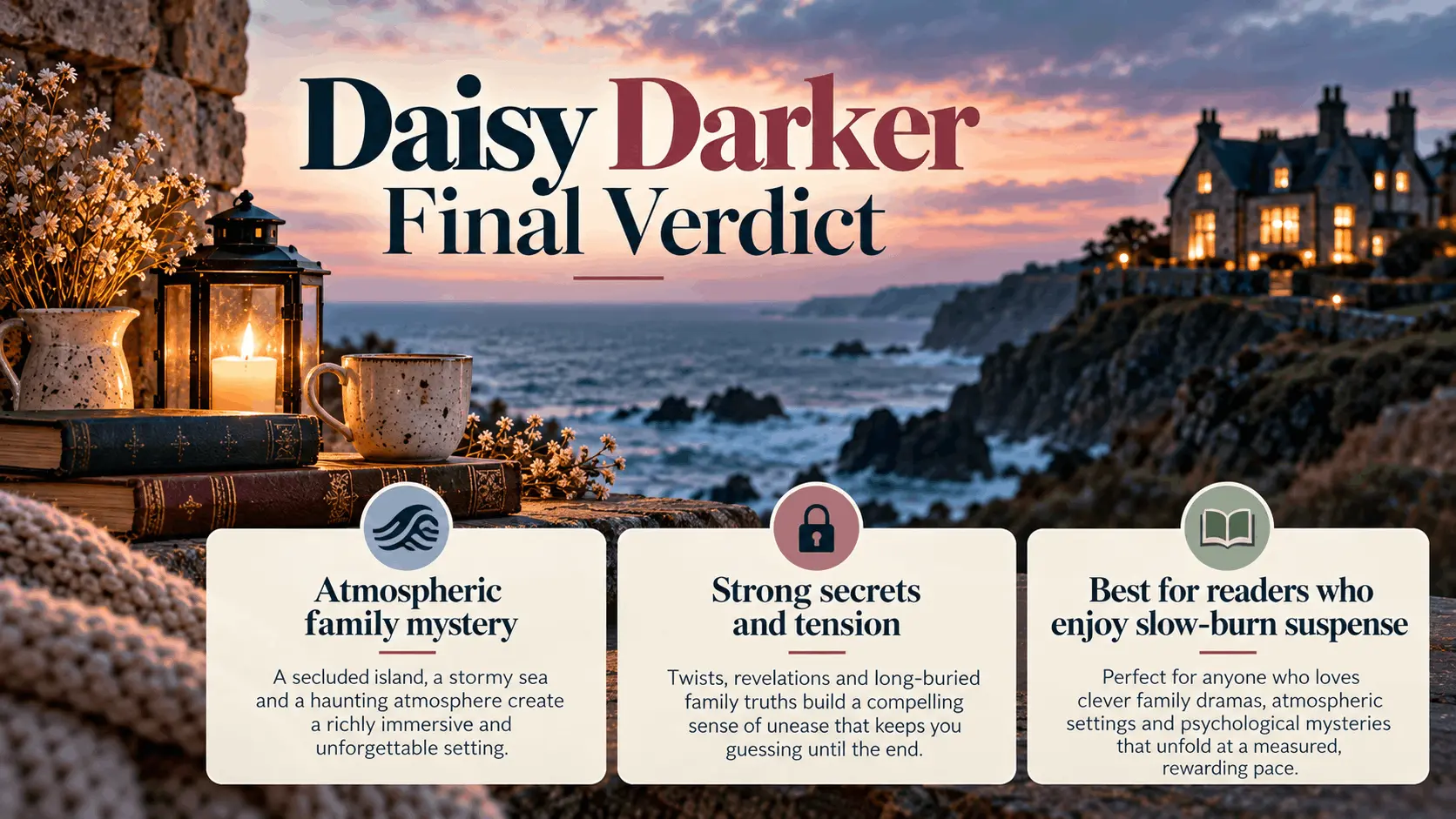
Daisy Darker is an atmospheric closed-circle thriller built around a dysfunctional family and a house nobody can leave.
If you enjoy mysteries where the setting traps the suspects and the past refuses to stay buried, it is one of Alice Feeney’s most distinctive novels.
What to Read After Daisy Darker
If you want another Alice Feeney thriller, read:
Rock Paper Scissors Review: Is Alice Feeney’s Thriller Worth Reading?
For her complete reading order:
Alice Feeney Books in Order: Complete Reading Guide
If you want another isolated thriller:
Never Lie Review: Is Freida McFadden’s Thriller Worth Reading?
And the next article in this cluster will be:
Books Like Daisy Darker: 12 Locked-Room Thrillers to Read Next
Once published, that should become the strongest recommendation link from this review.
Frequently Asked Questions
They share unreliable storytelling, isolation, secrets, and major twists, but Daisy Darker focuses more on family while Rock Paper Scissors focuses more on marriage.