
Some thrillers leave readers arguing about the ending long after they finish the final page. The Silent Patient invites that kind of conversation through its central mystery, unusual storytelling structure, moral ambiguity, and use of silence.
These The Silent Patient book club questions offer 20 original prompts for readers and discussion hosts. Start with eight spoiler-free questions, then move to twelve deeper questions only after finishing the novel. You will also find themes and character analysis, hosting suggestions, and a suggested 60-minute agenda.
Quick navigation: questions 1–8 are safe before finishing; the clearly marked warning opens the full-spoiler discussion for questions 9–20 and the analysis that follows. The FAQ answers avoid specific ending revelations. If you are choosing whether to read the book, start with our The Silent Patient review.
The Silent Patient: Quick Book Overview
| Detail | Overview |
|---|---|
| Book | The Silent Patient |
| Author | Alex Michaelides |
| Published | 2019 |
| Genre | Psychological thriller / mystery |
| Format | Standalone novel |
| Main setting | London and The Grove |
| Main themes | Silence, trust, obsession, trauma, storytelling |
| Discussion guide | 20 questions |
What Is The Silent Patient About? (Spoiler-Free)
Alicia Berenson is a successful painter whose husband, Gabriel, is murdered. After the shooting, she stops speaking. Psychotherapist Theo Faber becomes determined to understand her silence and works with her at The Grove, a secure psychiatric facility.
The novel combines diary entries, psychological suspense, and hidden motivations. Alicia’s self-portrait, Alcestis, introduces a connection with Greek tragedy, but knowing its ultimate significance is not necessary to begin the discussion. The questions below keep the ending out of view until the warning.

How to Use These Book Club Questions
You can use questions 1–8 before finishing the book. For a complete post-reading discussion, continue with questions 9–20 and the analysis after the warning. Hosts should check that everyone has finished and agrees to discuss spoilers before crossing that boundary.
- Begin with initial impressions.
- Discuss the storytelling and characters.
- Move to the clearly marked spoiler section only when everyone is ready.
- Compare interpretations and ask for supporting passages.
- End with the novel’s themes and each reader’s final assessment.
Choose a few prompts that interest your group rather than treating the list as a test. A useful discussion can stay with one question when members have contrasting readings.
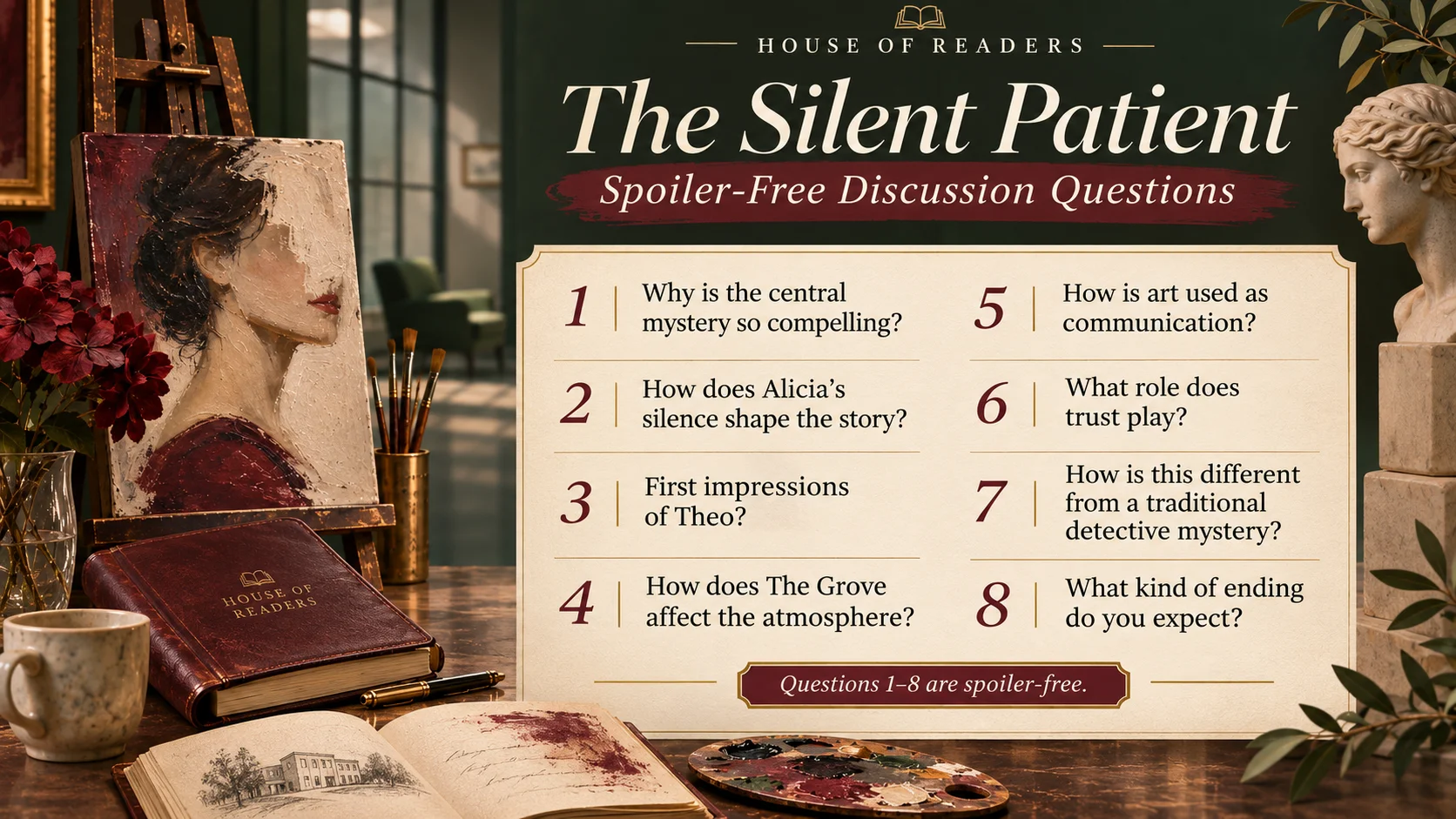
8 Spoiler-Free Book Club Questions for The Silent Patient
These first eight questions address the premise and reading experience. Keep predictions open, and save any explanation of the ending for the marked section.
1. What Makes the Novel’s Central Mystery So Compelling?
Alicia’s silence creates an unanswered question alongside the crime itself. Instead of asking only what happened, readers are invited to wonder why someone might refuse to explain it. Compare the pull of those two uncertainties. A useful opening discussion lets members identify what drew them in without asking anyone to confirm or dismiss a theory.
Optional follow-up: What first made you interested in the book?
2. How Does Alicia’s Silence Shape the Story?
Consider what happens when a central character cannot be questioned in the usual way. Other people interpret Alicia, but their interpretations need not agree. Discuss whether silence makes her seem more distant, more vulnerable, or more difficult to understand. Keep the focus on the experience of reading rather than searching for a single explanation.
Optional follow-up: Does silence always mean the same thing in a mystery?
3. What Are Your First Impressions of Theo Faber?
Theo presents himself as someone determined to reach Alicia. Which details in his introduction make that determination feel sympathetic, unsettling, or simply understandable? Separate what he says about himself from what readers can observe. Members may have different first impressions without either group needing to defend a prediction about his eventual role.
Optional follow-up: What do you usually look for when deciding whether a narrator is reliable?
4. How Does The Grove Influence the Novel’s Atmosphere?
The Grove places characters in a setting shaped by restricted access, institutional routines, and competing professional judgments. Discuss how that fictional environment affects tension and the information available to readers. Its portrayal is a storytelling choice, not a reliable account of psychiatric care generally. Ask members to point to atmosphere rather than speculate about real patients.
Optional follow-up: Would the mystery feel different in another setting?
5. How Does the Book Use Art as a Form of Communication?
Alicia’s paintings give readers another way to think about expression when spoken explanations are absent. Her self-portrait, Alcestis, also suggests that a title can frame how an image is understood. Without explaining its later significance, consider whether visual art feels more open to interpretation than a direct statement. Different readings can coexist.
Optional follow-up: Can art communicate feelings that characters cannot express directly?
6. What Role Does Trust Play in Psychological Thrillers?
Psychological thrillers often make readers work with incomplete accounts. Talk about the difference between trusting a character’s sincerity, trusting their memory, and trusting their interpretation. This helps the group discuss narrative reliability without naming a solution. Invite members to identify the kinds of evidence they find persuasive, rather than announce who must be right.
Optional follow-up: How does a reader decide which information to trust?
7. What Makes The Silent Patient Different From a Traditional Detective Mystery?
Compare the novel’s emphasis on motivation and emotional uncertainty with a mystery built around physical evidence or a detective’s orderly investigation. Alicia’s silence changes the form of inquiry, while the storytelling keeps attention on how people understand one another. There is no need to rank one approach above the other. Ask what each approach makes possible.
Optional follow-up: Do you prefer psychological or evidence-driven mysteries?
8. What Expectations Do You Have About the Novel’s Ending?
Keep this discussion about expectations, not answers. Some readers want every uncertainty resolved; others value ambiguity or an ending that changes how the preceding story feels. Invite participants to describe the kind of resolution they hope for without endorsing a prediction. If some members have finished, ask them to avoid reactions that might give anything away.
Optional follow-up: Do you prefer endings that surprise you or endings that feel inevitable in hindsight?
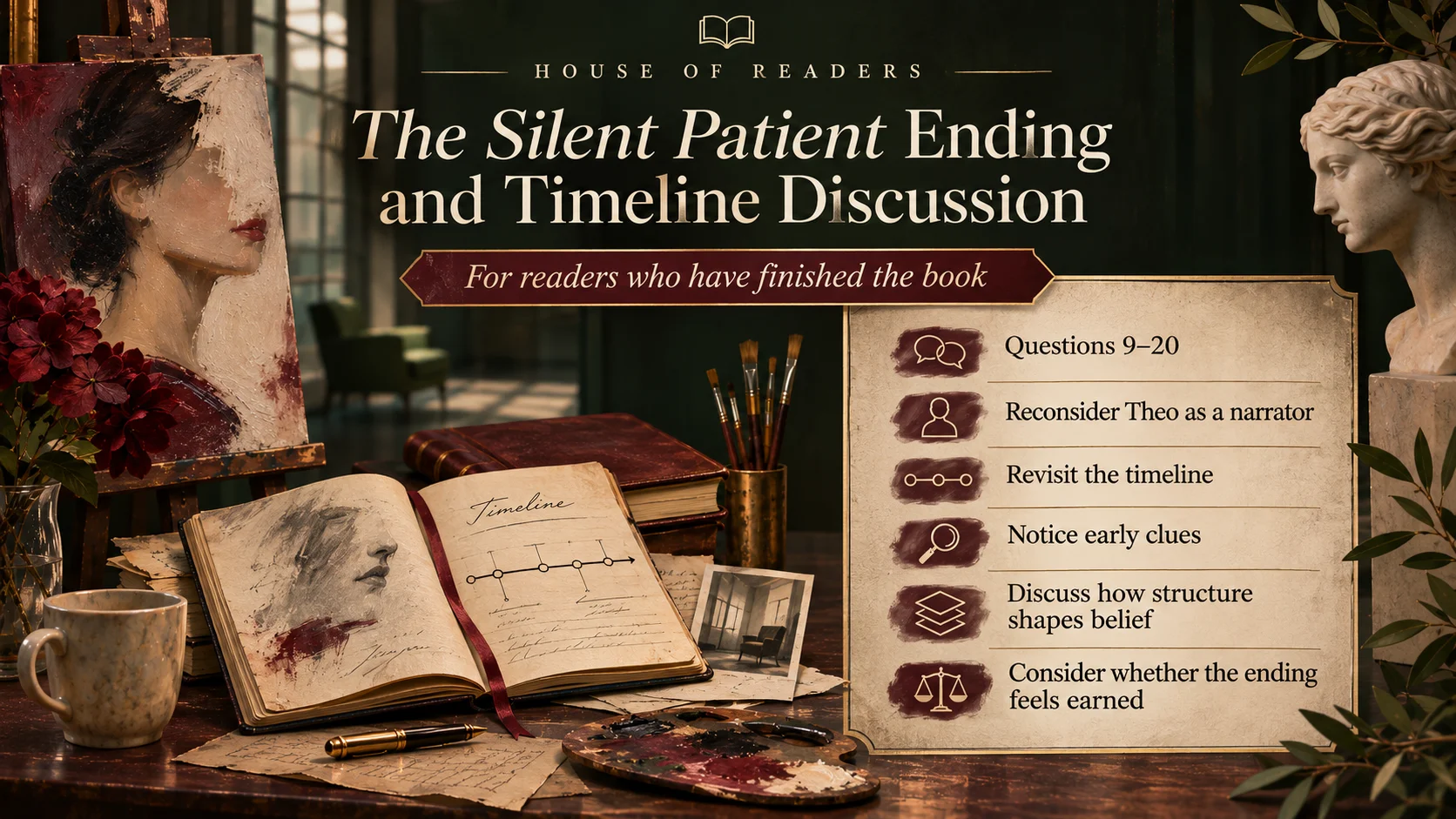
Spoiler Warning: Discussion Questions for Readers Who Have Finished the Book
SPOILERS AHEAD: The following questions discuss the novel’s ending, character revelations, and major twists. Continue only if you have finished The Silent Patient.
Stop here if you are still reading. Questions 9–20, the themes, and the character guide below are for completed-book discussions. Hosts should confirm that every participant is ready before continuing.
12 Spoiler Discussion Questions About The Silent Patient
From this point, the guide discusses the ending openly. Use the notes to open debate, not to establish a single approved interpretation.
9. How Does the Final Revelation Change Your Understanding of Theo?
The revelation that Theo was the masked intruder makes his account of helping Alicia impossible to read in the same way. Revisit the gap between his presentation as a rescuer and his involvement in her suffering. Ask whether the ending changes every earlier judgment or leaves some observations intact. Require textual support rather than treating all of his statements as equally false.
Optional follow-up: Which earlier moments seem different in retrospect?
10. How Does the Novel’s Timeline Influence What Readers Believe?
Theo’s account of discovering Kathy’s affair belongs to the period before Gabriel’s death, while his work with Alicia occurs later. The narrative encourages readers to connect those strands differently before their relationship becomes clear. Discuss what the ordering conceals and what assumptions readers supply themselves. Separate the chronology of events from the order in which information is delivered.
Optional follow-up: Does the structure feel fair once the full timeline becomes clear?
11. Which Early Details Become More Significant After the Ending?
Choose a specific passage rather than listing everything as a clue. Alicia’s sense of being watched, Theo’s account of following Kathy, and the title of Alicia’s self-portrait gain significance when the strands connect. Compare what each detail suggested on first encounter with what it supports afterward. A clue can be visible without making its meaning obvious.
Optional follow-up: Which detail would you pay more attention to on a second reading?
12. How Should Readers Evaluate Theo’s Motivations?
Theo describes a desire to help, yet his actions also protect his own position and seek control over the story Alicia could tell. Discuss how those motives overlap rather than deciding that a sympathetic account excuses conduct. His intrusion into Alicia and Gabriel’s home and his later actions at The Grove give the group concrete decisions to evaluate.
Optional follow-up: At what point does curiosity become harmful obsession?
13. How Does Gabriel’s Behavior Affect the Meaning of Alicia’s Silence?
When the intruder forces a choice, Gabriel indicates that Alicia should die rather than him. For Alicia, this becomes a devastating betrayal. Discuss how her interpretation of that moment changes the emotional meaning of her silence and painting. Distinguish understanding her perspective from excusing the killing or claiming that one scene settles every moral question about their marriage.
Optional follow-up: How does betrayal affect the way readers understand the character?
14. What Does the Alcestis Myth Add to the Novel’s Ending?
In Euripides’ Alcestis, Alcestis dies in her husband Admetus’ place; Heracles later brings her back, and she remains silent at the close. Alicia’s painting draws on the association between love and a husband’s willingness to accept his wife’s sacrifice. Explore the resonance without treating the novel as a scene-for-scene retelling. The differences matter as much as the parallels.
Optional follow-up: Would the story lose meaning without the Greek tragedy reference?
15. How Do Alicia’s Diary Entries Change the Reader’s Understanding of Events?
Alicia’s diary provides a perspective that Theo’s narration cannot fully contain. Her account records fear and observation before later revelations change their context, and its survival challenges his attempt to control what is known. Discuss what the diary establishes, what it conveys emotionally, and where interpretation is still required. A written account and a spoken account can each invite scrutiny.
Optional follow-up: Which narrative perspective did you find most illuminating after finishing the book?

16. How Does the Novel Explore Responsibility for Harm?
Gabriel’s killing is the most visible act of violence, but Theo’s intrusion and coercion also belong in a discussion of responsibility. His later attempt to silence Alicia adds another deliberate act to consider. Ask members to distinguish explanation, accountability, and legal judgment. Avoid turning the characters’ distress into a general claim that people experiencing mental illness are dangerous.
Optional follow-up: How do intention and consequences affect moral judgment?
17. What Does the Story Suggest About Professional Boundaries and Power?
Theo has professional authority and access to Alicia while withholding his own involvement in her past. That imbalance makes consent, trust, and the purpose of treatment central questions. Discuss the decisions he makes with that power, including whose interests they serve. This is a fictional depiction of misconduct and suspense, not a dependable model of psychotherapy.
Optional follow-up: How might clearer boundaries have changed the events?
18. How Do Childhood Experiences Influence the Characters’ Choices?
The novel gives both Alicia and Theo painful histories that influence how they understand relationships. Compare the meanings the characters attach to those histories with the choices they make as adults. An explanation need not become an excuse. Avoid diagnosing characters or suggesting that childhood harm inevitably produces violence, obsession, or any single adult outcome.
Optional follow-up: Can understanding someone’s history change how we judge their decisions?
19. Does the Ending Feel Earned or Manipulative?
Divide the discussion between information the novel withholds and assumptions readers make while reading. Consider whether the clues, timing, and final disclosures provide a satisfying retrospective pattern. Members who admire the construction can acknowledge questions of plausibility, while critics can identify what worked. Ask for a particular scene that supports each assessment rather than voting on the twist alone.
Optional follow-up: What separates a satisfying twist from a convenient surprise?
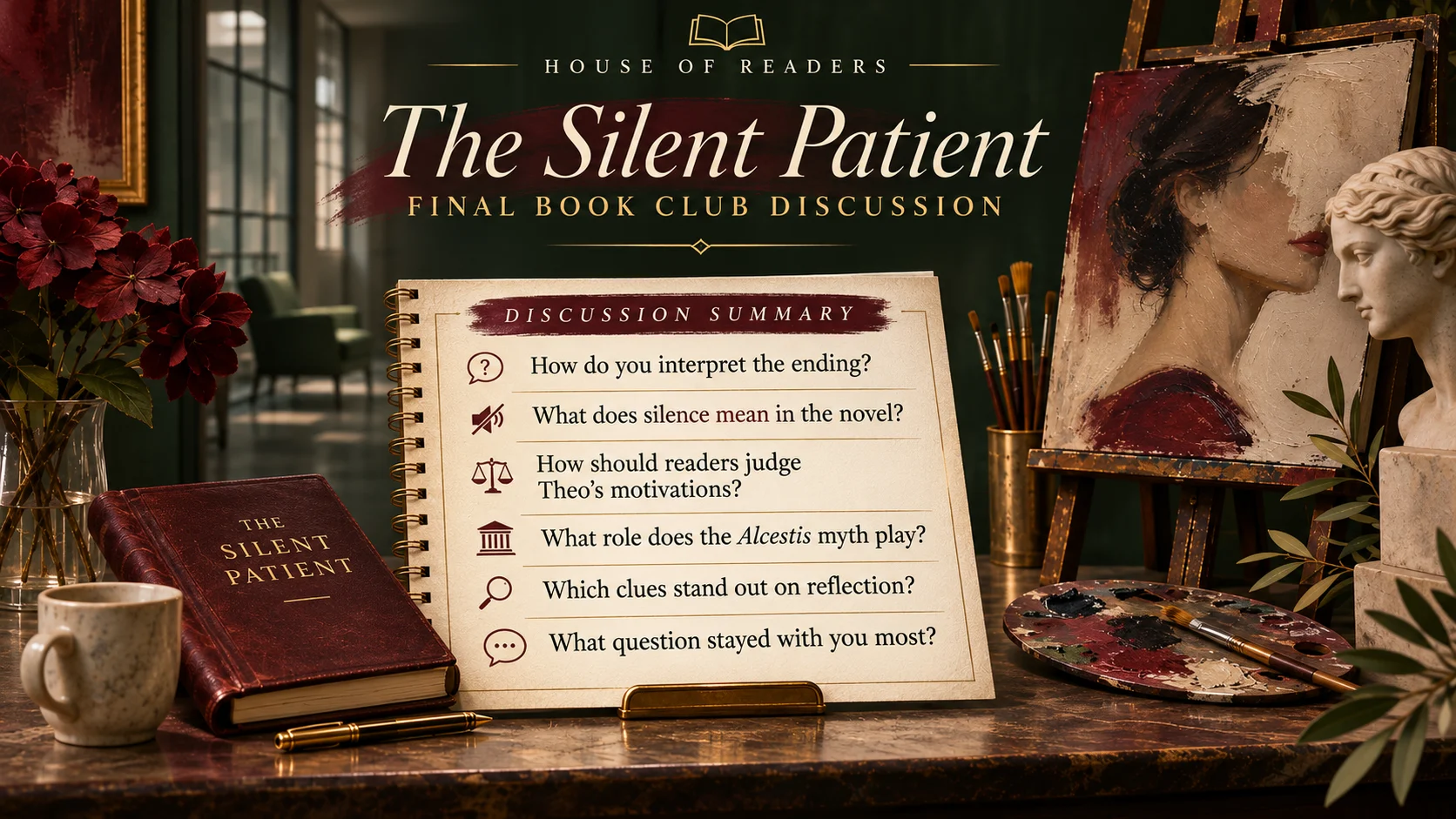
20. What Is Your Final Interpretation of The Silent Patient?
Bring together the novel’s silence, trust, trauma, obsession, and competing ways of telling a story. Does its lasting interest lie in the mystery’s construction, the damage done by control, the limits of knowing another person, or something else? Invite a concise interpretation supported by one passage. Leave room for unresolved questions instead of asking everyone to adopt a shared verdict.
Optional follow-up: Which question about the novel stayed with you after finishing it?
The Silent Patient’s Major Themes Explained
Silence and Communication
Alicia’s silence makes other people’s explanations unusually powerful. Painting and diary writing offer forms of expression that do not depend on accepting Theo as an interpreter. Together, they complicate the idea that speaking is the only way to possess a voice. Ask whose account is heard, whose is doubted, and what changes when Alicia leaves a record that outlasts a conversation.
Trust and Unreliable Storytelling
The novel turns selective disclosure into a source of authority. Theo can describe recognizable feelings while concealing the context that changes their meaning. His narrative and Alicia’s diary do not simply offer interchangeable perspectives. Their placement directs what readers can connect. The ending asks the group to reassess how much confidence a coherent personal account deserves.
Obsession and Control
Theo frames his interest in Alicia as exceptional understanding. His conduct exposes the danger of treating another person as a problem one is entitled to solve. Control operates through physical intimidation, professional access, and the management of information. The theme is strongest when grounded in those choices, rather than in a vague claim that intense interest is inherently harmful.
Betrayal and Responsibility
Gabriel’s response to the intruder’s threat carries emotional force for Alicia, while Theo’s role prevents the scene from being reduced to a private marital failure. The novel layers forms of harm without making them equivalent. A discussion can acknowledge Alicia’s sense of betrayal while retaining responsibility for violence and rejecting the idea that suffering makes later actions inevitable.
Greek Tragedy and Alcestis
The painting gives the myth an emotional function beyond a clue to be decoded. In the play, a wife’s sacrifice exposes uncomfortable questions about love and self-preservation. Alicia’s use of that story invites a comparison with Gabriel’s choice, but the novel transforms the pattern rather than reproducing it. For the original dramatic context, consult Euripides’ Alcestis.
The Silent Patient Character Discussion Guide
This comparison belongs to the full-spoiler discussion. Treat the questions as invitations to examine evidence, not as diagnoses or settled accounts of motivation.
| Character | Role in the story | Main discussion theme | Question to consider |
|---|---|---|---|
| Alicia Berenson | Painter, Gabriel’s wife, and the central figure in the shooting and silence | Expression and the struggle to be understood | How do her painting and diary complicate the accounts others give of her? |
| Theo Faber | Psychotherapist, narrator, and the intruder whose role is revealed at the end | Control, self-justification, and professional power | Where does his account ask for sympathy that his conduct undermines? |
| Gabriel Berenson | Alicia’s husband and a photographer; his affair is with Kathy | Betrayal and self-preservation | How does his response to the intruder’s threat change Alicia’s view of their marriage? |
| Kathy Faber | Theo’s wife, whose affair with Gabriel is part of the earlier timeline | Secrecy and perspective | What can the group establish about her actions, and what reaches us through Theo’s interpretation? |
How to Host a The Silent Patient Book Club Meeting
Before the meeting, let members know that the main discussion assumes a completed reading. If someone is still reading, begin with the first eight prompts and agree on when they will leave or when the group will stop. Do not rely on people guessing which questions are safe.
- Start with general impressions before debating the ending.
- Choose questions rather than deliver a lengthy plot retelling.
- Invite members with different opinions to explain the passage or detail behind their view.
- Keep the conversation about the fiction. Never require personal disclosures about trauma, relationships, or treatment.
- Allow disagreement over the twist without turning enjoyment into a measure of reading skill.
- Close with one takeaway from each participant and a suggestion for the next book.
For a small group, let one prompt develop into a conversation. In a larger group, invite brief opening responses or split into pairs before sharing with everyone. Members can pass on a question. The novel’s portrayal of psychotherapy is fictional and should not be treated as a guide to real-world clinical practice.
A 60-Minute The Silent Patient Book Club Agenda
This suggested agenda is for participants who have finished the novel. The times are flexible, not mandatory. If a topic produces useful disagreement, borrow time from a later segment.
| Suggested time | Discussion focus |
|---|---|
| 0–10 minutes | Opening reactions and favorite elements, without retelling the whole plot. |
| 10–20 minutes | Narrative structure, trust, and the relationship between accounts. |
| 20–35 minutes | Character motivations, boundaries, and moral responsibility. |
| 35–50 minutes | The ending, timeline, and the significance of Alcestis. |
| 50–60 minutes | Final interpretations, individual takeaways, and next reading choices. |

What Should Your Book Club Read After The Silent Patient?
Begin with the part of the discussion your group most enjoyed. Readers drawn to unreliable narrators may want another story that tests perspective. Those interested in psychological manipulation or therapy-related mysteries can look for carefully framed power dynamics. Others may prefer slow-burning suspense or a dark academic setting.
Our guide to Alex Michaelides books in order helps you compare the author’s novels without assuming they form a series. For a closer look at different settings and approaches, try our The Maidens review and The Fury review. If the group wants a broader shortlist, explore books like The Silent Patient and choose according to the reading experience you want next.
Final Thoughts
The Silent Patient gives a book club more to discuss than whether the twist was surprising. Its structure, competing perspectives, and psychological themes invite readers to weigh evidence, reconsider first impressions, and disagree about what the story achieves.
Use these The Silent Patient discussion questions flexibly. A strong meeting does not need twenty completed answers or a unanimous verdict. It needs room for a reader to explain an interpretation, another reader to challenge it thoughtfully, and both to leave with something new to consider.

Explore More Psychological Thrillers
Finished discussing The Silent Patient? Explore our reviews, Alex Michaelides reading guide, and related thriller recommendations to discover your next thought-provoking read.
- The Silent Patient review
- Alex Michaelides books in order
- The Maidens review
- The Fury review
- books like The Silent Patient
Frequently Asked Questions
Yes. Its central mystery, narrative structure, and questions about trust give groups several angles to debate. Members can disagree about its effectiveness while still having a useful conversation.
Yes. Questions 1–8 are spoiler-free. Stop at the prominent spoiler warning; questions 9–20 and the analysis that follows are intended for readers who have finished.
Questions 1–8 avoid ending revelations. Questions 9–20 discuss the completed novel and appear after a clear spoiler warning. The FAQ answers avoid specific ending details.
Major themes include silence, communication, trust, obsession, betrayal, storytelling, and responsibility. The guide examines their connections after the spoiler warning.
Choose a manageable selection, perhaps five to eight, and adapt to your group’s interest. You do not need to cover all twenty to have a thoughtful meeting.
Around an hour is a useful starting point. The suggested 60-minute agenda can be shortened or extended to suit the group and the topics that generate discussion.
Yes. The Silent Patient is a standalone novel. You do not need to read another book first.
Choose according to whether your group wants unreliable narration, psychological suspense, or a different setting. Our Alex Michaelides books in order guide and related reviews can help you compare options.