
The Maidens brings together a beautiful but unsettling Cambridge setting, an exclusive student society, a charismatic Greek tragedy professor, and a murder mystery. Books like The Maidens can follow any of those interests, but the closest choice depends on which part drew you in.
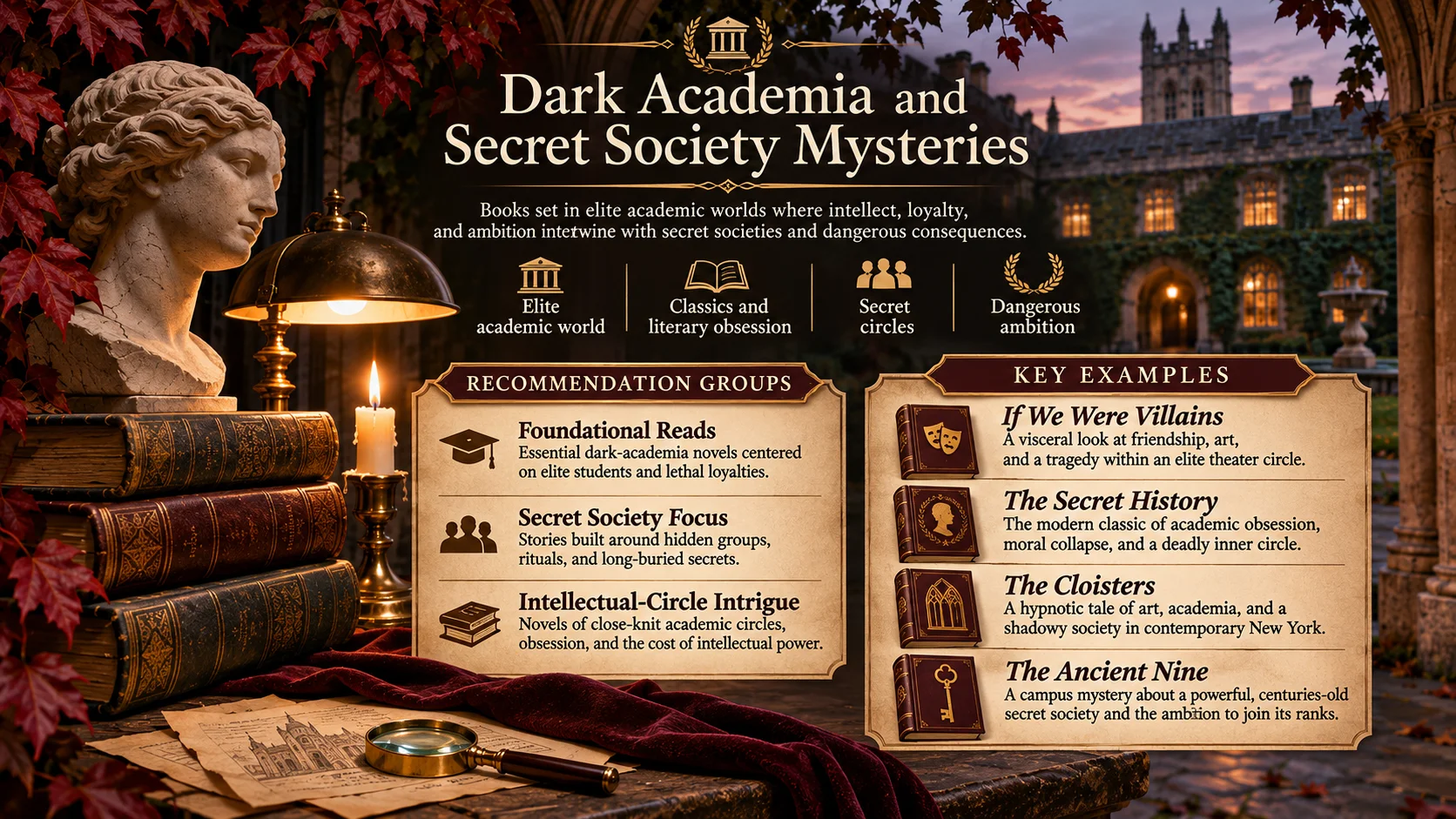
For academic obsession and murder-mystery atmosphere, start with If We Were Villains or The Secret History. For a more conventional university thriller, consider The It Girl. The Ancient Nine follows secret-society intrigue, while Ninth House takes dark academia into the supernatural.
These twelve spoiler-free recommendations range from literary mysteries to psychological campus thrillers and adult fantasy. Their pace and structure differ, so the comparisons below explain what each shares with Michaelides’ novel and where it takes a different direction.
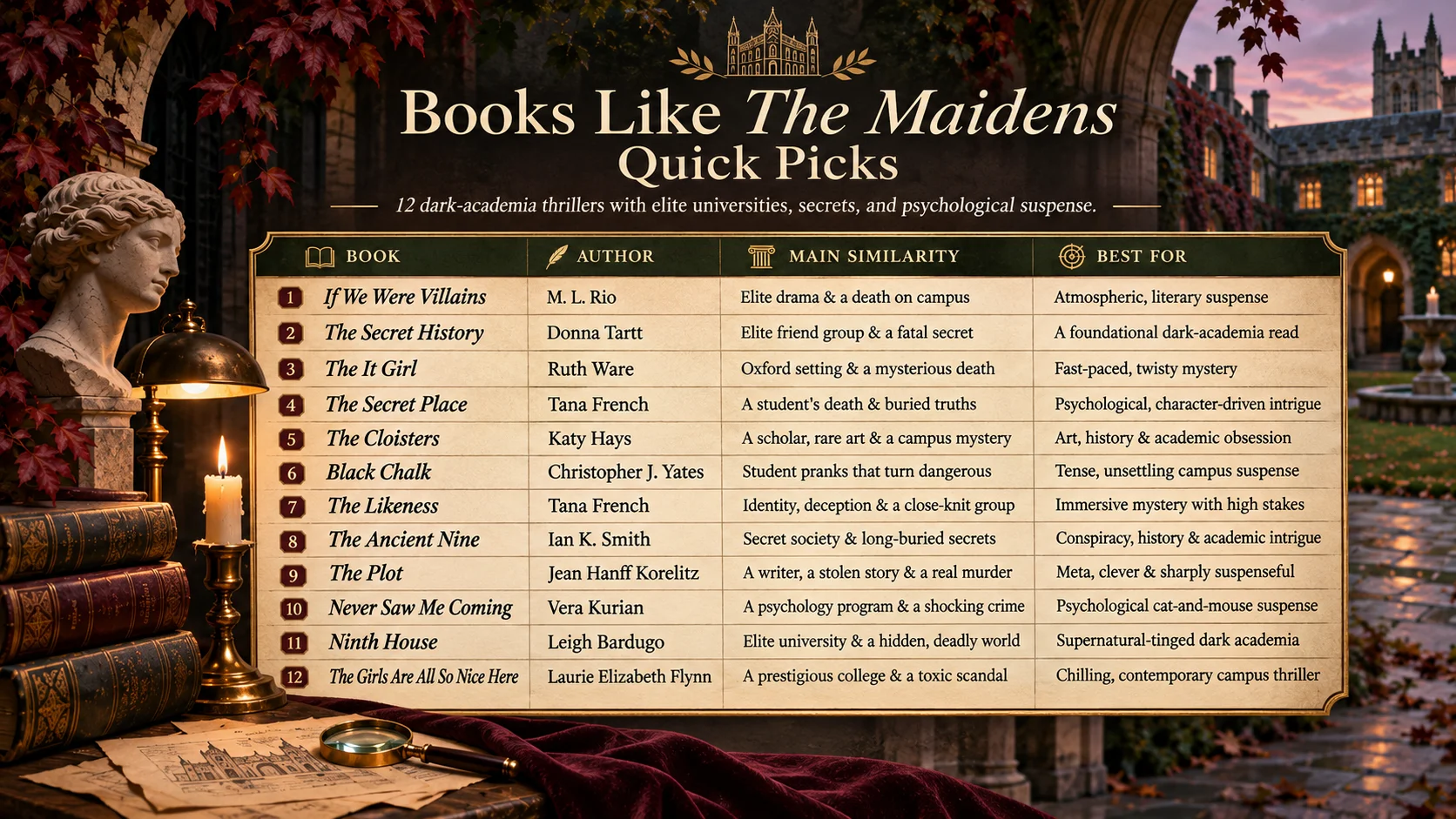
Best Books Like The Maidens: Quick Picks
| Book | Author | Main Similarity | Best For |
|---|---|---|---|
| If We Were Villains | M. L. Rio | Insular literary students | Academic obsession |
| The Secret History | Donna Tartt | Classics and professor influence | Greek cultural interests |
| The It Girl | Ruth Ware | British university murder | A grounded thriller |
| The Secret Place | Tana French | Student loyalties and suspicion | A school investigation |
| The Cloisters | Katy Hays | Scholarly ambition | Gothic intellectual mystery |
| Black Chalk | Christopher J. Yates | Competition and manipulation | Psychological campus suspense |
| The Likeness | Tana French | A close academic group | Identity and belonging |
| The Ancient Nine | Ian K. Smith | Exclusive campus club | Conspiracy and privilege |
| The Plot | Jean Hanff Korelitz | Intellectual ambition | Literary ethics and suspense |
| Never Saw Me Coming | Vera Kurian | Psychology and campus danger | A contemporary thriller |
| Ninth House | Leigh Bardugo | Elite secret societies | Supernatural dark academia |
| The Girls Are All So Nice Here | Laurie Elizabeth Flynn | Manipulative friendships | College secrets resurfacing |
What Makes The Maidens a Dark Academia Thriller?
A Prestigious Cambridge Setting
Historic academic surroundings and institutional tradition create a world that can feel inviting and difficult to enter at the same time. The setting gives social status and intellectual authority a visible shape.
Selective membership makes belonging part of the mystery. A private circle raises questions about loyalty, influence, and what members might be willing to defend.
Greek Tragedy and Academic Obsession
Classical study and a charismatic professor connect intellectual admiration with personal power. The literary tradition matters to the atmosphere rather than functioning only as scenery.
A Murder Mystery Driven by Suspicion
The central investigation gives the university setting a psychological-thriller structure. Mariana’s attention to the student circle makes uncertainty about people as important as the academic environment.
Grief, Secrets, and Obsession
The emotional background shapes how the mystery is approached. It adds a reason to look for psychological tension as well as campus architecture when choosing a similar book.
Our The Maidens review discusses that combination without revealing the main solution.
12 Books Like The Maidens Worth Reading Next
1. If We Were Villains by M. L. Rio
Seven Shakespeare students at an elite arts conservatory become caught in rivalry, obsession, and a tragedy that continues to shape their lives. A retrospective confession framework makes the past something to reconstruct, rather than a sequence of events unfolding without hindsight.
This is one of the strongest books like The Maidens because study and belonging are inseparable. The students share an intense literary world, and the group’s exclusivity makes personal tensions harder to separate from academic ambition. The difference is the tradition at its center: Shakespeare and theatre replace Greek tragedy and the therapist’s investigation.
Choose it for an insular student circle, literary references, and concealed truths. Expect a reflective account with theatrical language, not simply a brisk detective puzzle. It works especially well as a next choice if academic obsession mattered as much as identifying a killer.
2. The Secret History by Donna Tartt
At an elite Vermont college, a small group of classics students falls under an unusual professor’s influence and becomes involved in a devastating crime. Greek cultural interests, intellectual exclusivity, and moral obsession shape the group’s world.
The parallel with The Maidens is unusually precise: classical education and charismatic authority do not just decorate the setting, but help explain the attraction of the circle. Tartt’s novel gives that attraction a literary, character-driven treatment.
Do not approach it as a fast detective novel. It is an inverted mystery that discloses its central killing early and concentrates on motives and consequences, without this guide identifying those involved. Choose it for Greek classics and sustained psychological unease. If your priority is an investigation that steadily narrows a suspect list, The It Girl is a more direct fit.
3. The It Girl by Ruth Ware
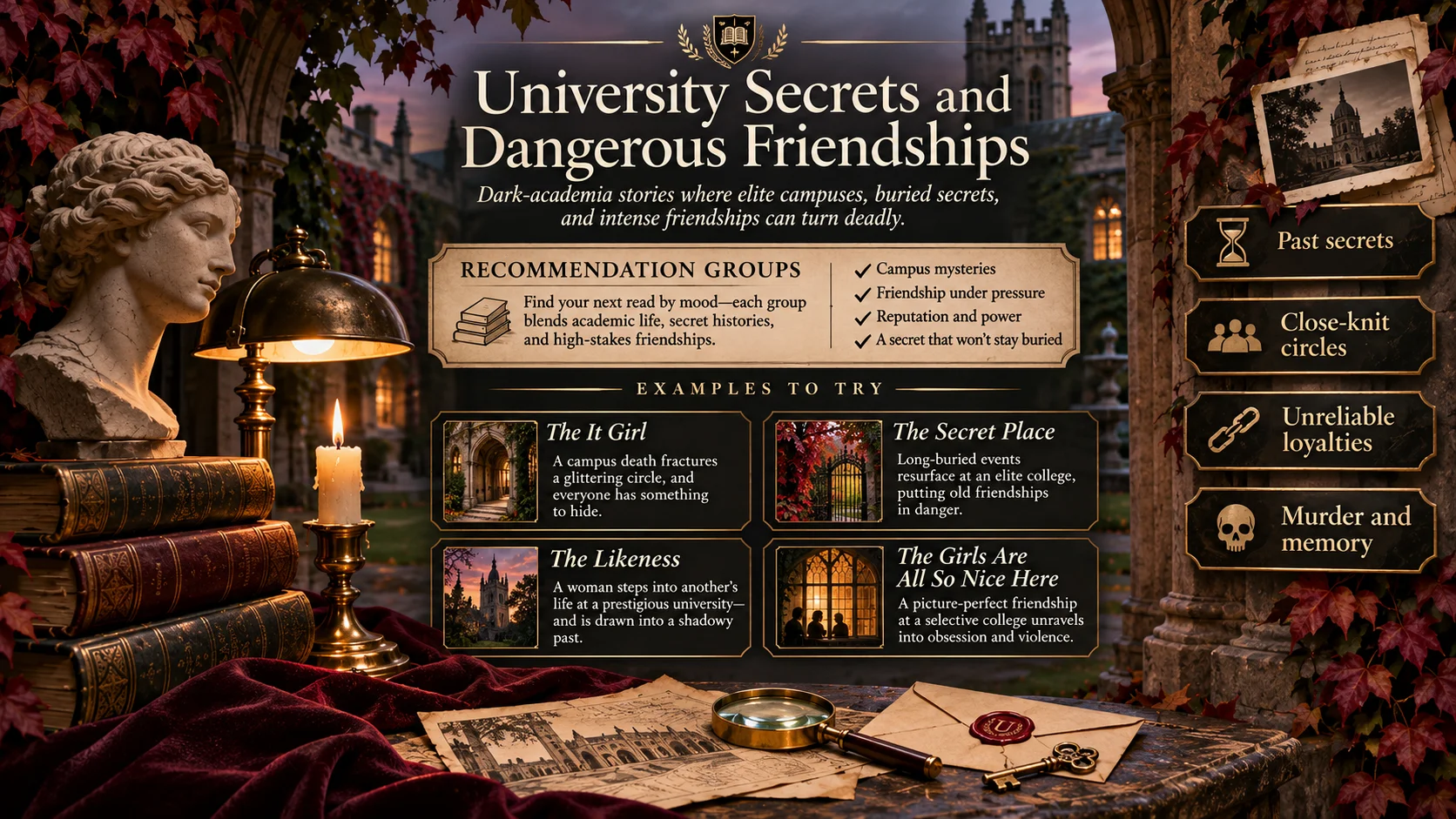
A woman revisits the murder of her Oxford University friend after new information raises doubts about the original conviction. Student friendships, memory, testimony, and guilt connect the university past to the present.
This is a practical choice when what you want from The Maidens is another prestigious British campus with a murder to investigate. Its academic setting carries friendship histories and hidden relationships, while the questions around what people remember give the mystery a grounded psychological focus.
The difference is the relative absence of classical mythology and a secretive intellectual cult of personality. Choose it for a more conventional university-thriller structure; choose Tartt or Rio if literary study itself is your chief interest. The It Girl can be approached independently, without working through Ware’s bibliography first.
To explore Ware’s other settings, see our Ruth Ware Books in Order guide.
4. The Secret Place by Tana French
A new clue revives a murder investigation at an exclusive Irish girls’ boarding school. The inquiry enters a world of teenage alliances, rumors, and private loyalties that adults cannot simply take at face value.
It connects with The Maidens through the tension between an investigator’s questions and the social rules of an exclusive student group. Who belongs, who speaks, and what a friendship protects become important reasons to keep questioning the visible story.
The difference is the age of the students and the stronger detective framework, rather than a university professor’s academic influence. Choose it for an investigation embedded in complex social dynamics, with room for a deliberate narrative. It is Dublin Murder Squad book five; the cases change, but publication order may suit readers who want recurring-character continuity.
5. The Cloisters by Katy Hays
A young researcher joins an enigmatic scholarly circle at a New York museum devoted to medieval art. Research into divination becomes increasingly entangled with ambition, secrets, and danger.
For readers drawn to the intellectual atmosphere of The Maidens, this shifts the focus from Greek tragedy to art history and the desire to uncover hidden knowledge. The Gothic museum setting and selective research world offer a different version of academic belonging and influence.
Choose it for scholarly obsession, historical objects, and uncertainty around mystical ideas. The important difference is that it takes place primarily in a museum, not a university, and tarot and divination matter more than a conventional campus investigation. It is a standalone choice for atmosphere; readers seeking a clearly grounded police case may prefer French.
6. Black Chalk by Christopher J. Yates
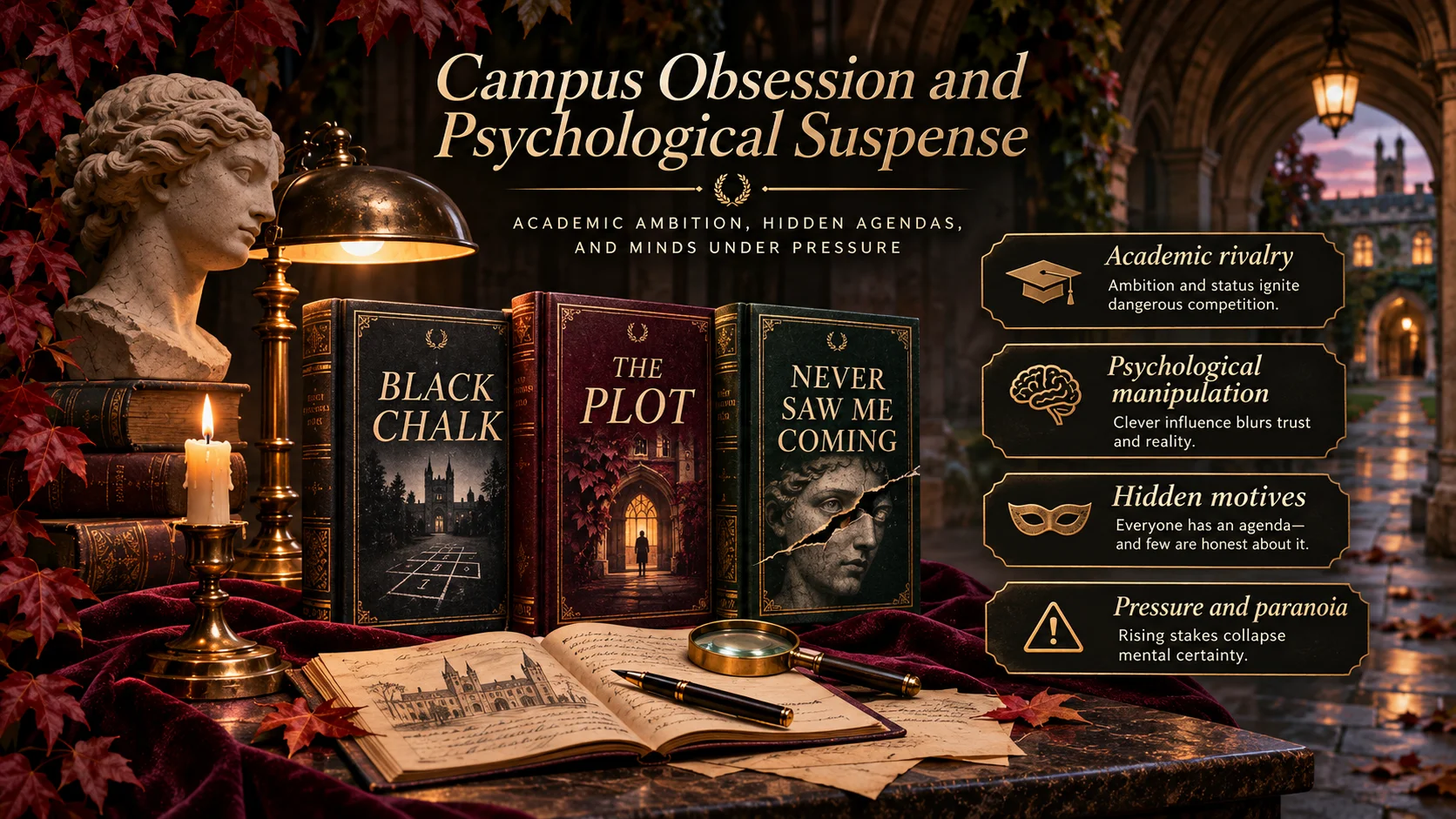
Six Oxford students begin a psychological game that grows more personal and dangerous. Its consequences follow them into adulthood, making the past a source of pressure rather than a safely finished chapter.
The Maidens readers interested in competition and manipulation may find this a sharper match than another novel chosen simply for attractive college buildings. A close academic friendship group knows enough about its members to make rivalry intimate. The game gives that knowledge a mechanism through which to become threatening.
This is psychological suspense around an escalating contest and its aftermath, rather than an investigation of a student society. Choose it if power shifting between friends interests you. Its gradual reconstruction of consequences offers a different structure from a straightforward campus whodunit, and it does not require a series commitment.
7. The Likeness by Tana French
Detective Cassie Maddox investigates the death of a woman who looks uncannily like her and had been living among a close-knit group of graduate students. The case develops into an undercover investigation that makes identity and belonging central to the suspense.
The academic circle offers a particular connection to The Maidens: an apparently complete social world is difficult to understand from outside. French turns the question of access into part of the investigation itself.
Choose it for the pull of an insular group and a more expansive, deliberate narrative. The detective operation and unusual resemblance premise distinguish it from Michaelides’ therapist-led inquiry. This is Dublin Murder Squad book two. Readers interested in Cassie’s earlier development should start with In the Woods; those seeking the fastest self-contained campus mystery may prefer The It Girl.
8. The Ancient Nine by Ian K. Smith
A Harvard student is drawn into an exclusive campus club and investigates the possibility of a hidden inner society. Institutional tradition, privilege, and access to concealed information drive the intrigue.
If the selective circle in The Maidens fascinated you more than its murder investigation, this recommendation follows that interest directly. The question is not only who can be trusted, but who is allowed into a powerful institution’s private world and what membership might conceal.
Choose it for secret-society suspense, ritual, and university power. Its main difference is the conspiracy-mystery structure, rather than a conventional student-murder thriller. It is the realistic-conspiracy option here; Ninth House takes a comparable interest in elite institutions into actual fantasy. Readers primarily looking for Greek literary references should start with The Secret History instead.
9. The Plot by Jean Hanff Korelitz
A struggling writing teacher uses a deceased student’s unpublished story idea, then receives threatening messages from someone who knows the secret. Intellectual ambition becomes an ethical problem with increasingly personal consequences.
This is a less literal campus match, but a useful recommendation for the obsession and moral uncertainty in The Maidens. A teaching relationship supplies the starting imbalance, while the pressure comes from what someone believes their talent and ambition entitle them to take.
The story moves beyond the classroom into authorship and publishing, so choose it for literary ambition rather than a secret student society. It can be your starting point without an earlier novel, but it now has a published follow-up, The Sequel. Read The Plot first if you plan to continue, and avoid the follow-up’s synopsis until afterward.
10. Never Saw Me Coming by Vera Kurian
A university student enrolled in a psychological research program faces danger as people within the study become targets. The campus gives the mystery a bounded social world, while suspicion and competing agendas complicate potential alliances.
This recommendation follows the psychology and mistrust in The Maidens rather than its classical setting. It offers a contemporary campus thriller in which deciding what to believe about others is part of the suspense.
The tone is sharper and the thriller approach more immediate than traditional literary dark academia. Choose it when you want psychology and deception without expecting scholarly rituals or Greek mythology. Its fictional characterizations are not a guide to real people with mental health conditions, and a diagnostic label should not be treated as a prediction of someone’s behavior. It can be read independently.
11. Ninth House by Leigh Bardugo
Alex Stern arrives at Yale and becomes involved in monitoring the occult activities of powerful secret societies. Here, the institution’s hidden world includes genuine magic, rather than only rumors or symbolic rituals.
The connection to The Maidens is elite academic power: selective membership, privilege, secrecy, and the dangerous authority of established groups. Bardugo turns those institutional inequalities into the framework for adult dark fantasy.
Choose it if you want supernatural secret-society intrigue and a darker campus world. This is not a purely realistic psychological murder mystery, so the fantasy distinction matters more than the shared university setting. It is the first book in a series, not a one-off recommendation. If you want conspiracy without actual magic, The Ancient Nine is the more appropriate direction.
12. The Girls Are All So Nice Here by Laurie Elizabeth Flynn
Two former college friends return for a reunion and confront threatening reminders of a troubling shared past. The narrative moves between their earlier college experience and the consequences resurfacing years later.
This matches The Maidens through social influence, manipulation, and the difficulty of separating friendship from control. The campus is important as the place where relationships took shape, even when the danger extends beyond student life.
Choose it if the psychologically complicated relationships were what kept your attention, rather than the academic subject matter. The difference is the emphasis on toxic friendship, past behavior, and revenge instead of scholarly obsession or secret rituals. It is a standalone psychological thriller with a past-and-present structure, so it suits readers who want college secrets without committing to a detective sequence.
Which Book Should You Read After The Maidens?
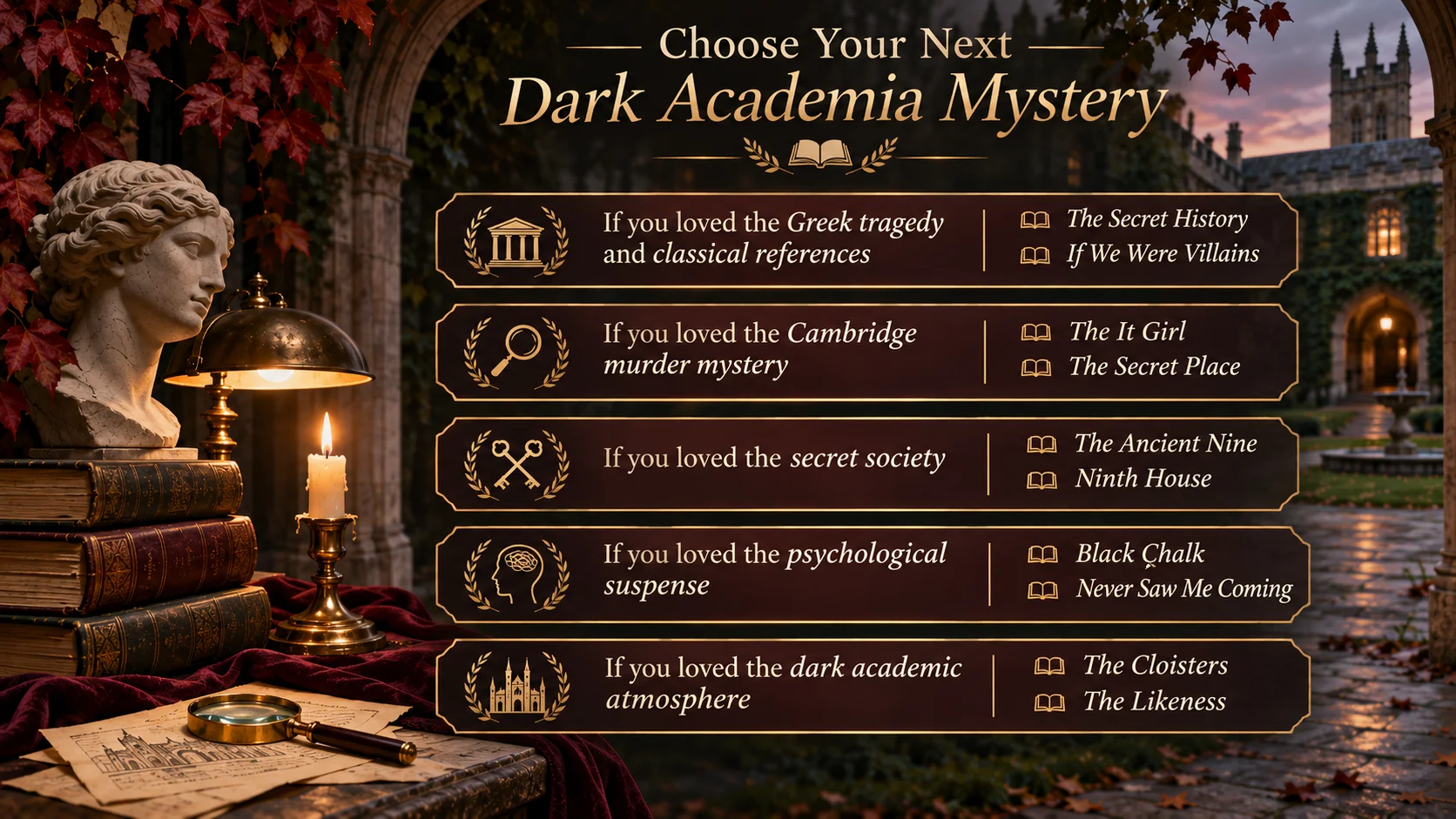
If You Loved the Greek Tragedy and Classical References
Choose The Secret History for classics students and Greek cultural influence. If We Were Villains offers a related intensity around literary study, but its tradition is Shakespeare and theatre, not Greek mythology.
If You Loved the Cambridge Murder Mystery
The It Girl moves to Oxford and questions an earlier conviction. The Secret Place moves to an Irish boarding school and enters student loyalties through detective work. Neither needs to reproduce Cambridge to follow the investigation-focused appeal.
If You Loved the Secret Society
The Ancient Nine offers a realistic conspiracy-mystery direction around institutional privilege. Ninth House introduces actual occult magic. Choose according to whether you want secrets within a recognizable world or adult dark fantasy.
If You Loved the Psychological Suspense
Black Chalk follows a competitive group game and its consequences. Never Saw Me Coming uses a psychological research program as the setting for contemporary campus danger.
If You Loved the Dark Academic Atmosphere
The Cloisters brings historical research into a Gothic museum. The Likeness draws its atmosphere from an insular graduate-student household and an undercover investigation.
If You Loved the Manipulative Relationships
The Girls Are All So Nice Here concentrates on damaging friendships and the past returning. The Plot shifts to an ethically compromised teaching relationship and literary ambition, making the connection one of power rather than identical social dynamics.
Dark Academia vs Psychological Thrillers: What’s the Difference?
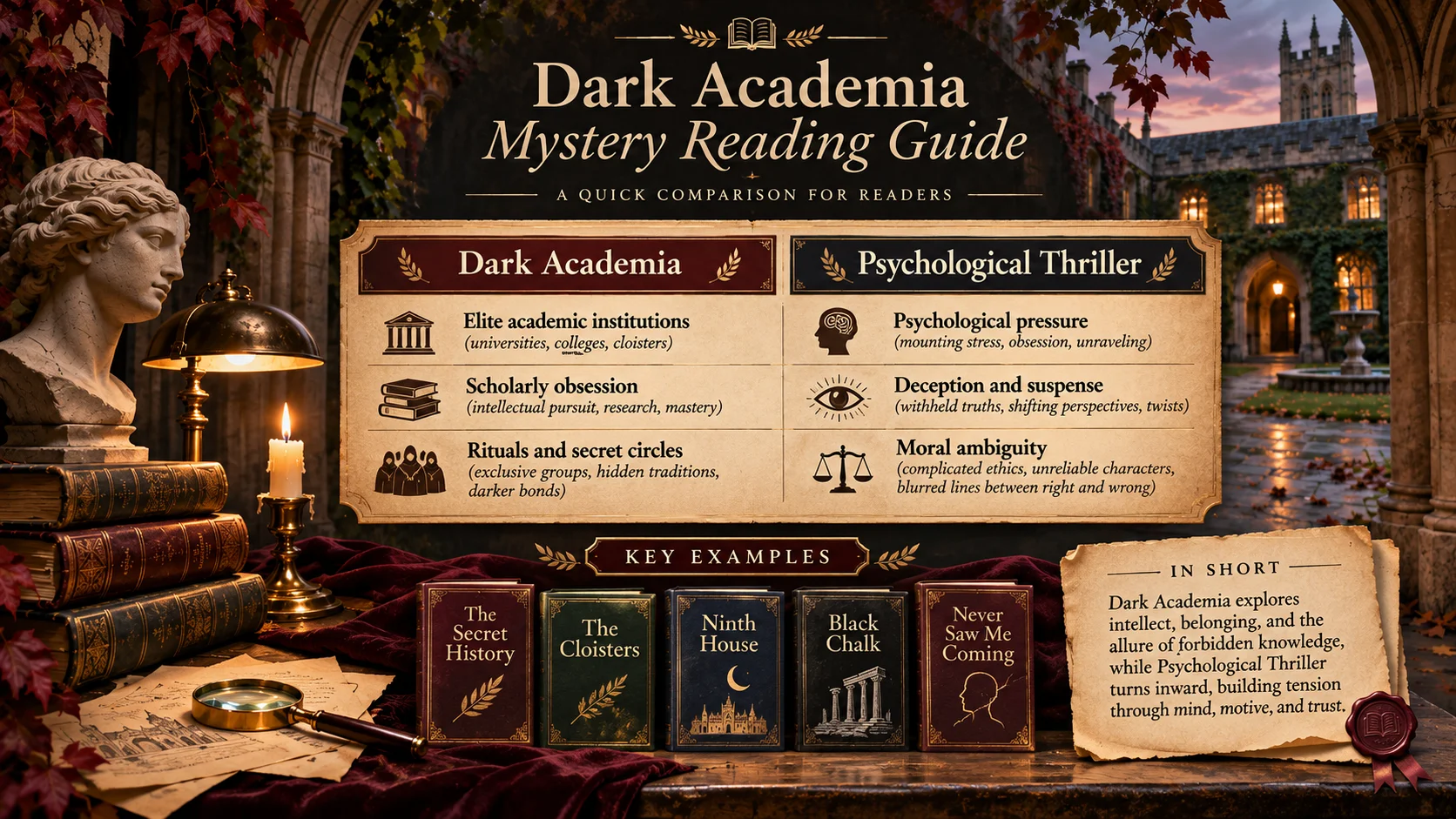
Dark academia is commonly an aesthetic and thematic category, not a rigid genre. Elite institutions, scholarly obsession, art or classics, privilege, rivalries, and dark atmosphere can appear in literary fiction, crime, or fantasy.
Psychological thrillers place greater emphasis on uncertainty, behavior, deception, and suspense. A novel can combine both approaches without every campus story operating the same way.
| Feature | Dark Academia | Psychological Thriller |
|---|---|---|
| Main emphasis | Study, belonging, institutions | Uncertainty, motives, deception |
| Typical pressure | Ambition or intellectual exclusivity | Threats and unstable trust |
| Possible structure | Literary, crime, or fantasy | Mystery or suspense-driven |
| Examples here | The Secret History; If We Were Villains | Black Chalk; Never Saw Me Coming |
| Overlap | Academic setting can carry a crime | A campus can shape the suspense |
The It Girl links a university past with a grounded mystery. Ninth House takes elite secrecy into actual fantasy. Dark academia is therefore not synonymous with supernatural horror.
Are These Books Standalone Mysteries?
Independent Starting Points
If We Were Villains, The Secret History, The It Girl, The Cloisters, Black Chalk, The Ancient Nine, Never Saw Me Coming, and The Girls Are All So Nice Here can be approached as standalone choices.
Dublin Murder Squad
The Likeness is book two and The Secret Place is book five. The sequence changes central cases and protagonists, but some characters recur. Begin with In the Woods if you want Cassie’s earlier development before The Likeness, or follow publication order for the broader continuity. The publisher’s series listing confirms the order.
Ninth House
Ninth House begins Leigh Bardugo’s adult fantasy series. Choose it with the expectation of a continuing world and supernatural elements, rather than a single realistic campus case.
A Note on The Plot
The Plot needs no earlier novel, but it is no longer accurate to describe its wider fictional continuity as having no follow-up. The publisher confirms The Sequel as its continuation. Read The Plot first; avoid the continuation’s plot description if you want to protect the first book’s surprises.
Are Books Like The Maidens Always Dark or Violent?
The level and kind of intensity vary. Literary tension in The Secret History is not the same experience as a school murder investigation, a psychologically threatening friendship, or the supernatural danger in Ninth House.
This guide does not attempt scene-by-scene content warnings. If you have specific concerns, check publisher descriptions and reliable content guidance before choosing. A shared academic setting does not mean the books have identical violence, horror, or emotional intensity.
Best Books Like The Maidens: Final Recommendations
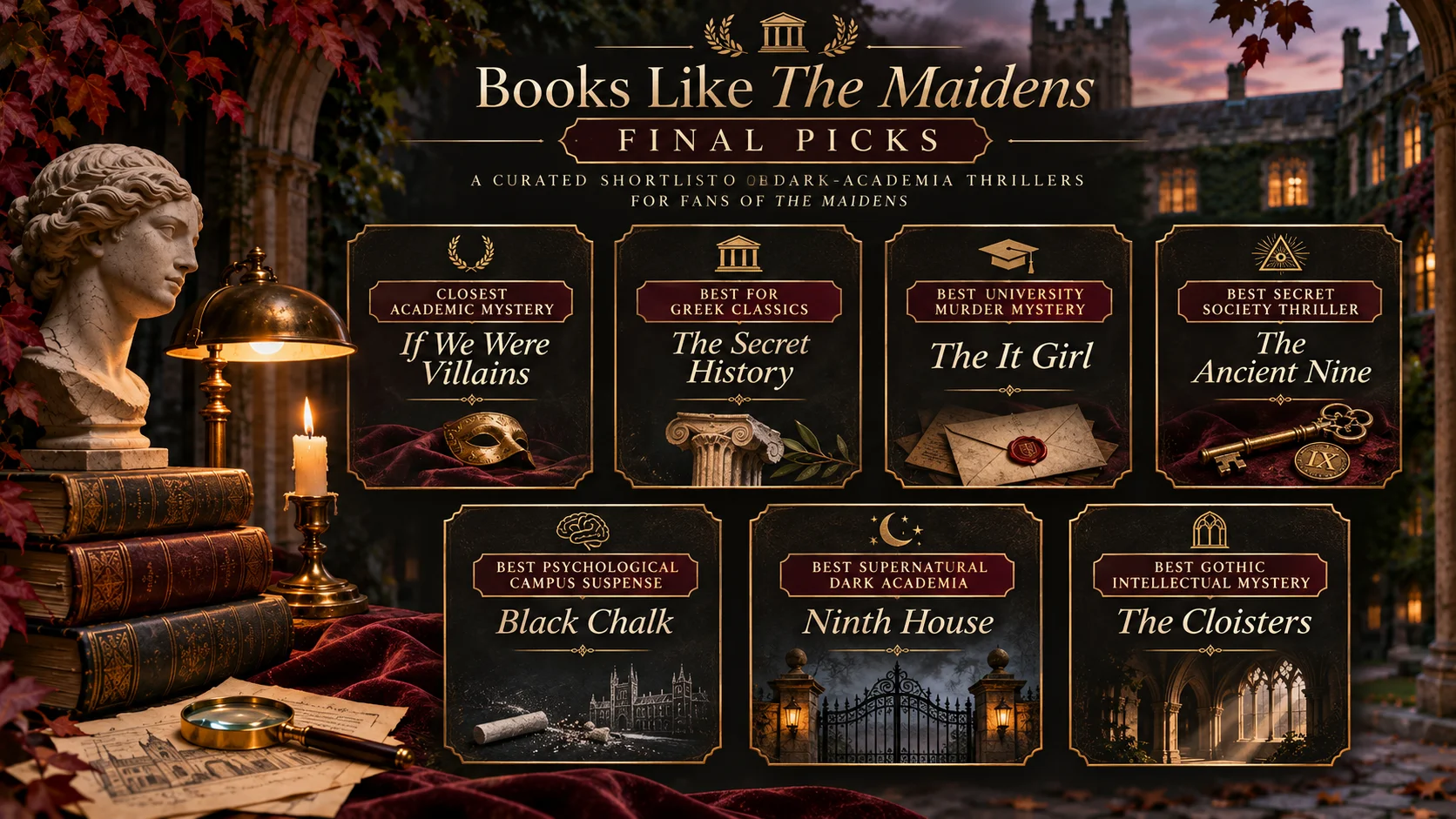
- Closest Academic Mystery: If We Were Villains.
- Best for Greek Classics: The Secret History.
- Best University Murder Mystery: The It Girl.
- Best Secret Society Thriller: The Ancient Nine.
- Best Psychological Campus Suspense: Black Chalk.
- Best Supernatural Dark Academia: Ninth House.
- Best Gothic Intellectual Mystery: The Cloisters.
These are editorial matches by preference, not universal rankings or numerical scores.
Final Thoughts
The Maidens combines classical literature, university traditions, secretive students, psychological obsession, and murder. A useful next read follows the element you want to explore, rather than repeating only the scenery.
Try If We Were Villains or The Secret History for academic obsession, The It Girl for a more conventional thriller, or Ninth House for supernatural secret-society intrigue. The differences are part of the recommendation: they help you choose the kind of reading experience you want next.
Discover More Twisty Mysteries
If you enjoy dark academic settings, suspicious characters, and secrets that slowly unravel, explore our book reviews, author guides, and related thriller recommendations to find your next read.
Our existing Alex Michaelides Books in Order guide covers his connected reading choices. You can also revisit The Maidens review or explore Ruth Ware’s books for another route into university and psychological mysteries.
Frequently Asked Questions
Start with If We Were Villains or The Secret History for academic obsession. Choose The It Girl for a more conventional university thriller, or Ninth House if you want actual supernatural elements.
If We Were Villains closely matches the exclusive literary group and concealed tragedy. The Secret History is especially relevant to classics, academic influence, and moral obsession.
Yes. Its Cambridge setting, classical literature, selective student circle, and themes of academic influence give it strong dark-academia elements alongside the murder mystery.
The Ancient Nine follows campus-club conspiracy. Ninth House follows occult secret societies and includes real magic. The Secret History also centers on an exclusive student circle, though it offers a different literary structure.
Yes. The It Girl revisits an Oxford murder, Black Chalk uses Oxford student competition, and Never Saw Me Coming places a contemporary psychological mystery on a campus.
The Secret History is the strongest classics-focused choice. If We Were Villains offers a related literary intensity through Shakespeare, not Greek mythology.
No. They range across literary dark academia, detective fiction, psychological suspense, Gothic mystery, and adult fantasy.
Ninth House explicitly includes actual magic. The Cloisters explores divination and mystical ambiguity; that should not be treated as identical to Bardugo’s fantasy world.
Many are independent choices. The Likeness is Dublin Murder Squad book two, The Secret Place is book five, and Ninth House starts a series. The Plot can be read first without prior books but has a published continuation, The Sequel.