
Reading faster sounds useful until you realize that speed means very little if you finish a page and cannot remember what you just read.
The goal is not to race through every book.
It is to become more efficient.
That means spending less time on unnecessary rereading, distractions, slow habits, and sections that do not deserve equal attention while still understanding the ideas that matter.
If you want to learn how to read faster without losing comprehension, the best approach is not a single speed-reading trick.
It is a combination of better focus, smarter pacing, stronger reading habits, and knowing when to slow down.
Quick Answer: How to Read Faster Without Losing Comprehension
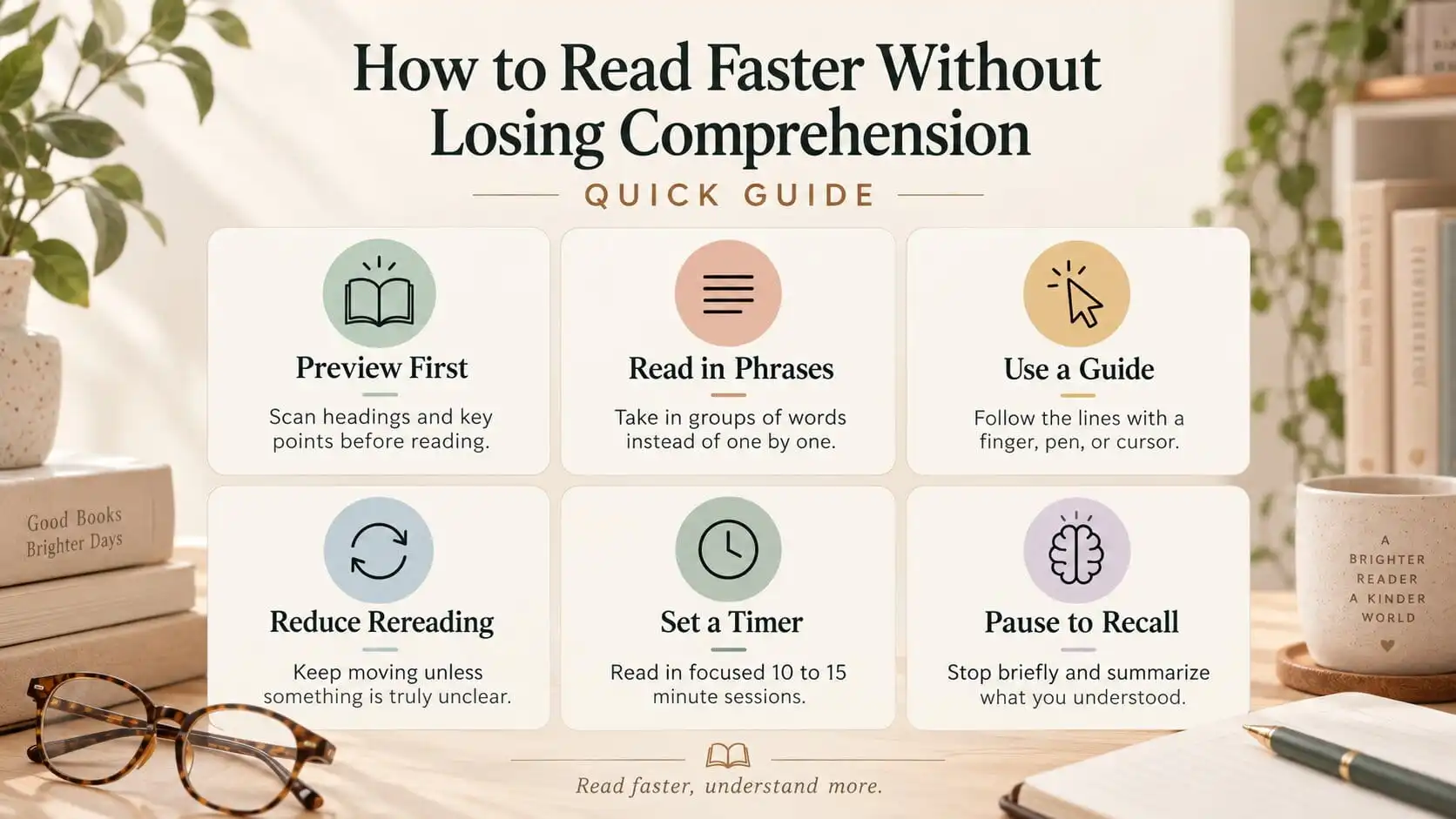
To read faster while still understanding what you read:
- Preview the material before starting.
- Stop giving every sentence the same amount of attention.
- Read groups of words instead of focusing on one word at a time.
- Use a finger, pen, or cursor to guide your eyes.
- Reduce unnecessary rereading.
- Remove distractions before you begin.
- Adjust your speed based on the difficulty of the material.
- Pause briefly after important sections to recall what you learned.
- Practice regularly instead of forcing extreme speed.
- Measure understanding, not just words per minute.
The biggest improvement usually comes from becoming a more focused and deliberate reader rather than simply trying to move your eyes faster.
First, Stop Trying to Read Everything at the Same Speed
One of the easiest ways to become a faster reader is to stop treating every part of a book as equally important.
A key argument deserves more attention than a familiar example.
A difficult explanation deserves more time than a transition paragraph.
A dramatic scene in a novel may naturally move faster than a complicated section full of clues or unfamiliar ideas.
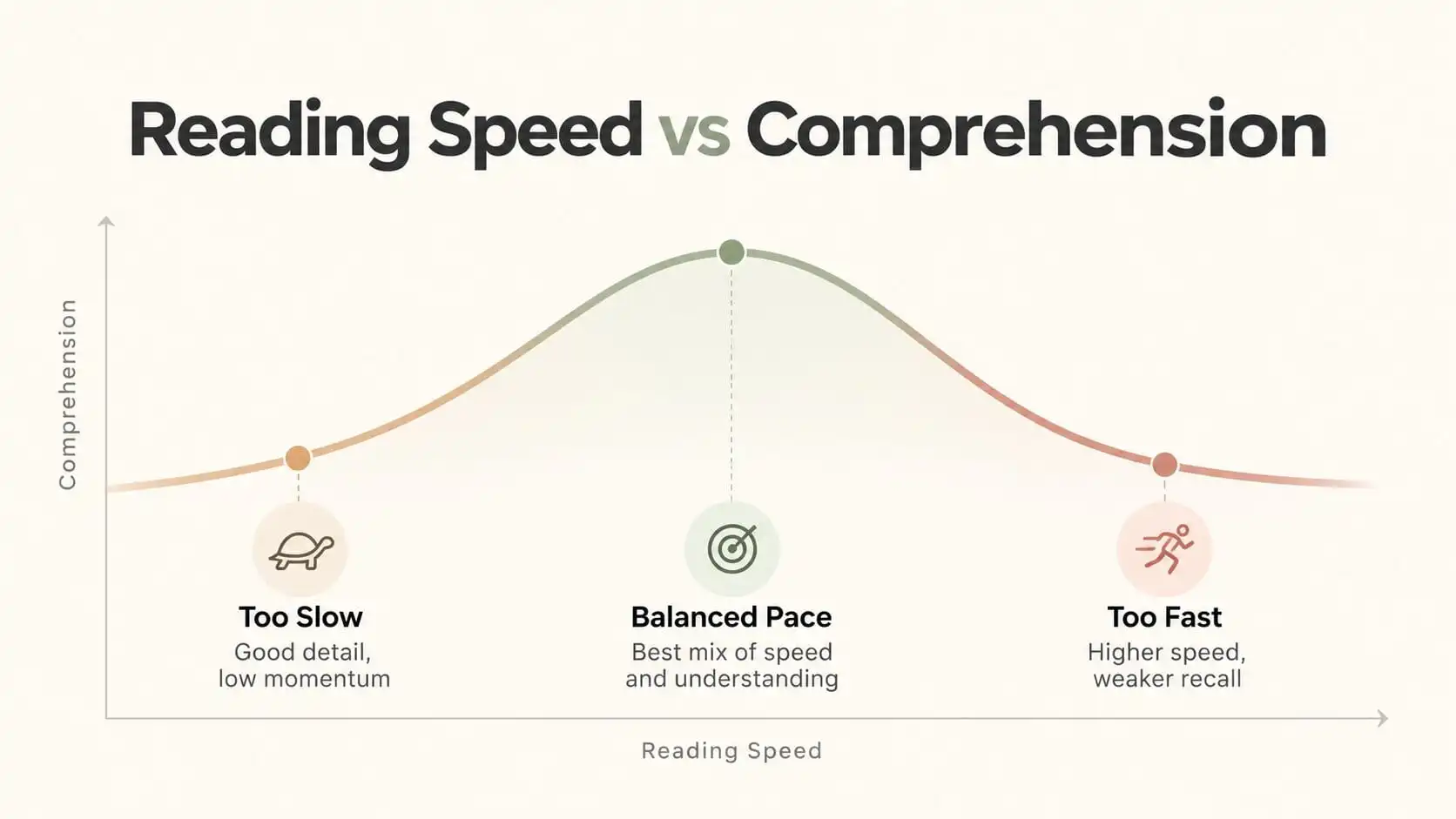
Good readers constantly change speed.
They slow down when the material becomes important or difficult and move faster when the writing is straightforward.
Slow down for:
- unfamiliar concepts
- important definitions
- complicated arguments
- dense instructions
- subtle character details
- information you need to remember
Speed up for:
- examples you already understand
- repeated explanations
- simple descriptions
- transitions
- predictable information
- sections that are not central to your goal
Reading faster is partly about knowing what deserves your time.
Preview Before You Start Reading
Going into a chapter completely blind can make reading slower because your brain has no structure for the information.
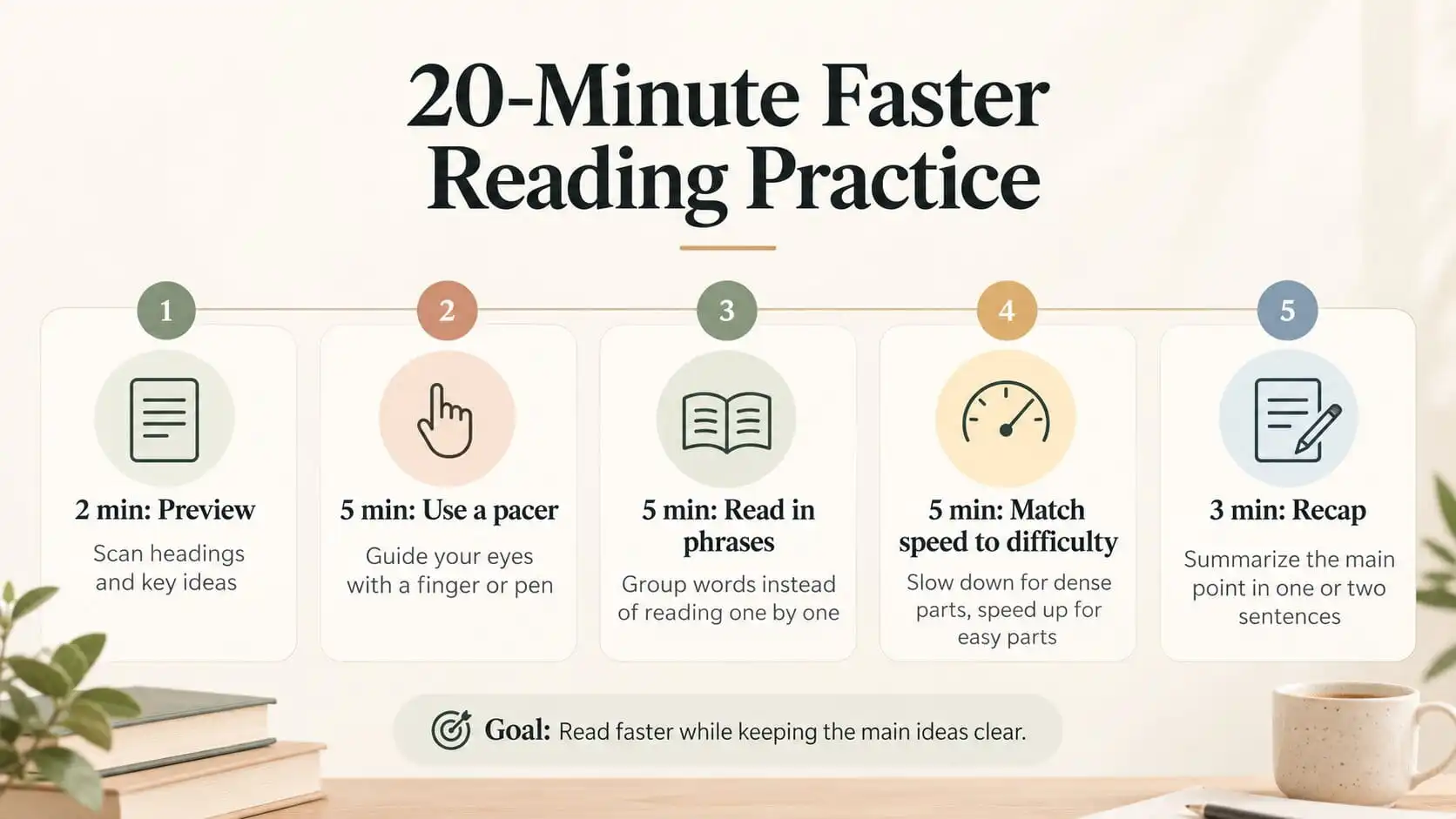
Before you start, spend a minute previewing what you are about to read.
For nonfiction, look at:
- the chapter title
- headings
- subheadings
- highlighted terms
- charts or illustrations
- summary sections
For fiction, you usually need less previewing because discovery is part of the experience.
However, even knowing where you left off, who is involved in the current scene, and what the main conflict is can help you settle into the book more quickly.
A short preview gives your brain a map.
Once you know what kind of information is coming, it becomes easier to recognize what matters.
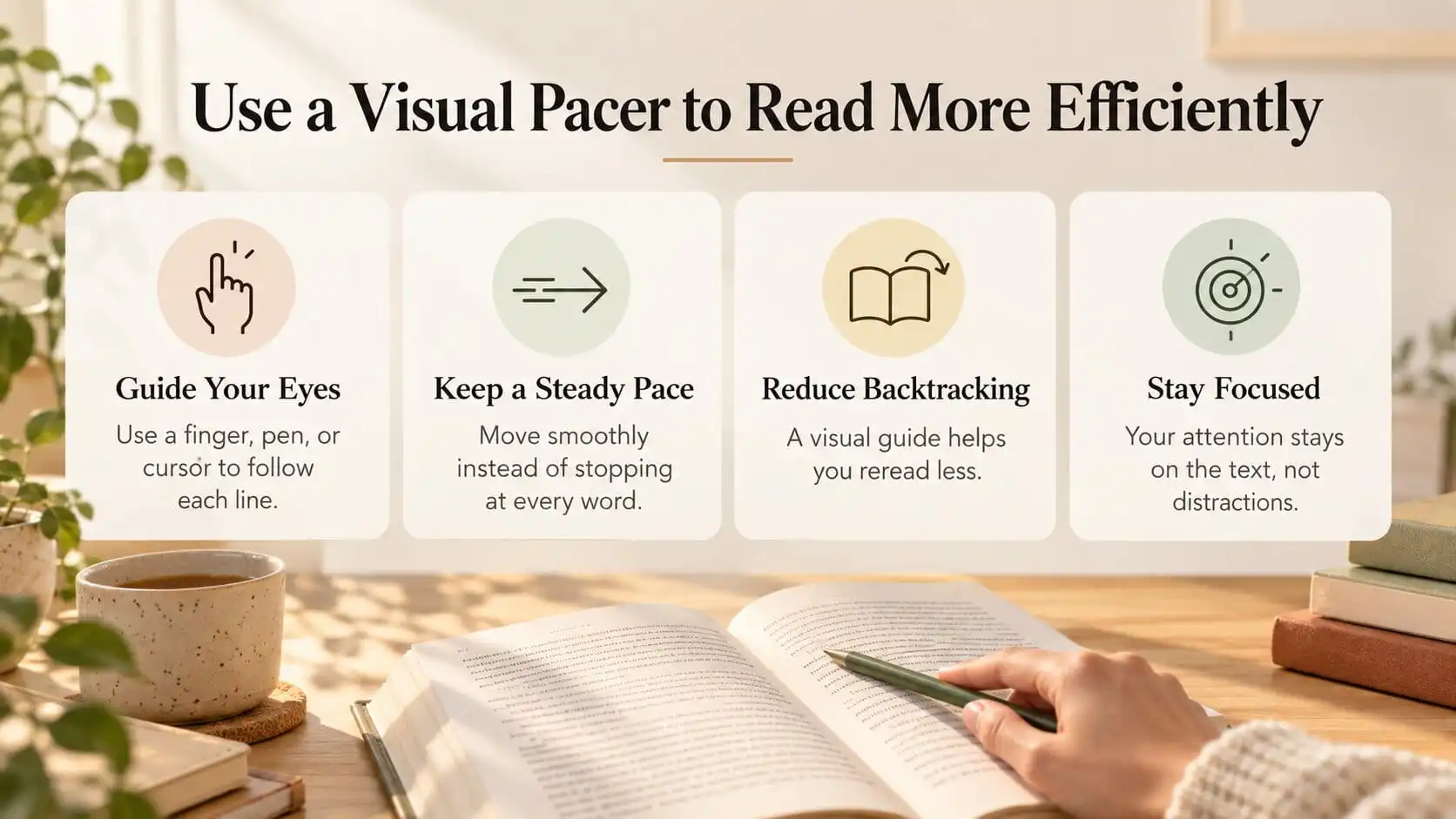
Use a Visual Pacer
Your eyes can drift when there is nothing guiding them across the page.
Using your finger, a pen, an index card, or even your mouse cursor on a screen can help keep your attention moving forward.
This does not need to look like traditional speed-reading training.
Simply move your guide steadily beneath the line you are reading.
The goal is to reduce:
- losing your place
- jumping backward unnecessarily
- staring at individual words
- getting distracted between lines
Start at a comfortable pace.
Once the movement feels natural, increase it slightly.
If comprehension drops noticeably, slow down again.
The correct pace is the fastest speed at which the material still makes sense.
Learn to Read in Phrases
Many people mentally process text one word at a time.
That can make reading feel slow and mechanical.
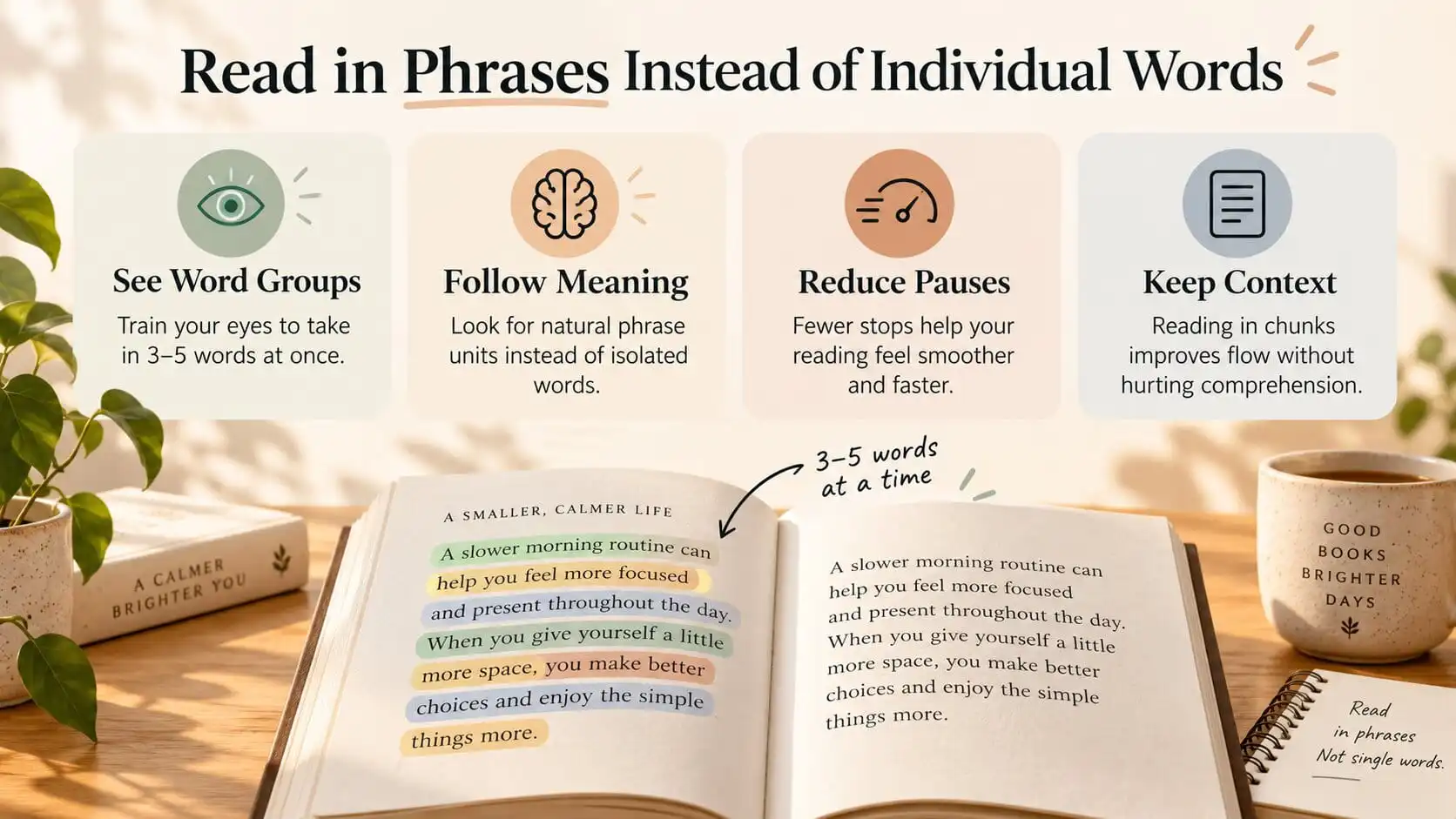
Instead, practice noticing small groups of words as meaningful units.
For example, instead of processing:
The / old / house / stood / at / the / edge / of / the / forest
try seeing:
The old house / stood at the edge / of the forest
You are still reading every important word.
You are simply processing them as connected ideas.
Start with short groups
Do not try to absorb an entire line at once.
Begin with groups of two to four words.
As it becomes more natural, your eyes may begin taking in larger chunks without conscious effort.
Let punctuation guide you
Commas, periods, and natural sentence breaks already divide writing into meaningful pieces.
Use those structures instead of forcing an artificial rhythm.
The objective is smoother reading, not skipping words randomly.
Stop Rereading Sentences Automatically
Rereading is useful when something genuinely does not make sense.
The problem is automatic rereading.
Some readers repeatedly move backward even when they understood the sentence the first time.
This can happen because:
- attention wandered
- reading became passive
- your eyes moved backward out of habit
- you are trying too hard to be accurate
Before rereading, ask:
Did I actually misunderstand this, or am I rereading out of habit?
If the meaning is clear, continue.
If something important is unclear, go back.
The goal is not to ban rereading.
It is to make rereading intentional.
Improve Your Focus Before Trying to Increase Your Speed
Poor concentration can make a normal reading pace feel extremely slow.
If you read one paragraph, check your phone, return to the book, lose your place, and then reread the paragraph, the problem is not reading speed.
It is fragmented attention.
Before a reading session:
- put your phone out of reach
- close unnecessary browser tabs
- choose a comfortable location
- decide what you are going to read
- set a short reading target
- remove obvious interruptions
Even twenty focused minutes can be more productive than an hour of distracted reading.
If difficulty concentrating has pushed you away from books altogether, our guide on how to get out of a reading slump may also help.
Match Your Reading Speed to the Material
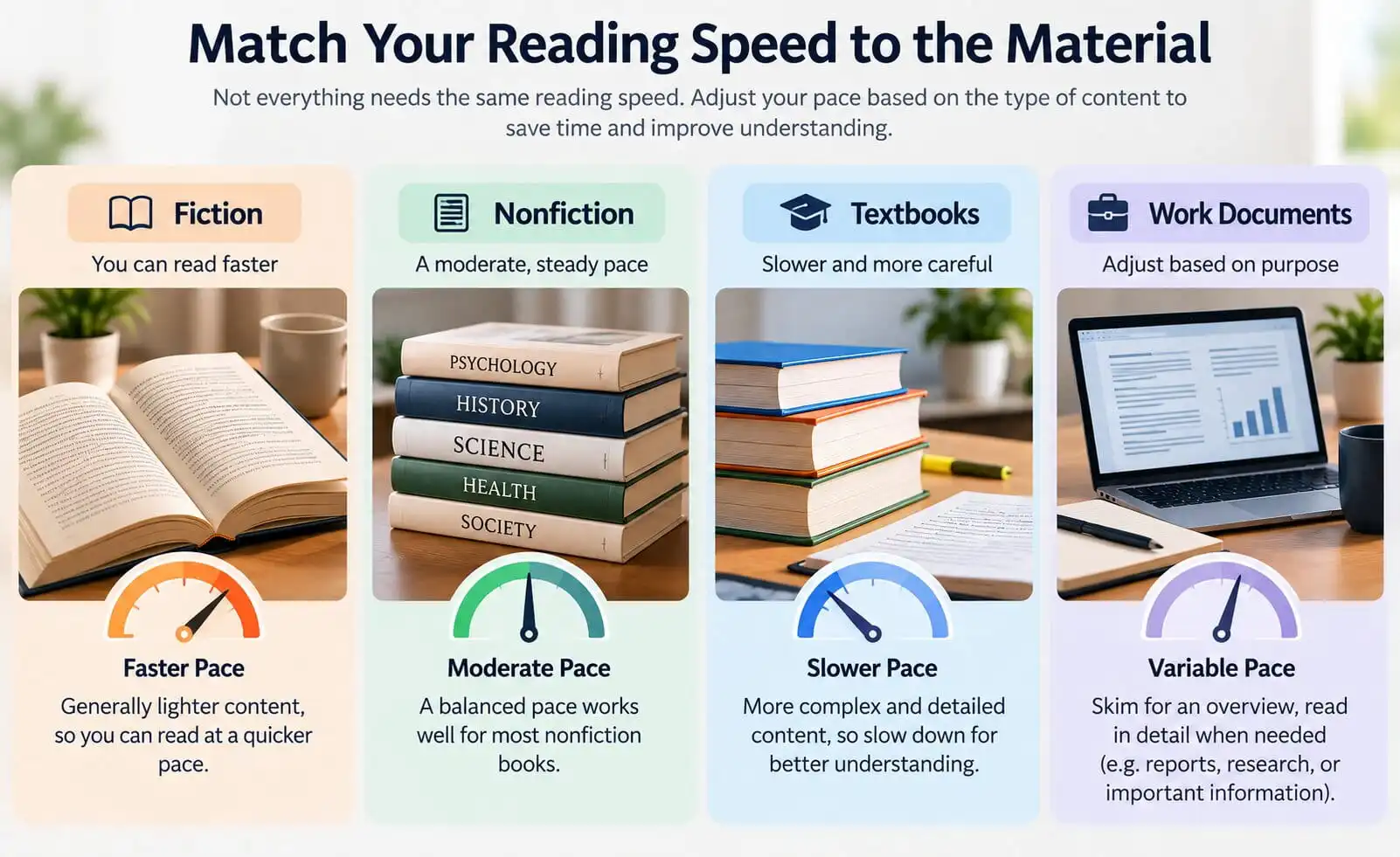
There is no single ideal reading speed.
Different books demand different levels of attention.
Fiction
Fiction can often be read at a natural, flowing pace.
Slow down when:
- a scene contains important clues
- the language is unusually dense
- several characters are involved
- you want to appreciate the writing itself
Speed up slightly through straightforward transitions or descriptions that are easy to follow.
General nonfiction
You can often move faster through familiar explanations and supporting examples.
Slow down for:
- new concepts
- arguments
- evidence
- definitions
- instructions
Textbooks and technical material
Trying to speed through dense study material usually defeats the purpose.
For difficult material, comprehension matters more than pace.
Read slowly enough to understand the idea, then test yourself before continuing.
Work documents
Start by identifying your goal.
Are you looking for:
- one fact
- the overall argument
- a decision
- instructions
- specific numbers
Once you know what you need, you can spend more time on relevant sections and less on everything else.
Do Not Try to Eliminate Subvocalization Completely
Subvocalization is the quiet inner voice many people experience while reading.
You may have seen advice claiming that eliminating it completely will dramatically increase reading speed.
That is not a useful goal for most readers.
Language is naturally connected to sound.
Trying too hard to silence every trace of inner speech can make reading uncomfortable and reduce understanding.
Instead, focus on reducing unnecessary emphasis on every individual word.
Let familiar phrases flow naturally.
Slow down when wording matters.
Move faster when meaning is obvious.
The aim is not silence.
It is efficiency.
Use Skimming Strategically
Skimming is useful when it matches your purpose.
It is not a replacement for careful reading.
You can skim when you are:
- looking for a specific fact
- reviewing material you already know
- deciding whether a section deserves close attention
- reading a long introduction
- scanning examples after understanding the main idea
You should not rely on skimming when:
- studying unfamiliar concepts
- following important instructions
- reading complex arguments
- analyzing evidence
- trying to remember detailed information
A strong reader knows when to skim and when not to.
Test Comprehension as You Read
Reading faster is meaningless if understanding quietly disappears.
You do not need a formal quiz after every page.
Use quick mental checks.
After a section, ask yourself:
What was the main point?
Try answering in one sentence.
What changed?
For fiction, this might mean:
- what happened
- what a character discovered
- how a relationship changed
- what new question appeared
What would I tell someone else?
If you can explain the idea simply, you probably understood it.
If you cannot explain what you just read, slowing down may save more time than continuing.
Build Vocabulary Over Time
Unfamiliar words naturally slow reading.
You stop.
You guess.
You reread the sentence.
Sometimes you search for a definition.
As your vocabulary grows, more sentences become immediately understandable.
You do not need to memorize dictionaries.
When an unfamiliar word matters:
- Try to understand it from context.
- Look it up if the meaning is still unclear.
- Continue reading.
- Notice the word when it appears again.
Vocabulary growth is gradual, but it improves both speed and comprehension.
Read More Often
Reading is a skill.
Like most skills, it becomes easier with regular practice.
Someone who reads frequently becomes more familiar with:
- sentence structures
- common vocabulary
- storytelling patterns
- argument structures
- genre conventions
This allows the brain to process familiar material more efficiently.
You do not need extremely long sessions.
Twenty focused minutes on most days can be more useful than forcing yourself through a large reading session once a week.
Use Short Timed Practice Sessions
If you want to deliberately improve your pace, practice in small sessions.
Choose an easy or moderately difficult book.
Set a timer for 10 minutes.
Read normally.
When the timer ends:
- Mark where you stopped.
- Summarize what you read.
- Ask whether you remember the main points.
- On the next session, try moving slightly more smoothly.
Do not aim to double your speed overnight.
Small improvements are easier to maintain.
Measure Progress by Understanding, Not Just Speed
Words per minute can be interesting, but it is not the most important measurement.
A better question is:
Can I understand more material in less time than before?
You might be improving if:
- you reread less often
- distractions interrupt you less
- you recognize phrases faster
- long chapters feel easier
- you remember more after finishing
- you can adjust your pace intentionally
That is meaningful progress even if you never calculate your exact reading speed.
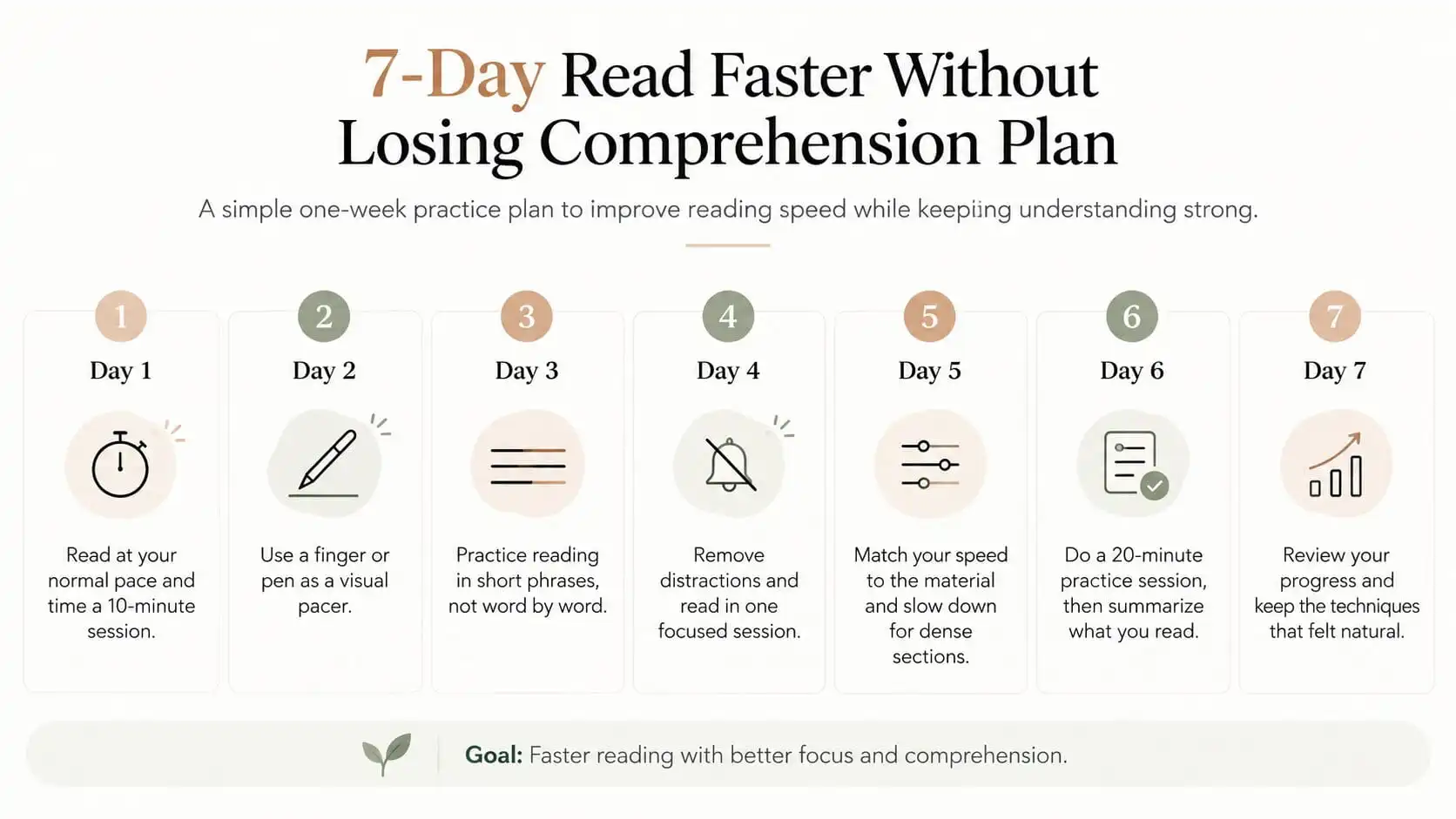
A 7-Day Practice Plan
You can start improving your reading efficiency without changing everything at once.
Day 1: Remove distractions
Read for 20 minutes with your phone away and notifications off.
Focus only on staying present.
Day 2: Use a visual pacer
Guide your eyes with your finger, pen, or cursor.
Notice whether you reread less.
Day 3: Practice phrase reading
Look for natural groups of two to four words.
Do not force yourself to read entire lines at once.
Day 4: Preview first
Before reading a chapter, spend one minute looking at its structure.
Then read normally.
Day 5: Adjust your pace
Deliberately slow down for difficult sections and move faster through simple ones.
Day 6: Test recall
After every few pages, pause and summarize the main point.
Day 7: Combine everything
Use:
- a distraction-free environment
- a short preview
- phrase reading
- a visual pacer if helpful
- flexible speed
- brief recall checks
Notice what actually improves your reading.
Keep the techniques that help.
Ignore the ones that make reading feel worse.
Common Mistakes That Make Reading Slower
Trying to force extreme speed
If the words stop making sense, you are no longer reading effectively.
Rereading everything
Return only when understanding actually requires it.
Reading while distracted
Interrupted reading creates more rereading and weaker recall.
Treating every book the same
A thriller, textbook, biography, and technical manual should not necessarily be read at the same pace.
Obsessing over words per minute
A bigger number does not automatically mean better reading.
Skipping too much
Skimming should be intentional.
Randomly skipping sentences often destroys context.
Turning reading into a performance test
Reading should still be useful or enjoyable.
If every page becomes a speed challenge, you may lose the reason you wanted to read more efficiently in the first place.
How to Read Faster When Reading Fiction
Fiction deserves its own approach because comprehension includes more than remembering facts.
You are following:
- characters
- relationships
- setting
- tone
- clues
- emotional changes
- plot development
The easiest way to increase your pace is usually to stay immersed.
Put away distractions.
Read in longer stretches.
Let straightforward scenes flow.
Slow down when details seem important.
If you constantly stop to measure your speed, you may actually make the experience worse.
How to Read Faster for Study
Studying requires more active comprehension.
Before a chapter:
- Identify what you need to learn.
- Preview the headings.
- Read one section.
- Close the book or look away.
- Explain the idea from memory.
- Continue only when you understand it.
You may read fewer pages per hour this way.
But if you remember substantially more, your total study time can still decrease.
How to Read Faster on a Screen
Digital reading creates extra distractions.
When reading online:
- use reader mode when possible
- close unrelated tabs
- increase text size if your eyes feel strained
- avoid notifications
- scroll steadily instead of jumping around
- use highlighting sparingly
- take breaks during long sessions
On long articles, preview the headings before reading from the beginning.
This gives you the same structural advantage you would get from previewing a nonfiction chapter.
Final Thoughts
Learning how to read faster without losing comprehension is less about racing and more about removing friction.
Read in phrases instead of obsessing over individual words.
Stop unnecessary rereading.
Protect your attention.
Preview difficult material.
Use different speeds for different kinds of information.
Most importantly, keep checking whether you actually understand what you are reading.
The best reading speed is not the fastest number you can reach.
It is the fastest pace that still lets you understand, remember, and enjoy what you read.