
A reading slump can make even a book lover feel strangely disconnected from reading.
You may still want to read.
You may still buy books, save recommendations, or carry one around.
But every time you open a book, your attention disappears.
Sometimes you stop after a few pages.
Sometimes you do not start at all.
The good news is that a reading slump usually does not mean you have stopped enjoying books.
It often means your current reading choices, routine, energy, or expectations are working against you.
If you are wondering how to get out of a reading slump, the best approach is usually not to force yourself through a difficult book.
It is to make reading easy and enjoyable again.
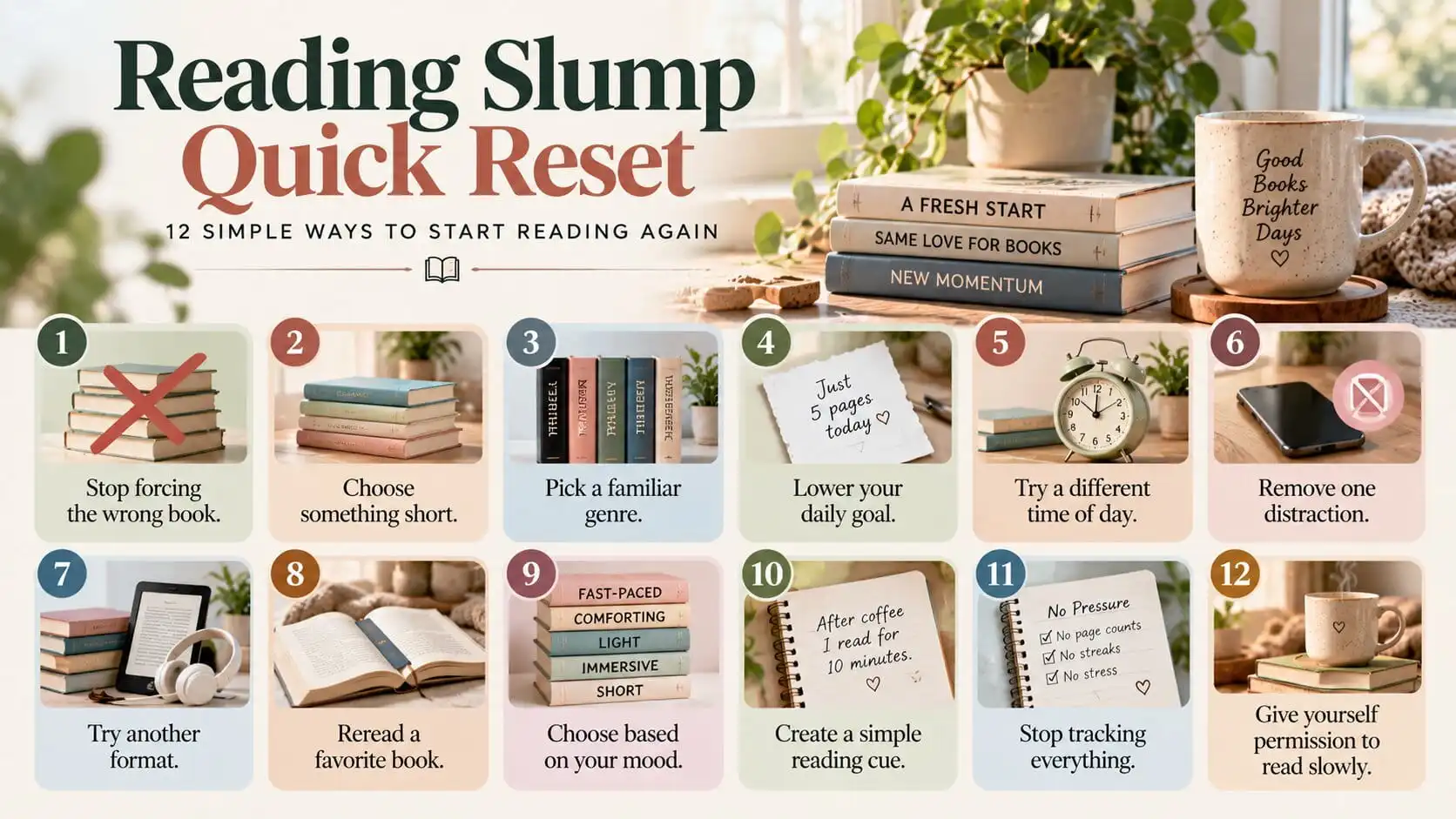
This guide gives you 12 practical ways to restart.
Quick Answer: How Do You Get Out of a Reading Slump?
Start by making reading easier.
You do not need to finish a long book or immediately return to your old reading pace.
Try this instead:
- Stop forcing the wrong book.
- Choose something short.
- Pick a familiar genre.
- Lower your daily reading goal.
- Read at a different time.
- Remove one distraction.
- Try another format.
- Revisit a favorite book.
- Choose based on mood.
- Create a simple reading cue.
- Stop tracking everything.
- Give yourself permission to read slowly.
The goal is not to prove that you can still read.
The goal is to make yourself want to open a book again.
Why Do Reading Slumps Happen?
Reading slumps can happen for many reasons.
Sometimes the problem is the book.
Sometimes it is your routine.
Sometimes you are simply tired.
Common causes include:
- reading books you are not enjoying
- trying to read when your energy is low
- choosing books because you feel you “should”
- reading too many similar books
- spending more time scrolling than reading
- setting unrealistic reading goals
- feeling pressure to finish every book
- burnout from work or study
- losing momentum after a long or difficult book
The important point is this:
A reading slump is not always a motivation problem.
Often it is a friction problem.
Change what is making reading difficult, and the desire to read can return.
1. Stop Forcing Yourself to Finish the Wrong Book
One of the fastest ways to make a reading slump worse is forcing yourself through a book you are not enjoying.
Ask yourself:
Do I not want to read, or do I not want to read this book?
Those are very different problems.
If the book feels like work every time you pick it up, put it down.
You can always return later.
Stopping one book is better than stopping reading altogether.
2. Pick a Short Book
A 500-page novel can feel intimidating when you are already struggling to read.
Choose something you can finish quickly.
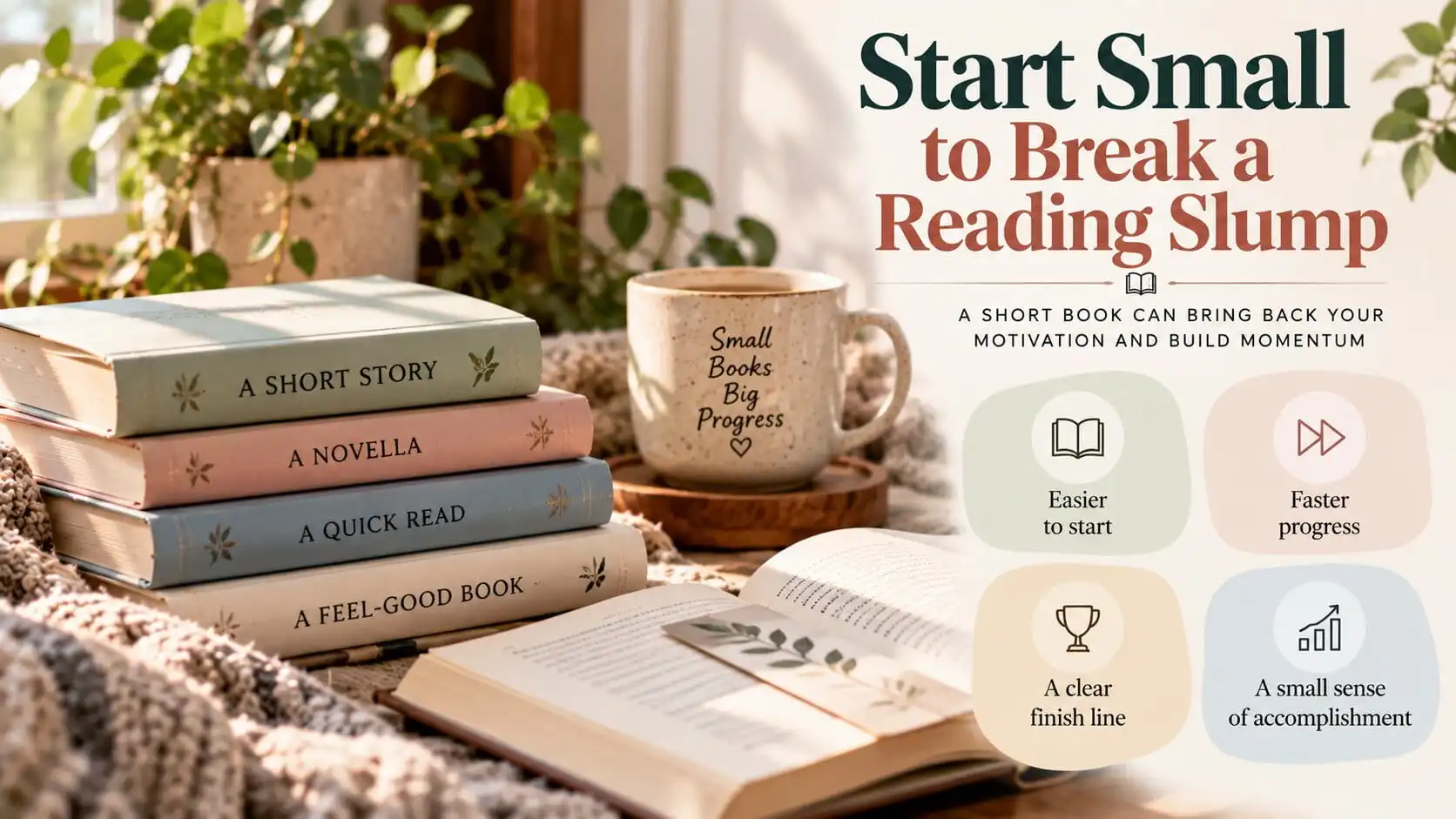
A shorter book gives you:
- an easier starting point
- faster progress
- a clear finish line
- a small sense of accomplishment
That momentum matters.
You do not need the “best” book.
You need a book that makes reading feel manageable again.
3. Return to a Genre You Already Love
A reading slump is usually not the best time to experiment with something difficult.
Go back to what already works for you.
If you usually love:
- psychological thrillers
- romance
- fantasy
- mysteries
- historical fiction
- young adult books
choose one of those.
Familiar genres reduce the effort required to get interested.
You already understand the pacing, tone, and type of story you are likely to get.
4. Lower Your Reading Goal
Do not tell yourself:
I need to read 50 pages tonight.
Try:
I will read five pages.
Or:
I will read for ten minutes.
A tiny goal removes pressure.
And once you start, you may naturally continue.
If you do not, that is fine too.
The habit matters more than the number.
5. Read at a Different Time of Day
You may not have lost interest in reading.
You may simply be trying to read at the wrong time.
If you always read at night but fall asleep after two pages, experiment.
Try:
- morning
- lunch break
- early evening
- commute time
- weekend afternoons
A different time can completely change how focused you feel.
6. Remove One Distraction
You do not need a perfect reading environment.
Just remove the biggest competitor.
Usually that is your phone.
Try:
Read 10 minutes before opening social media.
Or:
Leave your phone across the room while reading one chapter.
You do not need to avoid technology for hours.
A small distraction-free window is enough.
7. Try a Different Format
If physical books are not working, try an ebook.
If ebooks feel tiring, try print.
If sitting still feels impossible, try an audiobook.
Different formats fit different situations.
For example:
Physical books
Good for focused evening reading.
Ebooks
Useful for commuting, travel, or waiting.
Audiobooks
Great while walking, driving, cleaning, or exercising.
Changing the format can make reading feel new again without changing the habit itself.
8. Reread a Favorite Book
You do not always need something new.
A familiar book removes uncertainty.
You already know:
- you like the characters
- you enjoy the writing
- the story works for you
That means less effort is required to get invested.
A reread can remind you what you liked about reading in the first place.
9. Choose Your Next Book Based on Mood
A common mistake is choosing books from a fixed reading list instead of asking what you actually want right now.
Your mood matters.
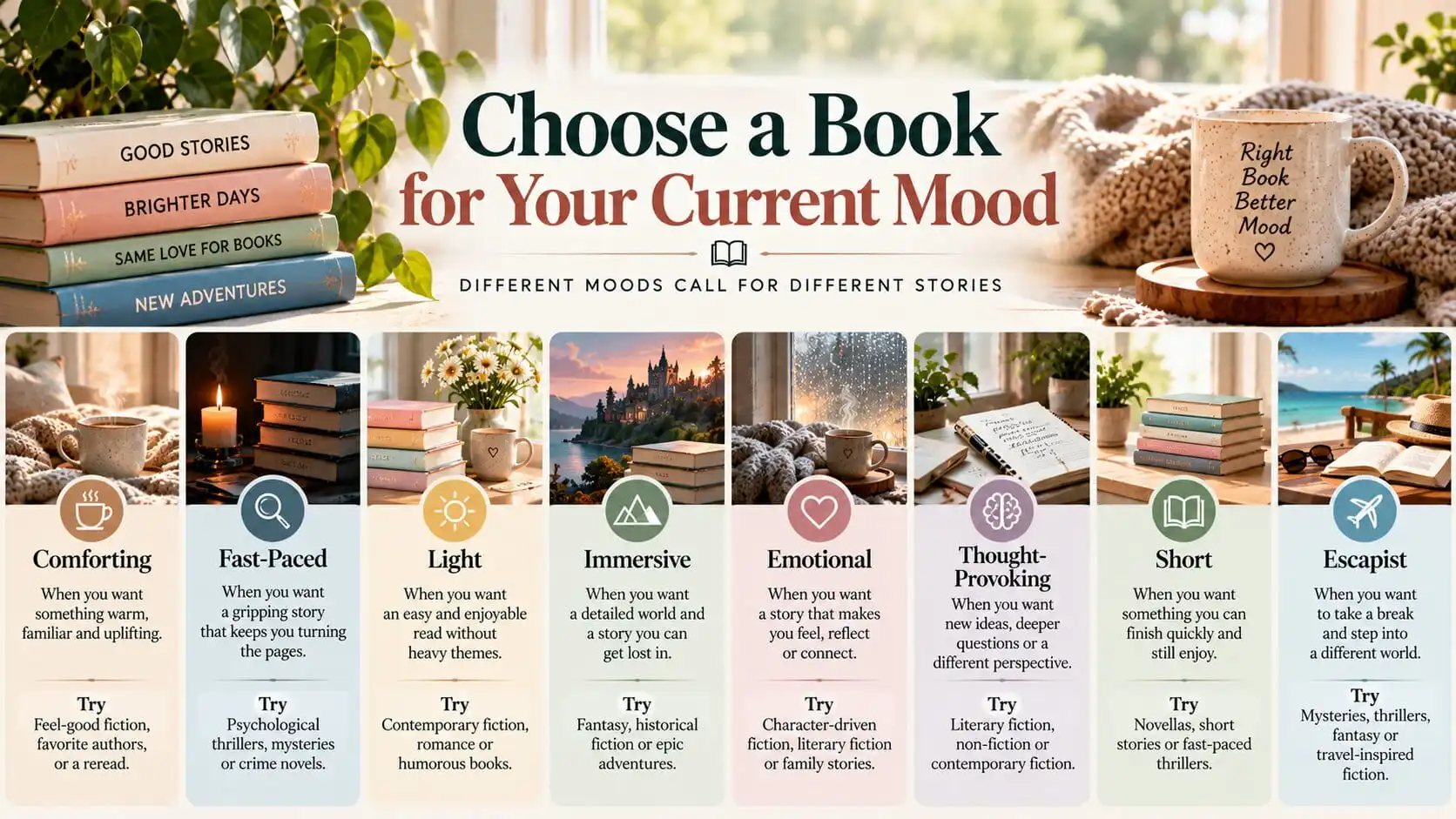
If you want something:
Fast
Choose a thriller.
Comforting
Choose a favorite genre or reread.
Light
Choose something easy and conversational.
Immersive
Choose fantasy or historical fiction.
Short
Choose a novella or compact mystery.
If choosing is the part slowing you down, read:
How to Choose What Book to Read Next
10. Create One Simple Reading Cue
Make reading happen after something you already do.
For example:
After I make coffee, I read for 10 minutes.
After dinner, I read one chapter.
When I get into bed, I open my book before my phone.
This removes the daily decision of when to read.
A routine makes reading easier to restart.
For a more complete system, see:
How to Build a Reading Habit That Lasts
11. Stop Tracking Everything for a While
Reading goals can be motivating.
They can also become pressure.
If you are constantly thinking about:
- number of books
- pages per day
- yearly targets
- reading streaks
- progress percentages
reading can start feeling like another task.
Try ignoring the numbers for a week.
Read because you want to know what happens next.
You can return to tracking later.
12. Give Yourself Permission to Read Slowly
You do not need to return to your previous reading pace immediately.
Maybe you used to finish two books a week.
Now it takes two weeks.
That is okay.
Reading slowly is still reading.
The goal of getting out of a slump is not speed.
It is rebuilding the connection.
Once reading becomes enjoyable again, speed and consistency often return naturally.
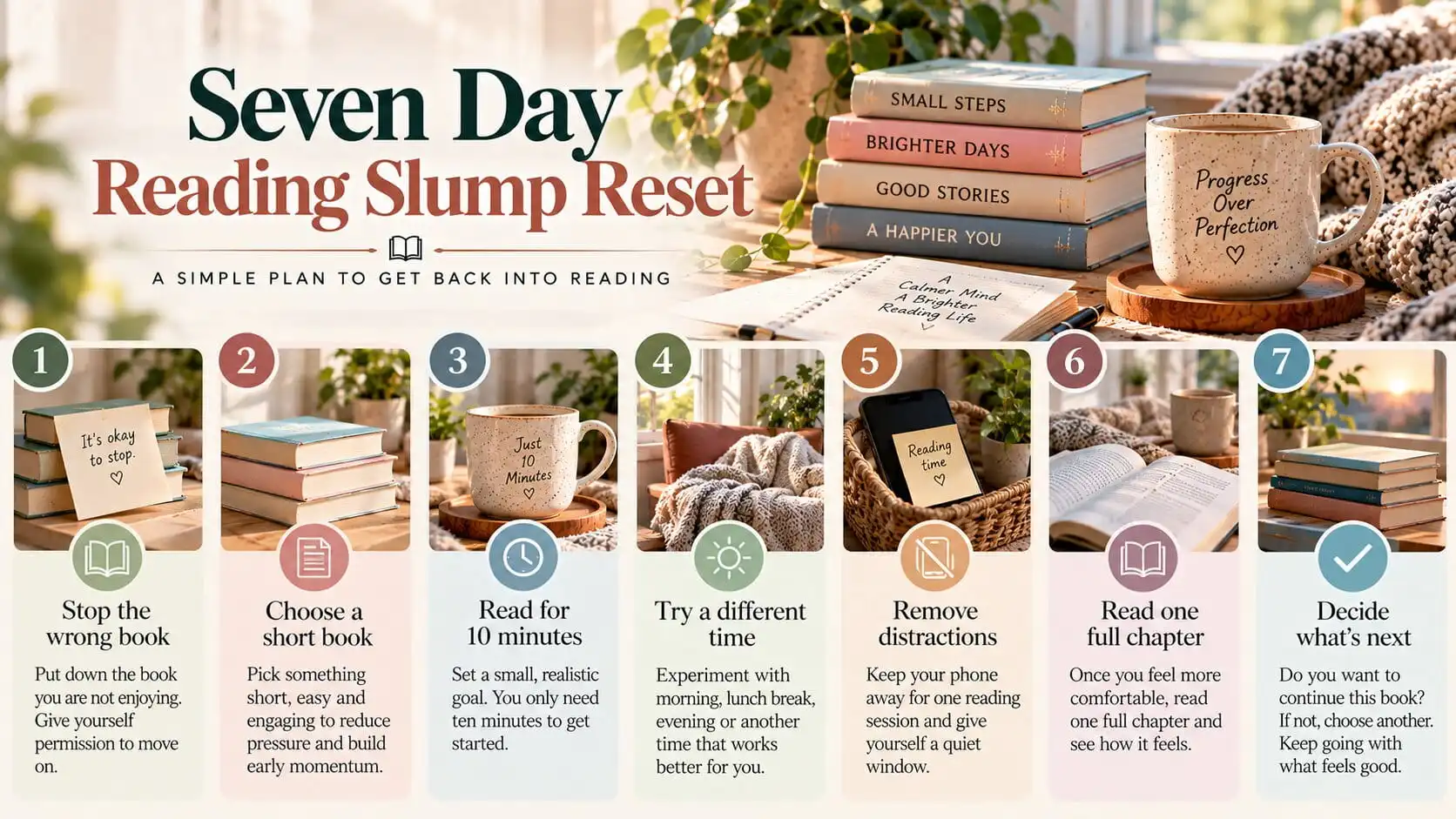
A Simple 7-Day Reading Slump Reset
If you want a practical plan, try this.
Day 1
Stop the book you are forcing.
Day 2
Choose one short, easy book.
Day 3
Read for 10 minutes.
Day 4
Read at a different time.
Day 5
Put your phone away for one reading session.
Day 6
Read one full chapter.
Day 7
Decide whether you genuinely want to continue the book.
If yes, keep going.
If no, choose another.
The point is not to complete a book in seven days.
It is to make reading feel normal again..
What Should You Read During a Reading Slump?
The best slump-breaking books usually have at least one of these qualities:
- short chapters
- simple premise
- quick pacing
- strong hook
- familiar genre
- manageable length
You may want to avoid:
- very dense books
- extremely long novels
- books you feel
- obligated to finish
- genres you are already tired of
A reading slump is usually a bad time to challenge yourself unnecessarily.
Are Thrillers Good for Reading Slumps?
Often, yes.
Thrillers tend to work well because they usually offer:
- short chapters
- immediate questions
- clear stakes
- frequent reveals
- strong momentum
If that is your preferred genre, House of Readers already has recommendation guides such as:
Books Like Daisy Darker: 12 Isolated Mysteries to Read Next
and:
Books Like Rock Paper Scissors: 12 Thrillers to Read Next
Should You Reread a Book During a Slump?
Absolutely.
Rereading removes the pressure of learning a completely new story.
A familiar book can feel comforting and easy.
You may notice details you missed the first time too.
There is no rule saying every reading session has to move you toward a new title.
What If You Keep Starting Books but Never Finishing Them?
Reduce the number of books you are trying simultaneously.
Choose one main book.
Give it a fair trial.
For example:
50 pages or three chapters.
Then decide:
Continue or stop.
Do not leave yourself with ten books sitting halfway finished.
Too many choices can make it harder to return to any of them.
How Long Does a Reading Slump Last?
There is no fixed length.
It could last:
- a few days
- several weeks
- months
Trying to force your way out can sometimes make it last longer.
Instead, remove pressure and focus on making reading enjoyable again.
Reading Slump vs Losing Interest in Reading
These are not necessarily the same thing.
A slump usually means:
You still want to read, but starting or continuing feels difficult.
Losing interest means:
Reading currently does not sound appealing at all.
If that happens, taking a genuine break can be better than forcing a habit.
Books will still be there when you return.
How to Get Out of a Reading Slump Without Forcing Yourself
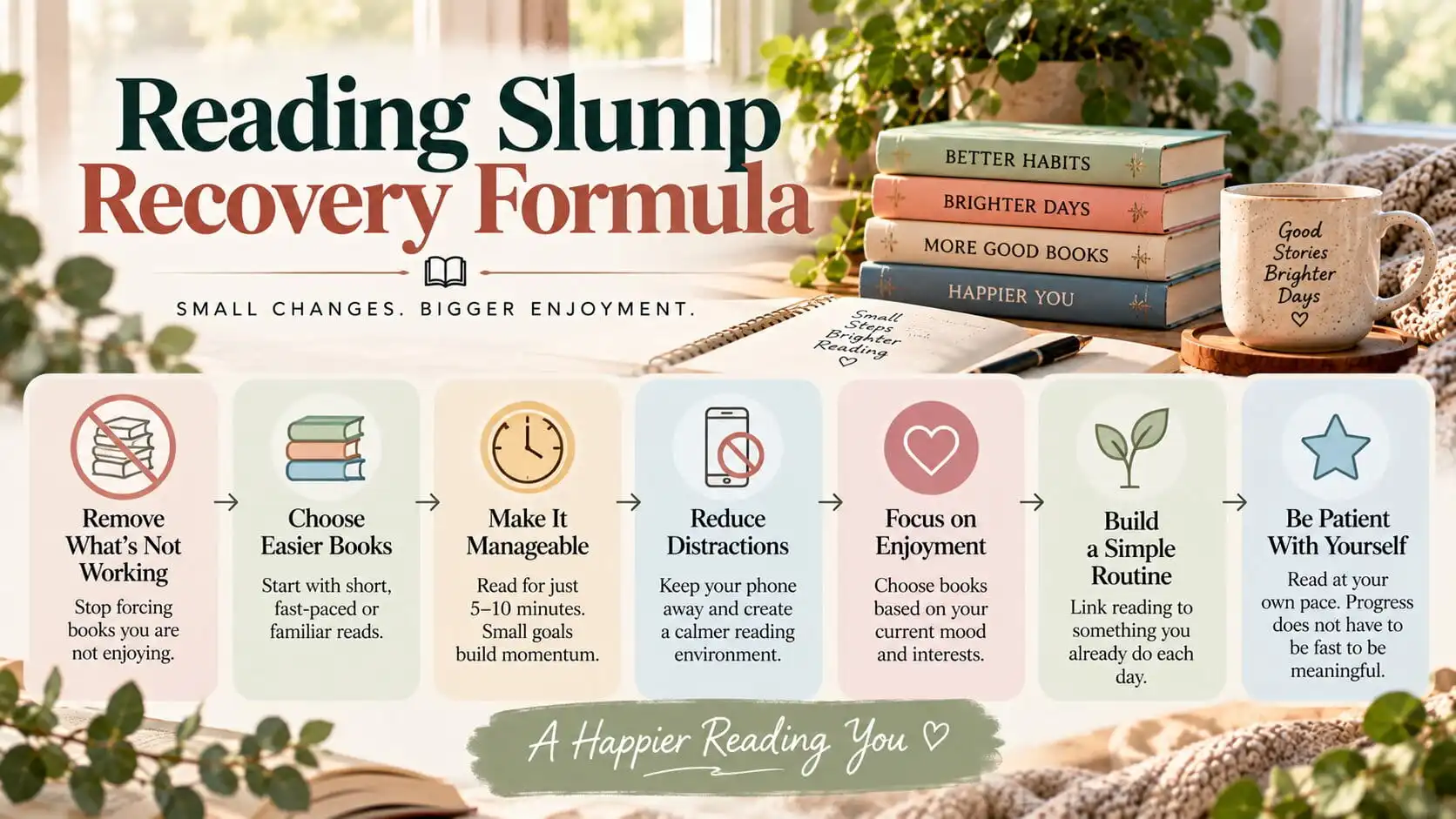
If you remember only one idea from this guide, use this:
Reduce friction instead of increasing pressure.
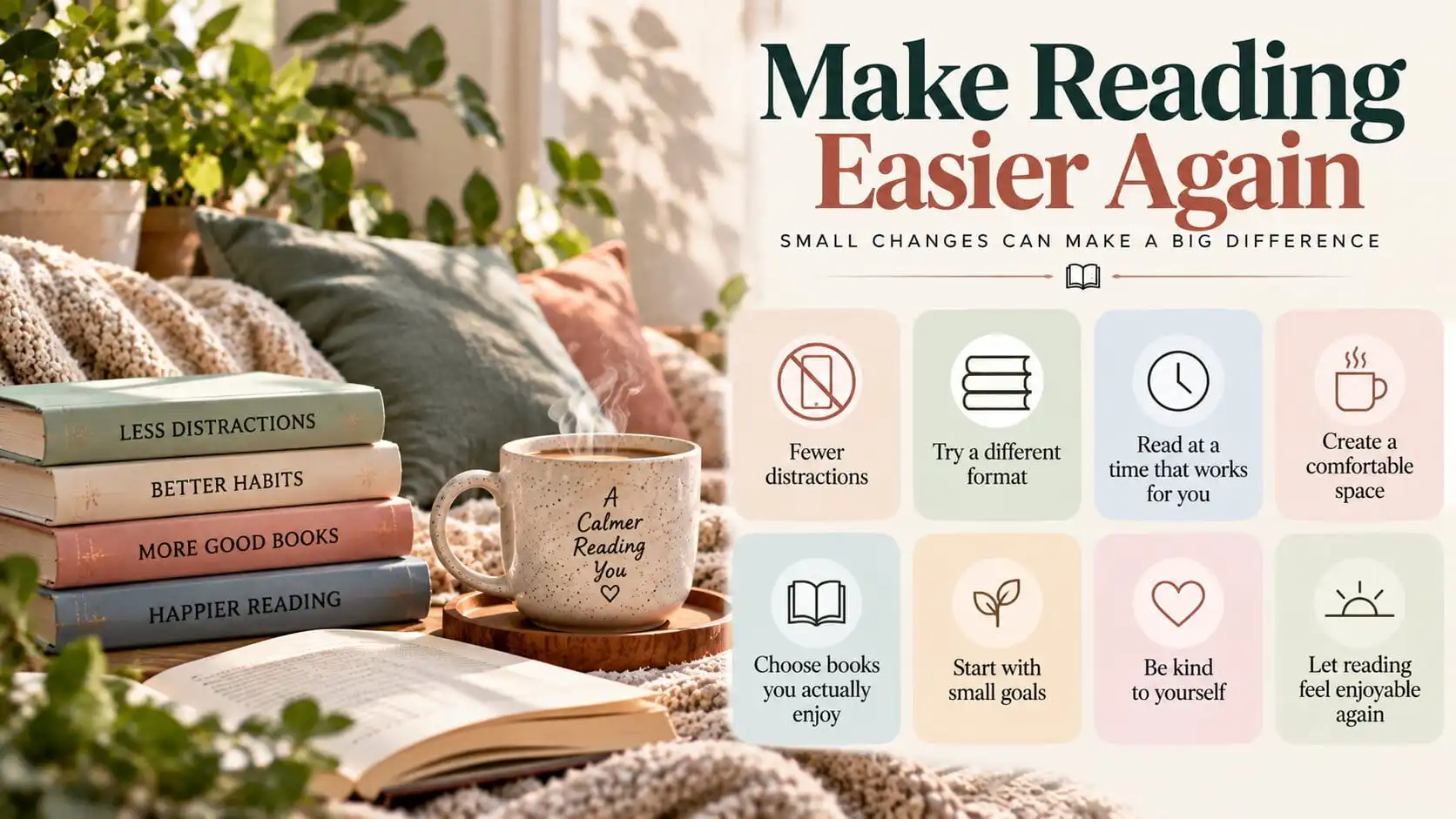
That means:
- easier book
- shorter goal
- fewer distractions
- better timing
- more enjoyable genre
- permission to stop
That is usually more effective than telling yourself to “try harder.”
Final Thoughts
Learning how to get out of a reading slump is mostly about making reading enjoyable again.
You do not need to finish a huge novel.
You do not need to read every day immediately.
You do not need to catch up with your yearly goal.
Start smaller.
Choose better.
Read when your energy is right.
Drop books that are making the slump worse.
And remember that taking a break does not make you less of a reader.
The simplest restart may be:
one good book + ten quiet minutes.
That is enough to begin.