How to Get Back Into Reading: 15 Simple Ways to Start Reading Again
There are times when reading used to feel easy.
You picked up a book, disappeared into it for an hour, and suddenly realized you had read far more than expected.
Then something changed.
Maybe life became busier. Maybe your attention shifted to your phone. Maybe you finished a few disappointing books in a row. Or maybe reading simply stopped feeling like something you naturally reached for.
If that sounds familiar, you do not need an ambitious reading challenge.
You need a simpler way back in.
This guide will show you how to get back into reading without turning it into another task on your to-do list.
Quick Answer: How Do You Get Back Into Reading?
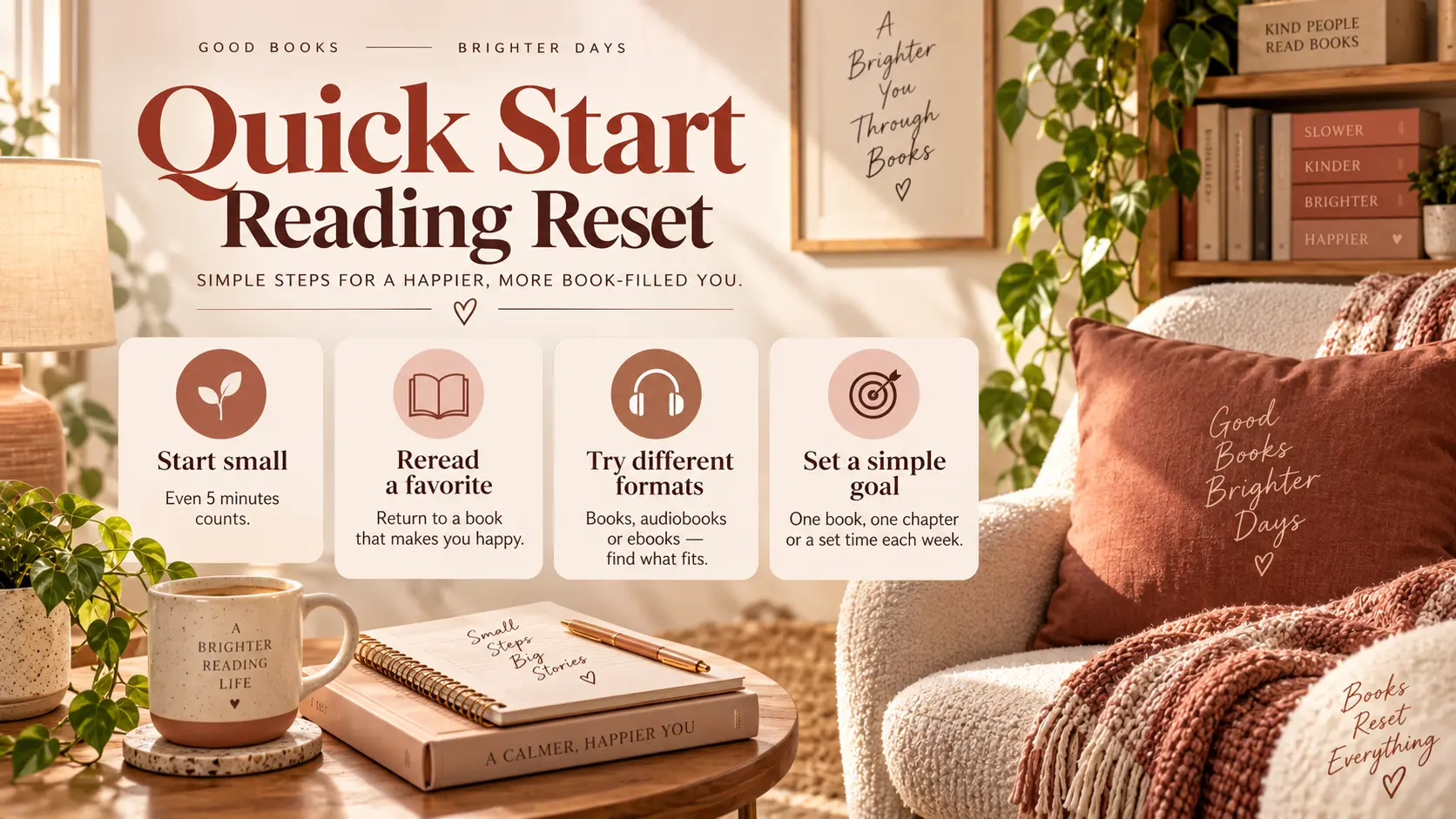
Start smaller than you think you need to.
Choose a book you are genuinely interested in, read for just 10 minutes, and stop trying to force yourself through books you are not enjoying.
The goal at first is not to read more.
The goal is to make reading feel easy again.
A good reset looks like this:
- choose one appealing book
- remove pressure
- read for a short amount of time
- make the book easy to reach
- stop when your attention is gone
- return the next day
Consistency matters more than volume.
1. Start With a Book That Feels Easy to Read
This is not the time to choose a book because you think you should read it.
Choose something that feels inviting.
That might mean:
- a thriller with short chapters
- a romance with an easy writing style
- a fantasy book you already know you enjoy
- a short nonfiction book
- a reread of something familiar
The best book for rebuilding a reading habit is often not the most impressive one.
It is the one you actually want to open.
2. Read for 10 Minutes
You do not need to promise yourself an hour.
Ten minutes is enough.
A short reading window makes starting feel easy.
And once you begin, you may naturally continue.
If you do not, that is fine too.
Ten minutes still counts.
The hardest part is often opening the book, not reading it.
3. Stop Forcing Yourself to Finish Books You Dislike
A book you are not enjoying can make reading feel like work.
If you keep thinking:
I should finish this before I start something else
you may end up reading nothing.
Give yourself permission to stop.
You are not being tested.
You do not need to complete every book you begin.
Sometimes the fastest way back into reading is simply choosing a better book.
4. Revisit a Genre You Already Love
When you are trying to rebuild a habit, familiarity can help.
Think about the books you used to finish quickly.
Was there a pattern?
Maybe you naturally enjoy:
- psychological thrillers
- mystery
- fantasy
- romance
- historical fiction
- young adult
- memoirs
Start there.
You can experiment later.
For now, give yourself the easiest possible path back into the habit.
5. Choose Shorter Books
A 600-page book can feel intimidating when you have not been reading much.
A shorter book creates faster progress.
That matters because visible progress makes reading feel rewarding again.
You do not need to choose the shortest possible book.
Just avoid making your return unnecessarily difficult.
A 200 to 300-page novel can often be a much easier starting point than an enormous series opener.
6. Keep Your Book Somewhere You Can See It
Environment matters more than most people realize.
If your book is hidden on a shelf, your phone will probably win.
Leave the book somewhere visible:
- beside your bed
- on your desk
- near the sofa
- in your bag
- beside your coffee mug
The easier it is to reach, the more likely you are to read.
This is a small change, but it removes one layer of friction.
7. Attach Reading to Something You Already Do
You do not necessarily need to create an entirely new routine.
Add reading to an existing one.
For example:
After morning coffee, read 10 pages.
Before bed, read for 15 minutes.
During lunch, read one chapter.
After dinner, read instead of immediately opening social media.
The habit becomes easier when it already has a place in your day.
8. Replace a Small Amount of Scrolling
You do not have to delete every app on your phone.
That usually makes the goal feel unrealistic.
Instead, replace a small amount of scrolling with reading.
For example:
If you normally spend 30 minutes scrolling before bed, try reading for the first 10 minutes.
You are not trying to become a completely different person overnight.
You are simply creating a little more space for books.
9. Try Audiobooks
Reading does not have to mean sitting still with a physical book.
Audiobooks can be useful when your schedule makes traditional reading difficult.
You can listen while:
- commuting
- walking
- cleaning
- cooking
- exercising
- doing repetitive tasks
For some people, audiobooks become the easiest way to reconnect with stories.
And once that interest returns, physical or digital reading often becomes easier too.
10. Use Ebooks When They Are More Convenient
A physical book is lovely.
But convenience matters.
If you always have your phone or tablet with you, an ebook can remove another barrier.
You can read:
- while waiting
- during a break
- before an appointment
- while traveling
A few pages here and there can add up quickly.
The best reading format is the one you actually use.
11. Keep a Small Reading List
A giant list of 200 books can create pressure rather than excitement.
Try keeping a shorter list instead.
Maybe:
5 books I genuinely want to read next
That is enough.
When you finish one book, choose from that list rather than spending an hour searching for the perfect next title.
You can always update it later.
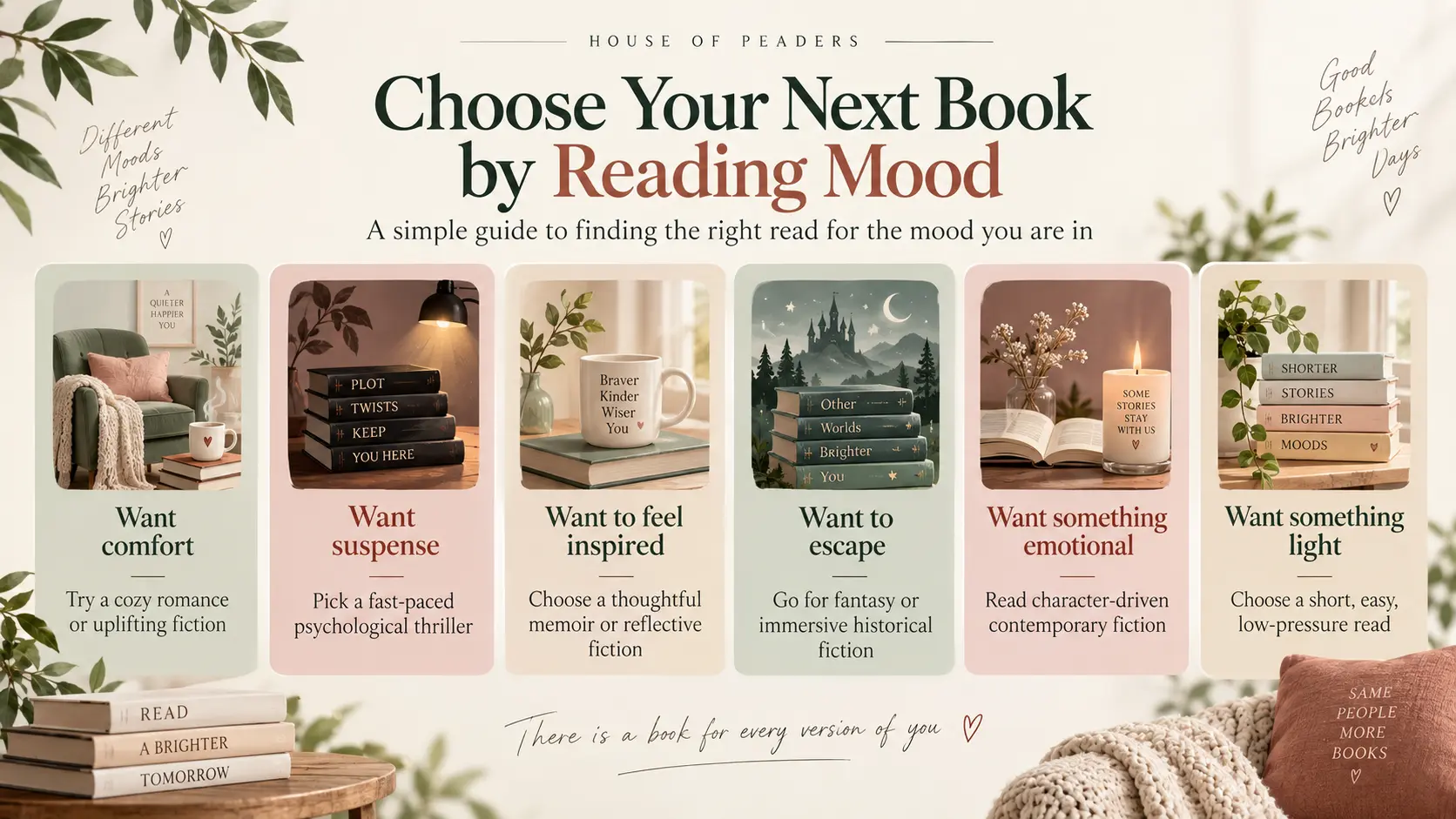
12. Choose Books Based on Your Mood
One of the easiest ways to lose momentum is choosing the wrong book for your current mood.
You may normally love fantasy.
But maybe right now you want something fast and simple.
Or maybe you usually read thrillers but currently want something calmer.
Ask yourself:
What kind of reading experience do I want today?
That question is often more useful than:
What book should I read next?
13. Read One Book at a Time if Multiple Books Feel Overwhelming
Some readers love having several books open at once.
Others find that it creates too many choices.
If you keep bouncing between three or four books without finishing any of them, simplify.
Pick one.
Read it until you either:
- finish it
- decide it is not for you
Then move on.
Less choice can sometimes make reading easier.
14. Track Your Reading Only if It Motivates You
Reading trackers can be fun.
They can also turn reading into homework.
If tracking:
- pages
- books
- reading streaks
- yearly totals
makes you excited, use it.
If it makes you anxious or competitive, stop.
You do not need to prove your reading habit to anyone.
The habit should support your enjoyment, not replace it.
15. Focus on Enjoyment, Not Numbers
This may be the most important point.
Reading is not more valuable because you finish 50 books instead of 10.
You do not need:
- a huge yearly goal
- a perfect reading streak
- a complicated tracker
- a list of classics you feel obligated to finish
If you read one book slowly and genuinely enjoy it, that is still a successful reading experience.
The best reading habit is one that makes you want to come back.

What If You Still Cannot Focus on Reading?
Sometimes the issue is not the book.
It is attention.
If you find yourself rereading the same paragraph again and again, try making the environment quieter.
You could:
- put your phone in another room
- use Do Not Disturb
- read somewhere without a television
- choose a shorter chapter
- set a 10-minute timer
- switch formats
You can also try reading at a different time of day.
Some people focus much better in the morning than at night.
Others are the opposite.
Experiment.
There is no universal perfect reading schedule.
Should You Reread an Old Favorite?
Yes.
Rereading can be one of the easiest ways to get back into reading.
You already know:
- the characters
- the world
- the writing style
- whether you enjoy it
That removes the uncertainty of starting something new.
And because you already know the story, there is less pressure to pay attention to every detail.
A familiar book can act like a bridge back into regular reading.
How Many Pages Should You Read a Day?
There is no perfect number.
For someone rebuilding the habit, I would rather recommend:
10 minutes per day
than:
50 pages per day
Time-based goals are usually easier because page length and writing style vary so much.
Ten minutes with a dense book may only be a few pages.
Ten minutes with a fast thriller could be much more.
Both are useful.
Is Reading Before Bed a Good Habit?
It can be.
Reading before bed works well because it gives the habit a predictable place in your routine.
But it is not mandatory.
If you are too tired at night and constantly fall asleep after one page, try another time.
Morning reading may work better.
Or lunch.
Or your commute.
The best time to read is the time you can realistically repeat.
What Is the Best Book to Start Reading Again?
There is no single best book.
The right book depends on what you enjoy.
But I would prioritize something with:
- an interesting premise
- accessible writing
- manageable length
- relatively short chapters
- a genre you already like
If you enjoy psychological thrillers, for example, you could start with our:
Or browse:
Books Like The Housemaid: 12 Psychological Thrillers to Read Next
The important thing is choosing a book you are curious about, not one you feel obligated to read.
A Simple 7-Day Reading Reset
If you want something more structured, try this.
Day 1
Choose one book.
Day 2
Read for 10 minutes.
Day 3
Read another 10 minutes.
Day 4
Move your phone away and read one full chapter.
Day 5
Decide whether you genuinely like the book.
If not, replace it.
Day 6
Read during a time you would normally scroll.
Day 7
Choose when reading naturally fits into your week.
That is enough.
You do not need a 30-day challenge before you can call yourself a reader again.
Final Thoughts
Getting back into reading is usually less about discipline and more about removing unnecessary difficulty.
Start with a book you actually want to read.
Keep it nearby.
Read for a few minutes.
Stop forcing books that are not working.
Experiment with different formats.
And do not turn the habit into a competition.
You are trying to rediscover the feeling that made you enjoy books in the first place.
Once reading starts feeling rewarding again, reading more often usually becomes much easier.