
Should you listen to a book, read it on a screen, or pick up a physical copy?
There is no single answer that works for every reader.
Audiobooks, ebooks, and physical books can all give you access to the same story or information, but the experience of using them can be very different.
An audiobook can turn a commute into reading time.
An ebook can put an entire library in your bag.
A physical book can give you a distraction-free experience that feels easier to settle into.
So when comparing audiobooks vs ebooks vs physical books, the useful question is not:
Which format is objectively best?
It is:
Which format works best for the way you actually read?
This guide compares all three across convenience, focus, portability, ownership, note-taking, travel, bedtime reading, multitasking, and overall reading experience.
Quick Answer: Audiobooks vs Ebooks vs Physical Books
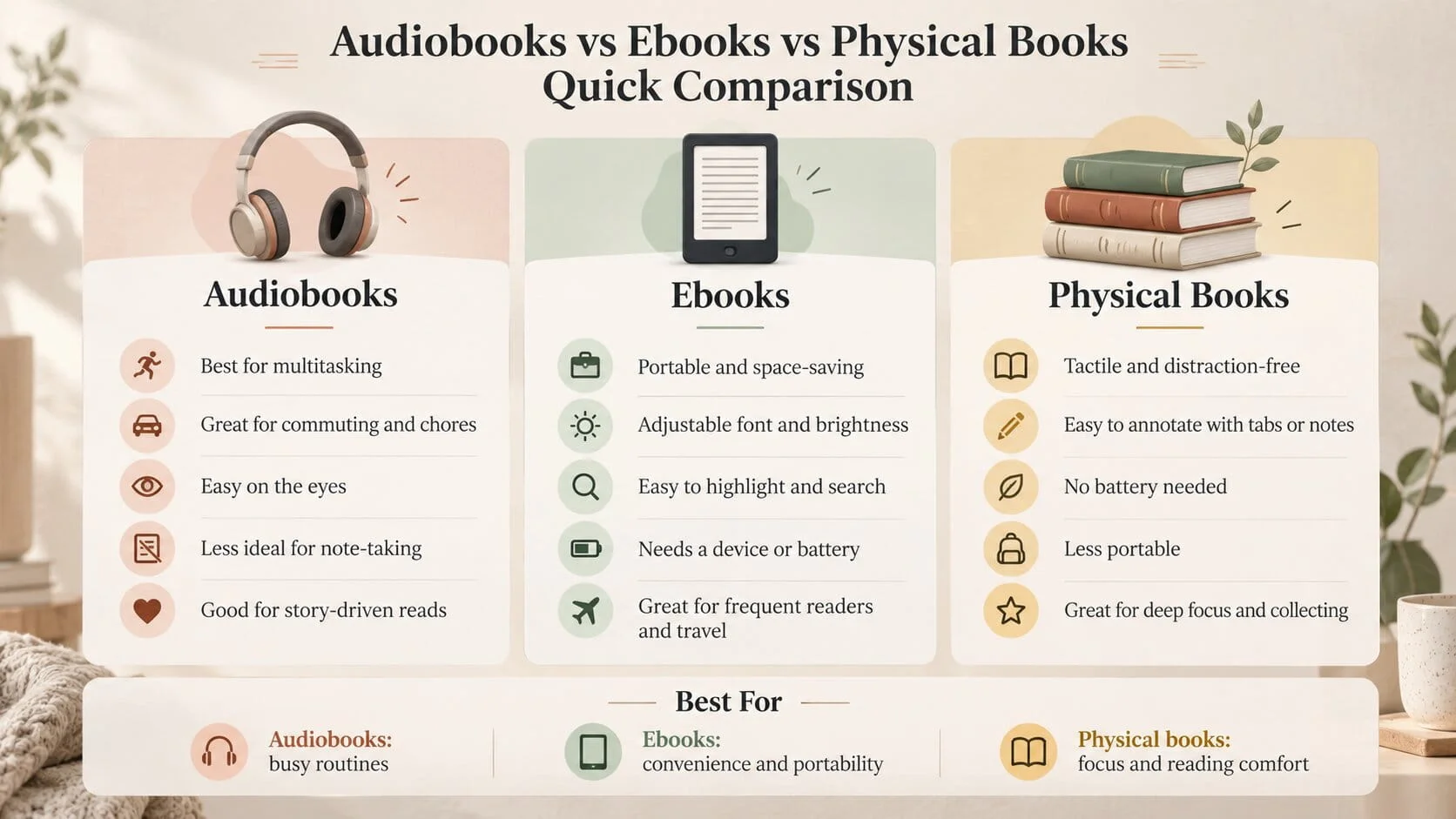
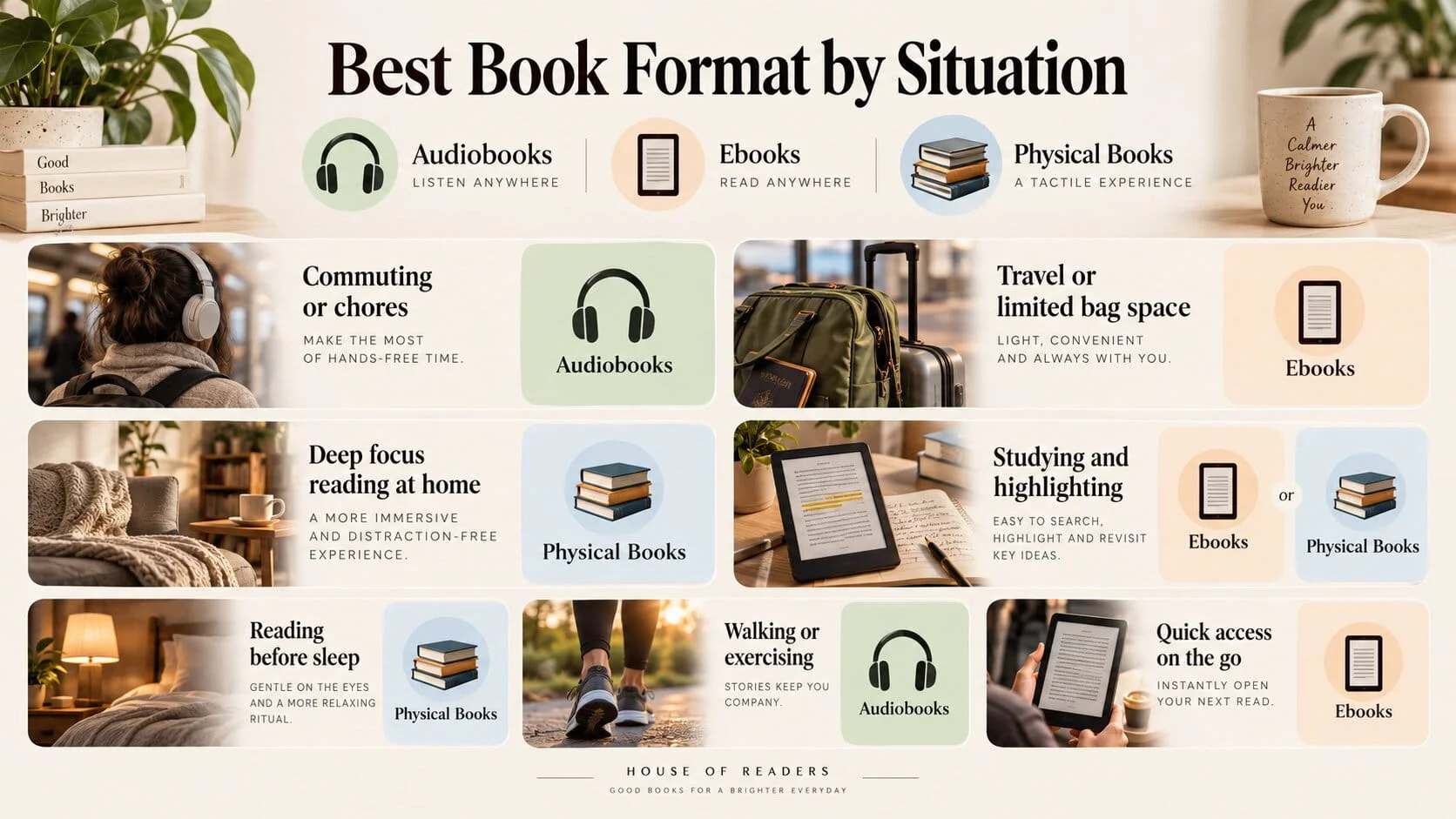
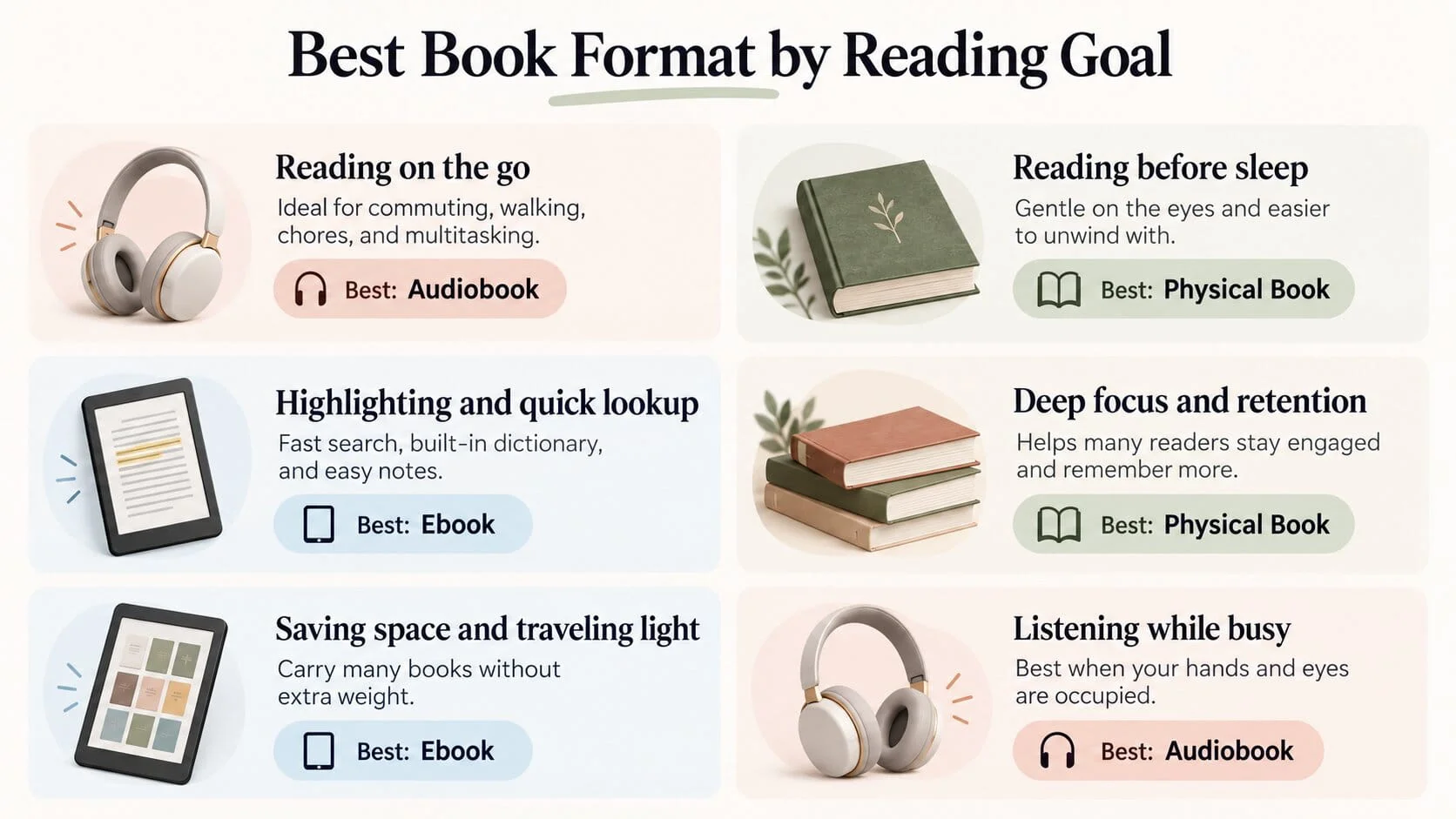
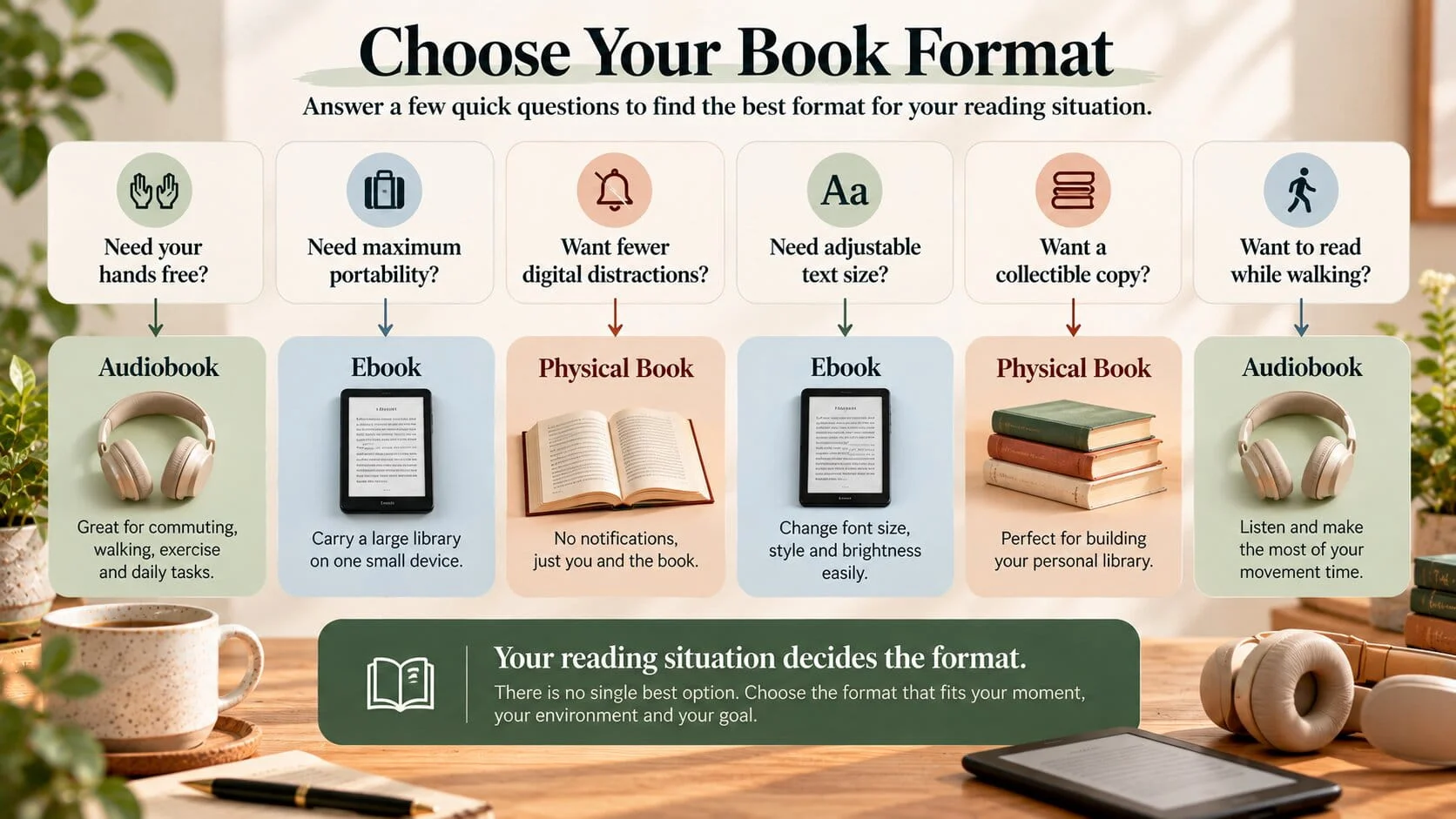
Choose audiobooks if you want to read while commuting, walking, exercising, doing chores, or completing other low-attention tasks.
Choose ebooks if you value portability, instant access, adjustable text, searching, and carrying many books on one device.
Choose physical books if you prefer a tactile experience, fewer digital distractions, easy page flipping, visible progress, collecting books, and owning a copy that is not tied to a device.
For many readers, the best solution is not choosing only one.
It is using different formats for different situations.
Audiobooks vs Ebooks vs Physical Books at a Glance
Here is the simplest comparison.
Audiobooks
Best when your eyes or hands are busy.
They work especially well during:
- commuting
- walking
- cooking
- cleaning
- exercising
- repetitive tasks
The narrator also becomes part of the experience.
A strong performance can make dialogue, humor, emotion, and character voices more memorable.
Ebooks
Best when convenience and portability matter.
One phone, tablet, or ereader can hold many books.
You can often:
- change font size
- search for words
- highlight passages
- add digital notes
- read in low light
- carry several books while traveling
Physical Books
Best when you want a dedicated reading experience.
There are no notifications inside the book.
You can physically see how far you have read.
Flipping backward is easy.
And once you buy the book, the object itself becomes part of your shelf or collection.
Which Format Is Most Convenient?
For pure flexibility, audiobooks and ebooks have an advantage.
Your phone may already be with you throughout the day.
That means your book can be with you too.
Audiobooks are convenient when you cannot look at a page
You can listen while your eyes are needed elsewhere.
That creates reading opportunities that would otherwise not exist.
Ebooks are convenient when you want instant access
There is no physical book to carry.
If you travel frequently, one device can replace a stack of books.
Physical books require more planning
You need to bring the book with you.
A large hardcover takes space.
You cannot instantly switch to another title unless you brought it too.
But physical books have another kind of convenience:
they are extremely simple.
Open the book.
Find your page.
Read.
No charging, app, update, notification, or screen setting is required.
Which Format Is Best for Focus?
This depends heavily on the reader.
Physical books often create the simplest environment for focused reading because the object has one purpose.
There is no social media app one tap away.
No incoming message appears across the page.
No browser tab is waiting beside your book.
But physical books do not automatically create focus.
A distracted reader can still stare at the same paragraph five times.
Ebooks can be focused or distracting
A dedicated ereader can feel very different from reading inside a phone.
If your device is primarily used for books, the experience can stay simple.
If you read on a phone filled with notifications and apps, maintaining attention may be harder.
Audiobooks require a different kind of attention
Listening works beautifully when the second activity is simple.
Walking is one example.
Folding laundry may be another.
But trying to listen while doing mentally demanding work can make it easy to miss entire sections.
The important question is not whether you are technically hearing the audiobook.
It is whether you are actually following it.
Which Format Is Best for Comprehension?
No format guarantees comprehension.
The difficulty of the book, your attention, your familiarity with the subject, and what you need to remember all matter.
For casual fiction, all three formats can work well.
For difficult nonfiction or study material, you may prefer having text in front of you so you can:
- stop
- reread
- highlight
- compare sections
- examine diagrams
- return to earlier pages
Audiobooks can still work for nonfiction, especially when the book is conversational or narrative.
But information-heavy material may require more deliberate listening.
If you want to improve reading efficiency without sacrificing understanding, see our guide on how to read faster without losing comprehension.
Which Format Is Best for Remembering What You Read?
The format matters less than what you do with the information afterward.
If remembering matters, try:
- pausing after important sections
- summarizing the main idea
- highlighting selectively
- making short notes
- discussing the book
- reviewing key sections later
Physical books make margin notes and page flipping easy.
Ebooks make searching and digital highlighting convenient.
Audiobooks usually make immediate visual review less natural, although bookmarks and notes can still help depending on how you listen.
The strongest format is the one that encourages you to interact with the material rather than simply move through it.
Audiobooks: Biggest Advantages
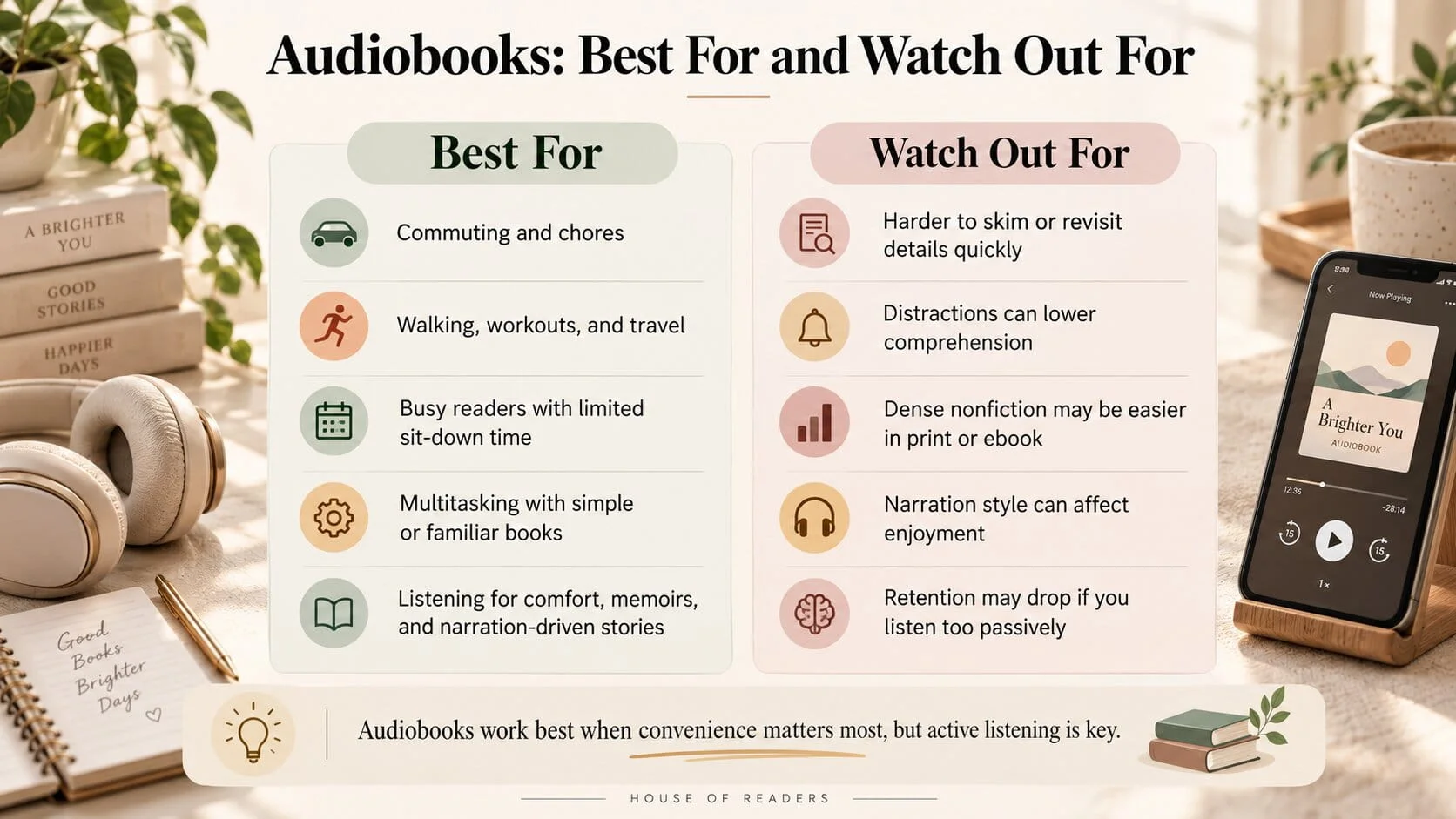
Audiobooks can create reading time where traditional reading is impossible.
You can read while doing other things
This is their biggest advantage.
You can listen while:
- driving
- walking
- exercising
- cooking
- cleaning
- organizing
- traveling
This can dramatically increase how many hours are available for books.
Narration can improve the experience
Some books become more enjoyable when performed.
Different voices can make characters clearer.
Humor can land differently.
Emotion can become stronger.
Memoirs narrated by the author can feel particularly personal.
They can reduce screen time
If most of your day already happens on a computer or phone, listening can give your eyes a break.
Audiobooks: Biggest Disadvantages
It is easy to lose attention
You can continue hearing words long after your mind has stopped following them.
Returning to a precise sentence can be slower
With print, your eyes can jump back instantly.
Audio usually requires scrubbing backward or finding a bookmark.
Not every narrator will suit you
A voice, pace, accent, or performance style can change how much you enjoy the book.
Some books are highly visual
Books containing charts, diagrams, footnotes, tables, maps, or unusual formatting may be easier to understand in text.
Ebooks: Biggest Advantages
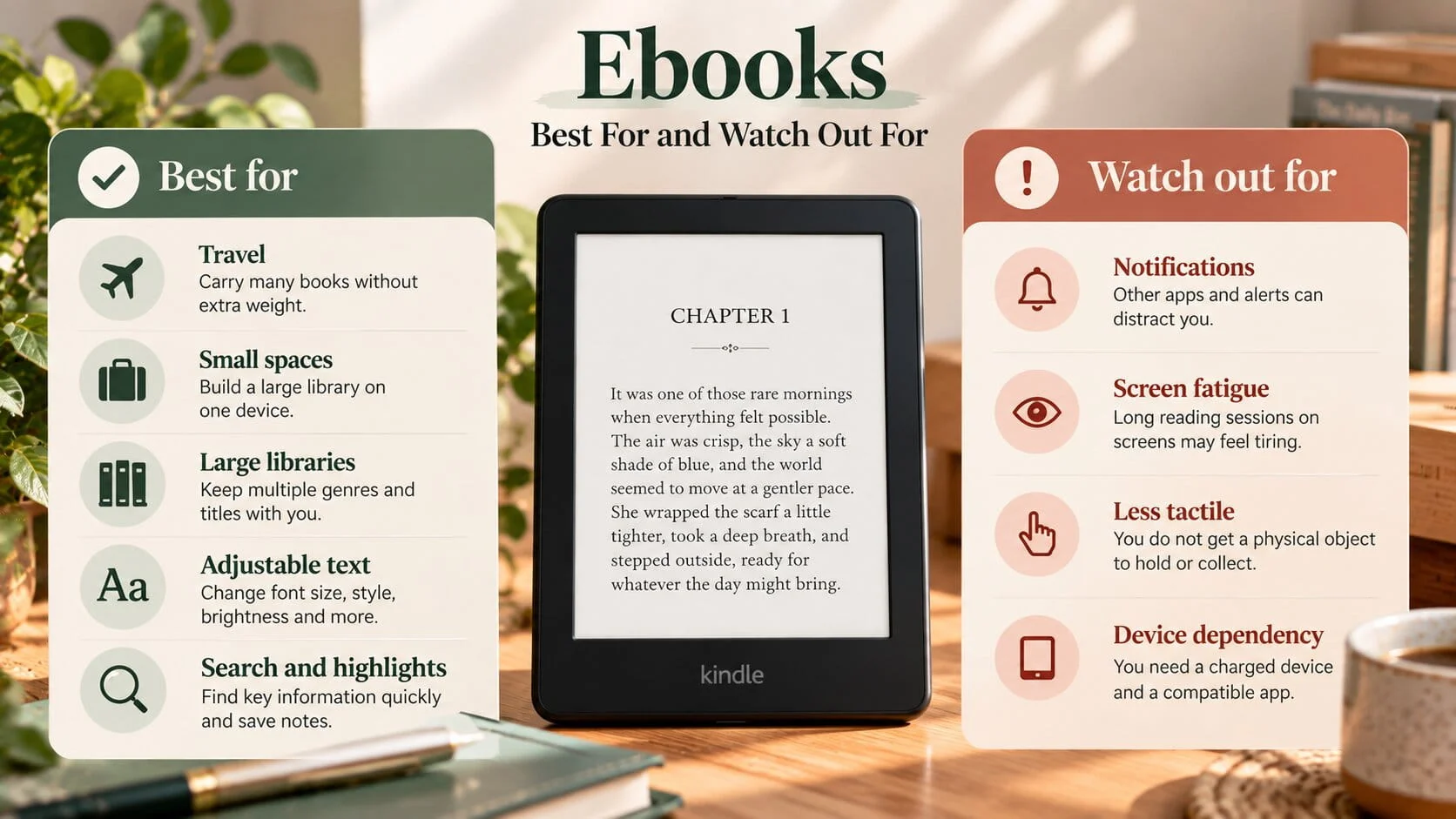
Ebooks are difficult to beat for portability.
Carry many books at once
You can switch between fiction, nonfiction, and reference books without carrying extra weight.
Start reading quickly
Digital books can usually be accessed without waiting for delivery or visiting a store.
Adjust the reading experience
Depending on the device or app, you may be able to change:
- font size
- font style
- spacing
- brightness
- background
- margins
That flexibility can make reading more comfortable.
Search can be extremely useful
Trying to remember where a character appeared?
Looking for a term in a nonfiction book?
Search can save a lot of page flipping.
Ebooks: Biggest Disadvantages
Digital distractions can interfere
This is especially true on phones and tablets.
The sense of location can feel different
With a physical book, you may remember that a passage appeared near the top of a left-hand page around halfway through the book.
Digital pages are less physically fixed.
Ownership can feel less tangible
You do not get a physical object to display, lend in the traditional way, annotate with a pen, or keep on your shelf.
Screens are not everyone’s preference
Some readers simply enjoy paper more.
That preference matters because the format you enjoy is usually the format you are more likely to keep using.
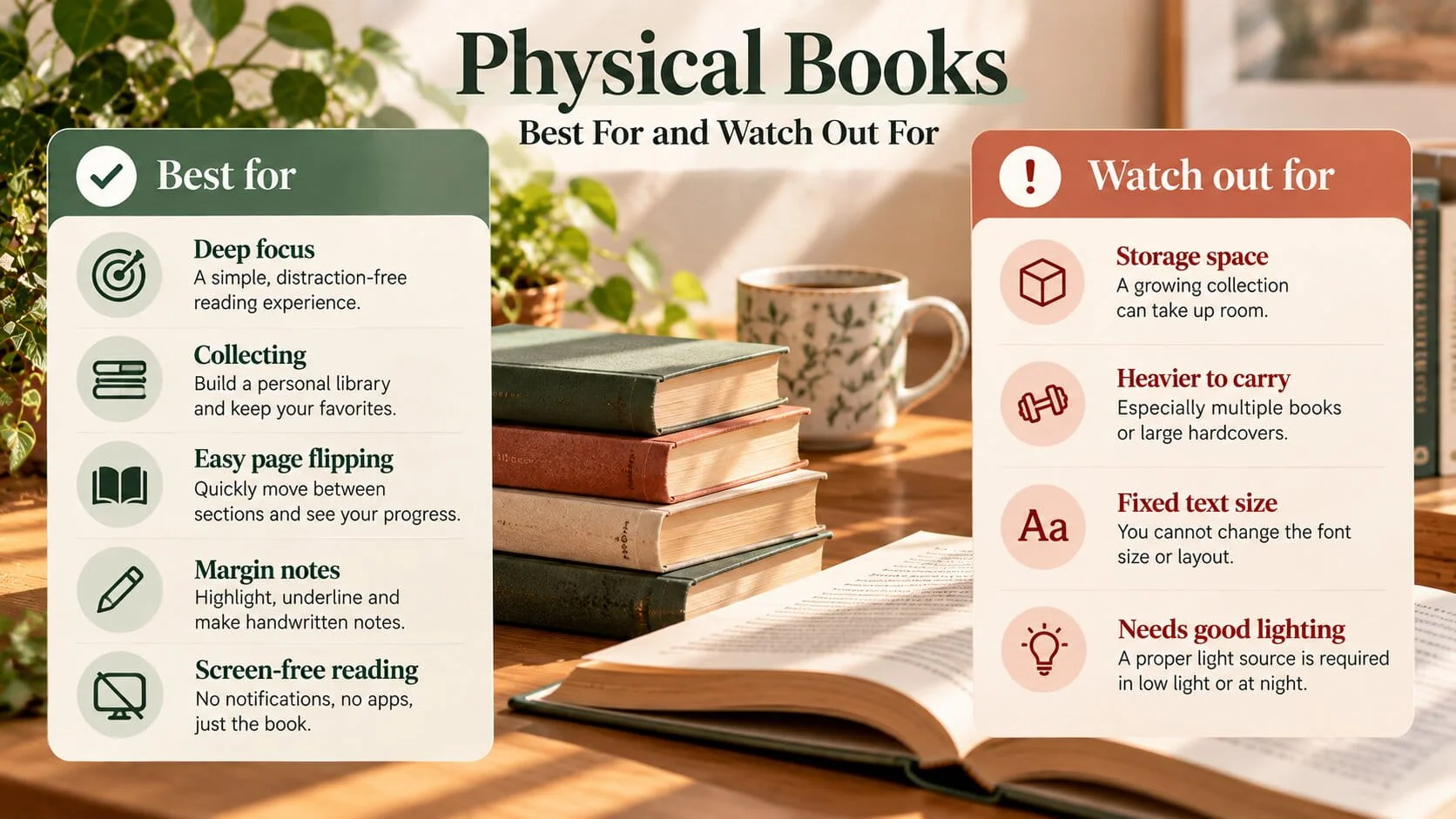
Physical Books: Biggest Advantages
Physical books give reading a clear physical boundary.
When you open the book, you are reading.
That simplicity has real appeal.
No built-in digital distractions
The book cannot send you a notification.
Easy navigation
You can flip backward.
Compare two sections.
Use bookmarks.
Place notes between pages.
Quickly see where one chapter ends and another begins.
Physical progress feels visible
The movement of pages from one side to the other gives you a constant sense of progress.
You truly have an object
It can sit on your shelf.
You can lend it.
Give it away.
Collect a particular edition.
Keep a favorite copy for years.
Physical Books: Biggest Disadvantages
They take space
A serious reading habit can quickly become a storage problem.
They are heavier
One book is manageable.
Several books during travel can become inconvenient.
You cannot instantly change text size
The typography is fixed.
Reading in poor lighting requires a light
Unlike a backlit device, the book does not illuminate itself.
Which Is Best for Travel?
For most trips, ebooks are the easiest option.
One device can carry several books without filling your luggage.
That matters especially when you do not know what you will feel like reading.
Audiobooks are also excellent during travel.
They work during:
- flights
- train journeys
- road trips
- airport waits
- walks
Physical books can still be wonderful on holiday.
You just need to choose what you bring.
If carrying one paperback does not bother you, there is no reason to replace it simply because a digital option exists.
Which Is Best for Commuting?
Audiobooks usually have the strongest advantage when you are driving.
Your eyes remain on the road while you listen.
For public transport, all three can work.
Choose based on the commute:
Crowded train: ebook or audiobook.
Long quiet train journey: physical book or ebook.
Driving: audiobook.
Walking: audiobook.
Which Is Best Before Bed?
Many readers prefer physical books before bed because they create a clear separation from phones and other digital activity.
A dedicated ereader can also work well, particularly when its display and brightness are comfortable for you.
Audiobooks can be relaxing in bed, but there is one practical problem:
you may fall asleep while the story continues.
Using a sleep timer can help.
Which Is Best for Note-Taking?
For handwritten notes, physical books win.
You can:
- underline
- circle
- write in margins
- use sticky notes
- mark pages
Ebooks are excellent for organized highlights.
You can often collect highlights in one place and search them later.
Audiobooks are less convenient when detailed note-taking is the main goal because listening and writing simultaneously can interrupt the flow.
Which Is Best for Studying?
For serious study, text usually gives you more control than audio.
Physical books and ebooks make it easier to:
- reread exact sentences
- compare sections
- highlight definitions
- inspect tables
- study diagrams
- move backward and forward quickly
Audiobooks can still be useful for review.
For example, you could read the text first and later listen to reinforce the material.
The goal should be understanding rather than finishing faster.
Which Is Best for Fiction?
All three can be excellent.
Choose based on the experience you want.
Choose an audiobook when:
- the narrator is excellent
- you want character voices
- you are commuting
- you want to continue the story while walking
Choose an ebook when:
- you travel
- you read in short bursts
- you want immediate access
- you enjoy adjustable text
Choose a physical book when:
- you want to disconnect
- you love the tactile experience
- you collect books
- you enjoy seeing progress physically
Which Is Best for Nonfiction?
It depends on the type.
Narrative nonfiction and memoir can work beautifully as audiobooks.
Dense instructional or reference books may be easier as text.
Ebooks are particularly useful when you expect to search for specific terms later.
Physical books work well when you want heavy annotation or frequent page comparison.
What About Cost?
There is no single cheapest format in every situation.
Prices vary between titles, editions, retailers, subscriptions, libraries, sales, and used-book options.
Instead of assuming one format is always cheaper, consider how you personally buy books.
You may save money through:
- public libraries
- digital library borrowing
- used physical books
- ebook sales
- audiobook subscriptions
- borrowing from friends
- buying only books you know you want to keep
A format that encourages unnecessary purchases is not automatically cheaper simply because individual titles sometimes cost less.
What About Ownership?
This is one of the biggest differences between physical and digital reading.
With a physical book, ownership is straightforward.
The book is on your shelf.
Digital access can work differently depending on the store, platform, account, and licensing terms involved.
That does not automatically make ebooks or audiobooks a bad choice.
It simply means readers who strongly value collecting, lending, keeping editions, or having a permanent physical library may prefer print.
Do Audiobooks Count as Reading?
For everyday conversation, there is no useful reason to turn this into a competition.
If your goal is to experience a story, learn from a book, discover ideas, or enjoy literature, listening can absolutely serve that purpose.
The experience is different.
That does not make it meaningless.
Instead of asking whether audiobooks “count,” ask whether the format helps you engage with books.
If it does, use it.
Can You Combine Formats?
Yes, and this may be the best approach for many readers.
You might:
- listen during your commute
- continue the ebook during lunch
- keep a physical copy at home
Or use different formats for different books.
For example:
Thrillers: audiobook during commuting.
Dense nonfiction: physical book.
Travel reading: ebook.
Favorite novels: physical editions.
There is no rule that says being an ebook reader prevents you from enjoying print.
Format loyalty is unnecessary.
Audiobooks vs Ebooks vs Physical Books: Side-by-Side Comparison
Audiobooks
Strongest for: multitasking and hands-free reading
Portability: excellent
Physical storage: none
Searching: limited compared with text
Visual material: less convenient
Collecting: digital rather than physical
Best situations: commuting, walking, exercise, chores
Ebooks
Strongest for: portability and flexibility
Portability: excellent
Physical storage: none
Searching: excellent
Text customization: excellent
Collecting: digital
Best situations: travel, small spaces, quick access, adjustable reading
Physical Books
Strongest for: tactile and distraction-free reading
Portability: moderate
Physical storage: required
Searching: manual
Text customization: none
Collecting: excellent
Best situations: focused reading, annotation, collecting, screen-free time
Which Format Should You Choose?
Start with your real reading habits.
Choose audiobooks if:
- you spend a lot of time driving
- you walk frequently
- chores consume potential reading time
- you enjoy narration
- you want less screen time
Choose ebooks if:
- you travel frequently
- storage space is limited
- you want adjustable text
- you switch between several books
- search and digital highlights matter
Choose physical books if:
- you want fewer digital distractions
- you love collecting books
- you annotate by hand
- you prefer paper
- you enjoy a dedicated reading ritual
If you are struggling to read consistently at all, the format may be less important than rebuilding the habit. Our guide on how to get out of a reading slump can help with that.
Final Verdict
There is no universal winner in the audiobooks vs ebooks vs physical books debate.
Audiobooks are excellent for turning otherwise unavailable time into reading time.
Ebooks offer unmatched portability and flexibility.
Physical books offer a simple, tactile, screen-free experience that many readers still prefer.
The most practical answer is to stop treating the formats as competitors.
Use an audiobook when your hands are busy.
Use an ebook when you need portability.
Use a physical book when you want to sit down and disconnect.
The best format is the one that makes it easier for you to read consistently, understand what you are reading, and enjoy the experience.